A practical, vendor-neutral guide for CIOs, IT directors, and digital workplace leaders evaluating SharePoint consulting partners in Australia — including a comparison...
TL; DR • The AI model isn’t the weak link. Copilot’s answers are only as good as your SharePoint content, metadata, and permissions. • An AI Readiness Assessment is not a migration health check or governance audit. It’s a narrower focus, and specifically what feeds Copilot. • It looks at five things: governance, information architecture, content quality, security and permissions, and search. • By far the biggest risk is permission. Copilot will display a file if someone has access to it, sensitive or not. • The practical path is to assess and audit content, fix metadata, tighten governance, review security, pilot, and then roll out in phases. • Copilot pilots don’t fail because of the technology, so don’t do the readiness work. They fail because people stop believing the answers. • Not all departments are starting at the same point. HR and legal are riskier. IT and Operations are likely to see wins sooner. • And readiness isn’t a one-and-done check, it erodes as content builds, so it requires a revisit here and there.
Enterprise IT budgets have been moving strongly toward AI for the past two years, with Microsoft Copilot at the center of that movement for most Microsoft 365 customers. The management teams looked at the demos, signed off on the licenses and wanted results yesterday. Then the rollout starts and the results are mixed, correct in some departments, confusing or plain wrong in others.
A SharePoint AI Readiness Assessment helps companies identify those problems before employees do. It’s a framework for assessing governance, info architecture, content quality, security, and search configuration, the five conditions that determine whether Copilot performs well or performs badly in each tenant. This guide will take you through what the assessment covers, how to run one, what a realistic improvement roadmap looks like, and how to judge whether a consulting partner really understands the difference between a SharePoint migration and an AI readiness engagement.
Quick Answer Box
What it is: A structured evaluation of SharePoint governance, metadata, permissions, and content quality to determine whether an environment is prepared for Microsoft Copilot and AI-powered search.
Who needs one: Any organization licensing or piloting Microsoft 365 Copilot, especially those with SharePoint environments older than three years, multiple legacy migrations, or no formal governance program.
Primary business outcomes: Fewer inaccurate Copilot answers, reduced risk of oversharing sensitive content through AI, faster knowledge discovery, and a defensible rollout plan for IT leadership.
Typical timeline: 2 to 6 weeks for the assessment itself, depending on tenant size and the number of site collections in scope.
Why AI Readiness Matters
The traditional SharePoint search looks for keywords in indexed terms. Predictable, if sometimes frustrating, a user knows the wrong file didn’t show up because the words didn’t match up. AI-powered search works differently. Microsoft Copilot and Microsoft Graph use the semantic index in Microsoft Search to understand intent and context and provide an answer rather than a list of links. A synthesized wrong answer sounds just as confident as the best one. This is much more helpful if the underlying content is trustworthy and much more dangerous if it is not.
In our own engagements, this is the hardest thing to explain to a CIO who has already signed the Copilot purchase order: the AI is rarely the variable that determines success. The tenant is. We have walked into environments with strong governance where Copilot performed well from week one of a pilot, and environments with the identical license and identical model where it took three months of remediation before employees trusted it. The difference was never the model.
This is a governance problem before it’s a technology problem. Microsoft Graph builds relevance around what a user is permitted to see, how recently content was touched, and how it’s tagged. Weak permission structures, abandoned sites, and undocumented metadata all feed directly into what Copilot decides is authoritative. Employees don’t see the plumbing; they see an answer, and they either trust it or they stop using the tool.
The stakes go beyond convenience. Enterprise investment in generative AI has moved past the pilot stage industry-wide: McKinsey’s 2025 State of AI survey found that 88% of organizations now use AI in at least one business function, up from 78% a year earlier. Spending is following adoption. Gartner forecasts worldwide AI spending will reach $2.52 trillion in 2026, a 44% increase year over year. At the same time, Deloitte’s State of AI in the Enterprise survey found that 94% of global business leaders consider AI critical to their organization’s success over the next five years.
Inside Microsoft’s own ecosystem, usage patterns are shifting from novelty to genuine dependence. Microsoft’s 2026 Work Trend Index found that in telemetry drawn from actual Copilot conversations, 49% were classified as cognitive work such as analysis and problem-solving, and 58% of surveyed users said they were producing work they could not have produced a year earlier. That’s a meaningful shift in how much organizations are relying on AI output, which raises the cost of that output being wrong.
Expert Insight
“AI amplifies both good and bad content. Organizations with weak governance often receive less accurate AI responses, making users lose confidence in AI much faster than
What Is a SharePoint AI Readiness Assessment?
A SharePoint AI Readiness Assessment is a formal assessment of a Microsoft 365 tenant to see if the content, permissions, and architecture will enable accurate, secure Copilot responses. It’s more focused than a general governance audit, and different to the purpose of a migration assessment, albeit that there’s overlap between all three
Purpose: To identify some pre-copilot switch conditions, oversharing, duplicate content, missing metadata, orphaned sites, and inconsistent taxonomy degrading AI output for a large user base.
Who needs one: organizations that have purchased or are piloting Microsoft 365 Copilot licenses, especially tenants with more than three to five years of accumulated SharePoint content, multiple past migrations, decentralized site creation, or no active governance program.
When to conduct it: before a Copilot pilot expands past a small, controlled group, and again periodically as content volume grows or after major reorganizations, mergers, or migrations.
Business outcomes: a scored view of current readiness, a prioritized remediation list, and a realistic timeline for safe, broad deployment.
Assessment Type Comparison on SharePoint AI Readiness
Assessment Type
Purpose
When to Use
Business Value
Migration Assessment
Evaluates content and system readiness for moving to a new platform or tenant
Before a SharePoint or Microsoft 365 migration project
Reviews policies, roles, and lifecycle management practices
Periodically, or when governance issues (sprawl, ownership gaps) appear
Establishes accountability and long-term maintainability
AI Readiness Assessment
Evaluates whether content, metadata, permissions, and architecture can support accurate AI search and Copilot
Before and periodically after enabling Copilot or AI search
Improves AI accuracy, reduces risk exposure, protects employee trust in AI
If your organization has not gone through a SharePoint governance review recently, that’s often the right starting point before an AI-specific assessment, since many readiness issues are governance issues wearing an AI label.
The Five Pillars of AI Readiness
Pillar 1: Governance
Governance is the key to which all else lies. If there’s no consistent way for an organization to know what’s current, who’s responsible for it, or when it should be retired, there’s no consistent way to know the same.
Evaluation:
Content ownership assigned at the site and library level
Lifecycle management and retention schedules
Version control practices
Approval workflows for publishing
Policy documentation that’s enforced, not just written
The most common governance issue in a consulting engagement isn’t the lack of a governance policy document; most enterprises have one. It’s because the policy was created to fit a SharePoint environment from 2018 and wasn’t updated for hub sites, Teams-connected sites or for external scenarios that didn’t exist at the time the policy was drafted.
Real-world scenario: A medium-sized professional services company requests Copilot to provide an overview of “our current expense policy.” Copilot is returning a version that was never officially retired, due to no one being responsible for retiring it after a 2022 update to the finance site. The answer is fluent, well-formatted and incorrect.
Pillar 2: Information Architecture
Information architecture determines whether content is findable in a structural sense, independent of search quality. A well-organized site hierarchy with consistent taxonomy gives Microsoft Graph clean signals to work with; a flat, ad hoc structure gives it noise.
Assess:
Site hierarchy and hub site structure
Taxonomy consistency across departments
Metadata standards and adherence
Navigation logic
How search is scoped across the tenant
A recurring pattern: organizations that grew through acquisition or rapid headcount growth often have three or four competing taxonomies in different business units, none of which talk to each other. Copilot has no way to reconcile that on its own.
Real-world scenario: After two acquisitions, a manufacturing group ends up with three separate site structures, each using a different naming convention for “quality assurance” documentation. An employee in a newly acquired plant asks Copilot for the current QA checklist and receives a blended answer pulling from two of the three structures, neither of which is the plant’s actual current procedure. Beyond Intranet’s SharePoint intranet development work, in these situations, it typically starts with a single, hub-site-anchored taxonomy before any AI conversation happens.
Pillar 3: Content Quality
This is where most of the manual audit work happens. Poor content quality is the most direct cause of poor AI answers, because Copilot cannot distinguish an outdated file from a current one unless the metadata or governance signals tell it to.
Evaluate:
Duplicate documents across sites and libraries
ROT content, Redundant, Obsolete, Trivial material that should be archived or deleted
File and folder naming consistency
Version history hygiene
Gaps where institutional knowledge was never documented at all
A common enterprise pattern: a benefits policy exists in five versions across four sites, two of which are three years out of date. Copilot has no inherent way to know which is authoritative, it will surface whichever ranks highest by its relevance signals, which may not be the current one.
Real-world scenario: In a healthcare document management engagement, Beyond Intranet found that a single infection-control procedure existed in four locations across departmental sites, with the most recently modified copy actually being the oldest in substance, a staff member had “updated” formatting without updating content. A content audit like the one described in our document management case study is what catches this before an AI search surfaces the wrong version to clinical staff.
Pillar 4: Security & Permissions
This pillar carries the highest risk. Copilot respects existing permissions, which sounds reassuring until you consider that most tenants have permission structures accumulated haphazardly over a decade. Broken inheritance, over-permissioned groups, and forgotten external shares don’t cause problems in traditional search, where a user has to know a document exists to search for it. With AI, a user can ask a broad question and Copilot will surface anything they technically have access to, including content nobody intended them to see.
Sensitivity label deployment and enforcement through Microsoft Purview
Data Loss Prevention (DLP) policy coverage
Compliance alignment with industry regulations
Real-world scenario: A finance team stores a compensation-planning spreadsheet on a site originally provisioned for a cross-department project, then forgets to remove broad access once the project ended. Under traditional search, this sits quietly, and an employee already know it exists. Under Copilot, an employee in an unrelated department can ask “what’s the average salary band for senior engineers” and receive an answer synthesized directly from that file. Beyond Intranet’s work supporting an ISO 27001–aligned information security management solution for a compliance-driven client follows this same principle: permission review has to happen before AI access, not after.
Pillar 5: Search & AI Experience
The final pillar evaluates the search layer itself, the components Copilot actually queries against.
Evaluate:
Search relevance and result tuning
Metadata completeness and consistency
Synonym and acronym mapping
Bookmarks and curated results for common queries
How Microsoft Graph is signaling relevance
Whether the semantic index has adequate, clean content to draw from
Search analytics and query log review
AI Readiness Checklist
Use this checklist as a starting scorecard. Score each item as Yes, No, or Needs Improvement, then tally by section.
Assessment Area
Yes
No
Needs Improvement
Every site collection has a named, active owner
Site ownership is reviewed on a regular schedule
A documented content governance policy exists
Approval workflows exist for published content
Retention and disposition policies are configured in Microsoft Purview
Version history is enabled and consistently used
Obsolete content is regularly archived or removed
A defined site hierarchy exists (vs. ad hoc site sprawl)
Metadata fields are consistently applied to key document types
A basic taxonomy or term store is in place
Hub sites are used to connect related content areas
Navigation allows new employees to find key content without help
Duplicate documents have been identified and addressed
ROT (Redundant, Obsolete, Trivial) content has been assessed
Naming conventions are documented and followed
Authoritative versions of key policies are clearly marked
Known knowledge gaps have been identified
Entra ID groups are structured around job function, not ad hoc requests
External sharing settings align with a documented policy
Permission inheritance has been reviewed for drift
Sensitivity labels are applied to sensitive content
DLP policies are configured and active
A recent permissions audit has been completed
Sites with “everyone” or overly broad access have been identified
Compliance requirements specific to your industry are documented and met
Search analytics are actively reviewed
Common failed searches have been investigated and addressed
Synonyms and acronyms are mapped in search configuration
Managed properties and refiners are configured
Microsoft Graph connectivity spans SharePoint, Teams, and OneDrive
Microsoft’s Copilot readiness guidance has been reviewed
A pilot group has tested Copilot against real content and use cases
Employees have a channel to report inaccurate or outdated AI answers
Leadership has aligned on what “AI ready” means for the organization
For HR, Legal and Finance content, expand this list to 30-40 questions by including department specific questions for which sensitivity and accuracy matters the most.
AI Readiness Score
Score Range
Maturity Level
What It Means
0–20%
Beginner
Significant governance and content gaps; not ready for broad Copilot rollout
21–40%
Developing
Foundational governance exists but content quality and permissions need work
41–60%
Mature
Ready for a controlled pilot with monitoring
61–80%
Advanced
Ready for phased rollout across most departments
81–100%
Optimized
Ready for enterprise-wide deployment with ongoing governance
Expert Tip
Score departments separately, not just the tenant as a whole. A finance team with strict document control can score “Advanced” while a marketing team with years of unmanaged file shares scores “Beginner” in the same tenant. Rolling those into one number hides the departments that need attention first.
Common AI Readiness Challenges
Challenge
Business Impact
Recommended Solution
Poor or missing metadata
Copilot cannot distinguish relevant from irrelevant content
Establish and enforce a metadata taxonomy
Duplicate documents
Conflicting answers pulled from outdated copies
Run a deduplication audit before rollout
Permission chaos
Sensitive content surfaced to the wrong users
Audit Entra ID groups and inheritance
Content sprawl
Search relevance degrades as noise increases
Consolidate sites under governed hub structures
Shadow IT
Content exists outside governed systems entirely
Bring shadow repositories into governed SharePoint
Outdated content
AI presents stale information as current
Implement retention and review schedules
Missing ownership
No one is accountable for content accuracy
Assign and enforce site and library ownership
Low search relevance
Users lose trust in both search and Copilot
Tune search configuration and metadata together
Weak governance overall
Every other issue compounds without correction
Establish a governance framework before scaling AI
Common Mistake
Integrating Copilot from the start enhances performance. However, many organizations will activate Microsoft Copilot first, and only begin improving content quality in SharePoint later in the readiness journey.
Real world example: In a distribution company, an operations team is able to implement Copilot enterprise-wide without conducting any content audit in the same week licenses are activated. In two weeks, employees are receiving answers from a 2019 shipping policy merged with an update from 2024, and neither of those documents was saved nor was it cleaned up using the SharePoint migration style, because nobody did that. Content audit has been done after the fact, when it is needed, when trust is already out of the window, and just when a readiness assessment is supposed to be preventing it.
How to Improve AI Readiness
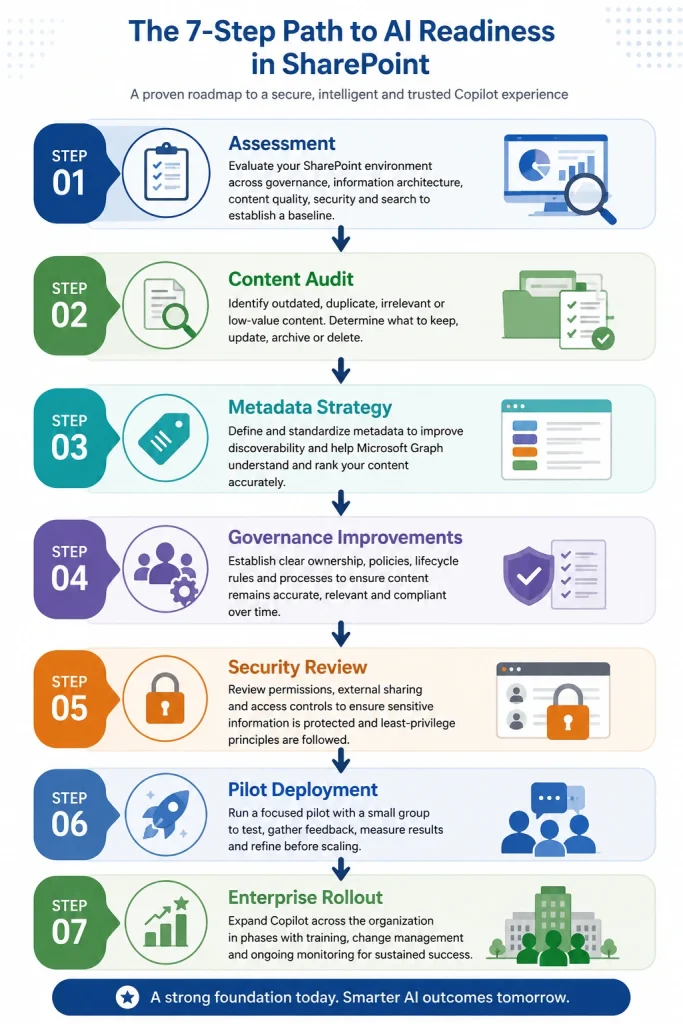
A practical roadmap moves through seven stages. Timelines vary by tenant size, but this sequence holds across most enterprise engagements.
Step 1: Assessment. Objective: establish a baseline score across the five pillars. Deliverable: a scored readiness report with prioritized findings.
Step 2: Content Audit. Objective: identify duplicate, obsolete, and trivial content across in-scope sites. Deliverable: a remediation list by site and library.
Step 3: Metadata Strategy. Objective: define a consistent taxonomy and apply it to priority content sets. Deliverable: a metadata schema and tagging plan.
Step 4: Governance Improvements. Objective: assign ownership, formalize lifecycle policies, and close policy gaps identified in the assessment. Deliverable: an updated governance framework.
Step 5: Security Review. Objective: correct permission inheritance issues, configure sensitivity labels through Microsoft Purview, and tighten external sharing. Deliverable: a permissions remediation report.
Step 6: Pilot Deployment. Objective: enable Copilot for a defined group with monitoring in place. Deliverable: pilot metrics on answer accuracy and user trust.
Step 7: Enterprise Rollout. Objective: expand access in phases by department, prioritizing the departments that scored highest in the readiness checklist. Deliverable: a phased rollout plan with ongoing governance checkpoints.
How Microsoft Copilot Uses SharePoint
Copilot doesn’t search SharePoint directly in the way a user typing into the search bar does. It queries Microsoft Graph, which combines the semantic index, permission data, and relationship signals, to decide what’s relevant to a given prompt. It then grounds its natural-language response in that retrieved content using a retrieval pattern documented in Microsoft’s Copilot architecture overview, rather than generating an answer purely from its own training.
Component Table
Component
Purpose
Business Value
Microsoft Graph
Connects signals across SharePoint, Teams, OneDrive, Outlook
Provides context for relevant, permission-aware answers
Semantic Index
Understands meaning and intent, not just keywords
Improves natural-language search accuracy
Permissions layer
Enforces who can see what at query time
Prevents unauthorized content exposure
Metadata
Tags content with structured attributes
Improves relevance ranking and filtering
First, permissions are not checked at retrieval time, making it not only a security issue, but a search quality issue too. Second, the semantic index must have sufficient well-tags and well-structured content to be able to operate on, poorly organized libraries will provide a smaller amount of information to support Copilot’s answers leading to it providing a more generic response or simply making up information.
Turn SharePoint Into an AI-Powered Workplace
Connect Copilot with your Microsoft 365 environment and unlock secure, intelligent access to business knowledge. Explore Copilot Integration
Benefits of Becoming AI Ready
Before AI Readiness
After AI Readiness
Employees can’t tell which version of a policy is current
AI surfaces the single, correctly labeled authoritative version
Search returns dozens of loosely related results
Search and Copilot return precise, contextually relevant answers
Sensitive content is exposed through permission drift
Access aligns with actual role-based need
Knowledge lives in individual employees’ heads
Knowledge is discoverable and reusable across teams
Onboarding relies heavily on asking colleagues
New employees can self-serve accurate answers faster
IT fields repetitive basic questions
Copilot resolves routine queries, freeing IT for higher-value work
Duplicate work happens because past efforts aren’t findable.
Prior work is surfaced and reused instead of recreated
Leadership has limited visibility into content risk
Governance and security posture are documented and auditable.
With the same amount of AI investment, organizations with a mature readiness score often experience gains across three dimensions, including fewer repetitive tasks, faster internal knowledge discovery, and fewer help desk tickets associated with “where” queries, as they get addressed directly by Copilot rather than by a human.
AI Readiness Across Departments
Readiness work rarely lands the same way twice across departments, which is why Beyond Intranet’s SharePoint knowledge management engagements typically score departments individually before recommending a rollout order, rather than treating the tenant as a single unit.
Department
Current Challenge
AI Opportunity
Business Outcome
HR
Policy documents scattered across sites, some outdated
Natural-language answers to benefits and policy questions
Fewer HR help desk tickets
Finance
Reports and models spread across shared drives and SharePoint
Faster access to historical financial documentation
Reduced time spent locating records
Sales
Proposal templates and case studies duplicated across teams
Quick retrieval of the latest approved materials
Faster proposal turnaround
Marketing
Brand assets and campaign history poorly tagged
AI-assisted content discovery and reuse
Reduced duplicate creative work
IT
Documentation for systems and processes incomplete
Faster internal troubleshooting via Copilot
Reduced ticket volume
Operations
Process documentation inconsistent across sites
Standardized, searchable operating procedures
Fewer process errors
Legal
High sensitivity, strict access requirements
Faster contract and policy lookup with tight permission control
Reduced legal research time
Executive Leadership
Reporting scattered across dashboards and documents
The pattern below holds across sectors: organizations that had already invested in clean SharePoint foundations for reasons unrelated to AI, compliance, onboarding speed, or document control were the ones best positioned when Copilot readiness became a priority. The examples below are drawn from Beyond Intranet’s own documented client work, referenced here at a summary level; full details are available in the linked case studies.
Healthcare Challenge: Clinical and administrative policy documents scattered across departmental sites, with strict compliance requirements around access. AI Solution: A readiness effort focused heavily on the Security & Permissions pillar, combined with sensitivity labeling for patient-related and compliance-sensitive content.
Business Outcome: Staff can locate current policy and procedure documents faster, while access to sensitive material remains tightly controlled.
Manufacturing Challenge: Technical documentation and safety procedures duplicated across plant-specific sites, with inconsistent version control. AI Solution: Consolidation of duplicate documentation, paired with metadata identifying plant, equipment type, and revision status.
Business Outcome: Frontline staff and engineers get consistent, current safety and procedural guidance regardless of which site they search.
Construction Challenge: Project documentation siloed by job site, making cross-project knowledge reuse difficult. AI Solution: Hub site structure connecting project sites, with standardized metadata for project phase and document type.
Business Outcome: Project teams can reference prior project documentation and lessons learned more easily.
Professional Services Challenge: Client deliverables and internal templates scattered across individual consultants’ working folders. AI Solution: Governance policies requiring deliverables to be stored in structured, permissioned client sites with consistent metadata.
Business Outcome: Faster proposal development through reuse of prior, approved work product.
Nonprofit Challenge: Limited IT resources to maintain governance, resulting in significant content sprawl over time. AI Solution: A lightweight, prioritized readiness effort focused on the highest-traffic content areas rather than a full-environment overhaul.
Business Outcome: Meaningful improvement in search and Copilot accuracy achieved without a large governance program.
Government Challenge: Strict compliance and records retention requirements combined with legacy content accumulated over many years. AI Solution: Readiness work anchored heavily in retention policy alignment and permissions auditing before any AI rollout.
Business Outcome: AI search deployed within a compliant framework, with clear audit trails for content access.
Organizations in regulated industries should treat the security and permissions pillar as a prerequisite gate, not a parallel workstream; misconfigured access in these sectors carries compliance consequences that go well beyond a bad search result. Notably, none of the case studies above were originally built as “AI readiness” projects. They were governance, migration, and knowledge management engagements, which is precisely why the organizations behind them were in a stronger position when Copilot conversations started.
AI Governance Best Practices
Responsible AI governance for SharePoint and Copilot extends existing information governance practices rather than replacing them. The organizations that get this right build on tools they may already have, particularly Microsoft Purview for classification, retention, and auditing, alongside Microsoft’s data security posture management guidance for AI for Copilot specifically.
Governance Checklist
Sensitivity labels are applied consistently across document libraries
Retention and disposition schedules are enforced, not just documented
Microsoft Purview auditing is enabled for content accessed through Copilot
External sharing policies are reviewed on a defined cadence
A responsible AI usage policy exists and is communicated to employees
Security reviews are scheduled before each phase of rollout expansion
A process exists for employees to flag inaccurate AI answers back to IT
Consultant Recommendations
Treat AI governance as an extension of your existing information governance program, not a separate initiative running in parallel. Duplicate governance structures create confusion about which policy takes precedence, and that confusion tends to surface at the worst possible time, during an audit or a security incident.
How to Choose an AI Readiness Consulting Partner
Decision Matrix
Evaluation Criteria
Why It Matters
Microsoft ecosystem expertise
AI readiness spans SharePoint, Graph, Entra ID, and Purview — narrow expertise misses cross-system issues
SharePoint governance experience
Readiness work is largely governance work applied to an AI use case
Microsoft Graph knowledge
Understanding how Graph signals relevance is essential to diagnosing AI answer quality
Copilot deployment experience
Theoretical knowledge differs from having managed real pilot-to-rollout transitions
Information architecture capability
Taxonomy and metadata design require dedicated expertise, not just technical configuration
Security and compliance knowledge
Permission and DLP review requires depth beyond basic SharePoint administration
Enterprise implementation track record
Multi-department rollouts surface different challenges than single-site projects
Ongoing support model
Readiness is a maintained state, not a one-time project
Vendor Evaluation Checklist
Does the partner separate AI readiness from generic SharePoint consulting in their methodology?
Can they show a structured assessment framework rather than an informal review?
Do they have experience with Microsoft Purview and sensitivity label deployment specifically?
Do they offer a phased rollout plan, or only a one-time cleanup engagement?
Is post-assessment support available for the governance and remediation phases?
Why Choose Beyond Intranet
Beyond Intranet approaches AI readiness as an extension of its long-standing SharePoint consulting and SharePoint governance practice, rather than as a standalone AI add-on. That matters because most of the work involved in AI readiness, metadata strategy, permission review, content lifecycle management, is the same discipline that has shaped enterprise SharePoint environments for over a decade, applied with an AI-specific lens.
The methodology is governance-first: assess before recommending, score before remediating, and pilot before scaling. That sequencing is less exciting than a fast Copilot activation, but it’s the sequencing that avoids the trust-damaging early failures that stall so many enterprise AI programs.
When Organizations Are NOT Ready for AI
Some organizations should slow down before starting an AI readiness assessment at all, because the underlying SharePoint foundation isn’t stable enough yet:
SharePoint adoption is low, with most content still living in file shares or personal drives
Content is largely unstructured, with no consistent taxonomy across the organization
Governance is effectively nonexistent, no assigned site owners and no lifecycle policies
The Microsoft 365 deployment itself is incomplete or fragmented
There’s no executive sponsorship for the AI initiative, meaning remediation work will stall without authority behind it
Metadata is largely absent across document libraries
Large volumes of ROT content dominate the environment
In these situations, the right sequence is to strengthen the SharePoint foundation first, migration cleanup, governance framework, and basic taxonomy, before layering an AI readiness assessment on top. Running an AI assessment on an unstable foundation just produces a long list of findings without a realistic path to remediation.
Future Trends (2026–2028)
Evolution of semantic index: Microsoft is still working on the semantic index’s relationship signals weighting, which will give more weight to the content freshness and ownership metadata over time.
AI Agents: AI agents that are purpose-built in Copilot Studio are transitioning from experimental to production status for specific workflows, leading to the need to access a scoped and well-governed set of data per agent.
Enterprise knowledge graphs: Organizations are defining relationships between people, projects and content that go beyond the capabilities of SharePoint metadata.
Retrieval-Augmented Generation (RAG): More custom enterprise AI tools are being built on RAG architectures that pull directly from SharePoint and Graph, extending the same readiness requirements beyond Copilot itself.
Microsoft Graph intelligence: More rich contextual signals beyond content metadata.
SharePoint Premium: Advanced content management and AI-assisted metadata tagging features are lowering the manual burden of some readiness work.
Intelligent document processing: Microsoft Syntex and like tools are taking over the automation of metadata extraction on a large scale, moving readiness from manual tagging to configuration and monitoring.
The rise of responsible AI governance: Regulators will pay greater attention to the way enterprises manage the access to internal data by AI, especially in regulated industries.
Myths vs Facts On SharePoint AI Readiness
Myth
Fact
Enabling Copilot automatically improves search
Copilot depends on existing content quality, metadata, and permissions to produce accurate results
Permissions don’t matter if content isn’t sensitive
Copilot surfaces content based on technical access, not intended sensitivity, making permission hygiene essential everywhere
Microsoft Graph replaces the need for good metadata
Graph uses metadata and content signals together; poor metadata still degrades relevance
AI readiness is purely an IT project
Readiness requires governance, business unit, and compliance involvement, not just IT configuration
Security review can happen after rollout
Permission issues surfaced through AI are harder to contain after broad exposure than before it
Enterprise AI adoption is still mostly experimental
Adoption has moved past the pilot stage industry-wide, with most organizations already using AI in at least one business function
It's a structured evaluation of governance, metadata, permissions, and content quality within a SharePoint environment, designed to determine whether the tenant will support accurate, secure Microsoft Copilot responses before broad rollout.
Governance determines who owns content, how long it's retained, and how consistently it's structured. Without it, Copilot has no reliable way to distinguish current, authoritative content from outdated or duplicate material.
No. Copilot depends entirely on the content, metadata, and permissions already present in the tenant. A poorly governed environment will produce inconsistent or inaccurate AI answers regardless of the model's c
Microsoft Graph connects signals across SharePoint, Teams, OneDrive, and Outlook, combining permission data and relationship context to determine what content is relevant to a given query, then Copilot grounds its response in that retrieved content.
Directly. Copilot enforces existing permissions at the moment of retrieval, meaning any user can be surfaced content they technically have access to, whether or not that access was intentional.
Yes, once the underlying content is well-governed. AI search can significantly reduce time spent locating information, but only after the readiness work is done.
Start with an assessment across the five readiness pillars, remediate the highest-risk findings, usually permissions and content quality, then pilot with a small group before expanding.
Metadata gives Microsoft Graph structured signals to rank and filter content by relevance, department, and currency. Missing or inconsistent metadata directly degrades AI search accuracy.
No. SharePoint Premium adds advanced content management and AI-assisted tagging capabilities, but a tenant can be AI-ready on standard licensing if governance and metadata are handled well manually.
Measurable outcomes typically include reduced time spent searching for information, fewer help desk tickets related to finding documents, and reduced risk exposure from oversharing, though exact ROI varies by organization size and starting maturity.
Begin with a scored baseline assessment across governance, information architecture, content quality, security, and search, then build a phased remediation roadmap from the findings.
Conclusion
The reality is that the journey of AI in Microsoft 365 begins long before you switch it on, it’s defined at the outset of factors like, governance, metadata, permissions, and information architecture, cause employees to either get trustworthy answers or to distrust its ability in their first few weeks of use. The SharePoint AI Readiness Assessment provides IT and governance leaders with defensible, actionable data on where they are now and a realistic roadmap to bridge gaps that make the most difference.
Organizations that establish this base prior to scaling Copilot experience more adoption and less incident of security issues and improved ROI on Microsoft 365 AI investment compared with those who view license activation as the end goal. If you’re on your way towards evaluating the readiness of your organization for Copilot, a SharePoint AI Readiness Assessment with the assistance of seasoned Microsoft Copilot consultants will be the most secure approach from uncertainty to a defensible rollout plan.
About Author
Sachin Jain
Sachin Jain is a Solution Architect at Beyond Key, based in Dallas, Texas. He specializes in designing and delivering enterprise solutions using Microsoft 365, SharePoint, and the Power Platform. He has led numerous digital transformation initiatives focused on automating business processes, building modern intranet solutions, and integrating enterprise systems with Power Apps, Power Automate, and Power BI.
Passionate about innovation and problem-solving, Sachin focuses on creating scalable, user-friendly solutions that bridge technology and business needs.