A practical, vendor-neutral guide for CIOs, IT directors, and digital workplace leaders evaluating SharePoint consulting partners in Australia — including a comparison...
There is no meeting where a supplier list stops working. The supplier count rises, a second team needs the same information, a certification requirement arrives, and the workbook that handled twelve vendors is carrying a hundred and eighty across four departments. Each workaround is small. None prompts a decision.
The signals below are structural rather than occasional. One appearing in a busy month means nothing. Several recurring means the tool has become the constraint.
Key takeaways
If more than one team touches supplier data by re-asking procurement for updates instead of checking a shared source, that is a structural problem rather than a communication one. Onboarding delays are rarely a supplier problem; they usually indicate that approval and document collection live in an inbox instead of a repeatable workflow. Reactive compliance tracking costs more than the software that would have flagged the expiry. And performance conversations built on recollection put renewal decisions on evidence nobody can produce.
Supplier data lives in different versions of the truth
How do I know if my business needs supplier management software?
If supplier data lives in multiple spreadsheets with no single source of truth, onboarding regularly takes weeks, or other departments have to ask procurement for basic supplier status, your business has outgrown manual supplier management. These are structural signs rather than one-off friction.
The symptom is familiar. Two files hold the same vendor with different contact details, and the person who knew which was current has left.
Duplication is the visible part. Reconciliation is the expensive part, because somebody has to decide which record is right, and that decision gets made from memory rather than evidence. Payment details, remittance addresses and escalation contacts drift the same way.
A new supplier waiting three weeks to be approved is rarely a slow supplier.
The delay sits in collection and approval. Insurance certificates, tax forms, banking details and signed terms arrive by email over several days, get filed in different places by different people, then wait for approvals nobody can see. When somebody asks where a supplier has reached, the honest answer requires opening an inbox.
The structural tell is that nobody can say where the process is stuck without investigating. A repeatable workflow answers that by existing. An inbox never will, because an inbox records messages rather than state.
Self-service registration changes this. When a supplier submits their own documentation into a structured portal and approval steps are visible to everyone involved, onboarding stops being a chase. That capability sits at the center of Beyond Intranet’s supplier management software, alongside centralized supplier profiles that hold the resulting records in one place.
Other departments have to ask procurement for basic supplier status
What problems does supplier management software solve?
It replaces scattered spreadsheets and email chains with a centralized system for supplier onboarding, compliance tracking and performance data, closing the visibility gap between procurement and the other departments that also depend on supplier information.
This is the sign most often misread as a people problem.
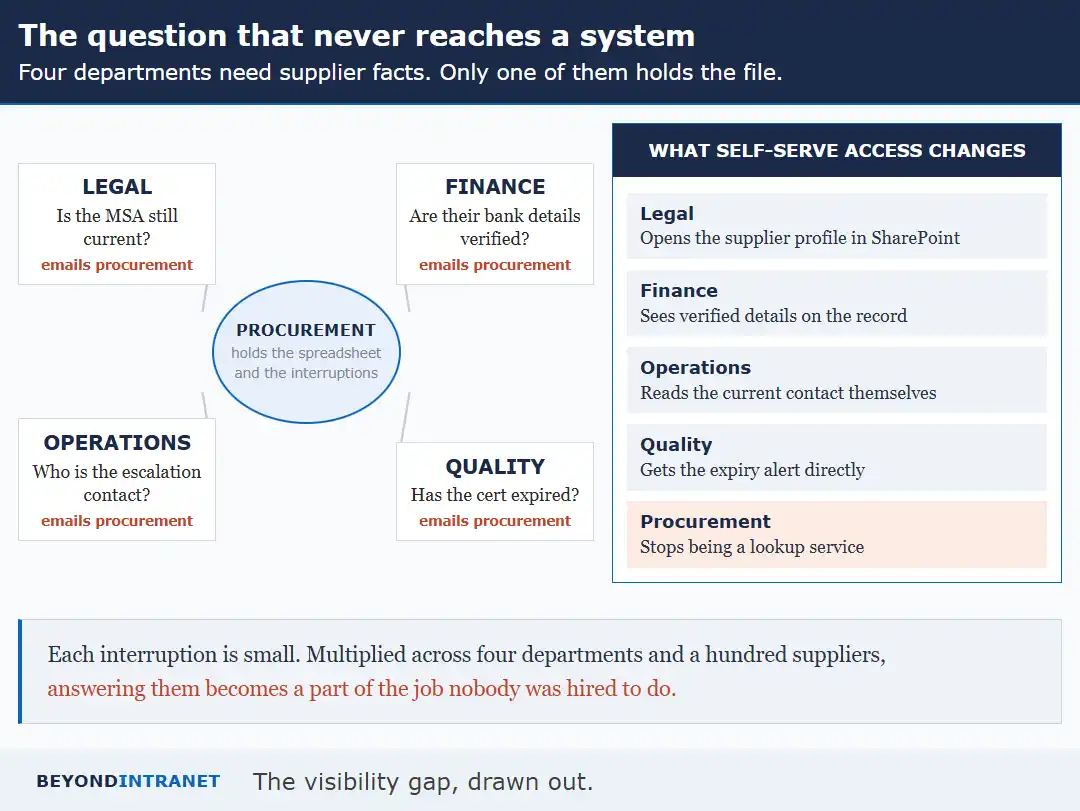
Legal asks whether the master agreement is current. Finance wants confirmation that banking details were verified. Operations needs the escalation contact for a site issue. Quality asks whether a certification is in date. Four reasonable questions, all arriving as messages to procurement, because procurement holds the file.
Four departments need supplier facts. Only one of them holds the file.
Each interruption is minor in isolation. Across four departments and several hundred suppliers, answering them becomes a standing part of the week nobody was hired for. And the answers are only as current as the last person to update the workbook.
The alternative is not a better process for asking. It is removing the need to ask. Where supplier records sit inside Microsoft 365, legal opens a supplier profile in SharePoint, operations checks a contact in Teams, and finance reads verified details without an intermediary. That is the practical argument for SharePoint-based procurement management: the information already lives where the other departments work.
Close the visibility gap between procurement and everyone else
Centralized supplier profiles, self-service onboarding and compliance alerts, inside the Microsoft 365 environment your teams already use every day.
Compliance tracking only happens after something goes wrong
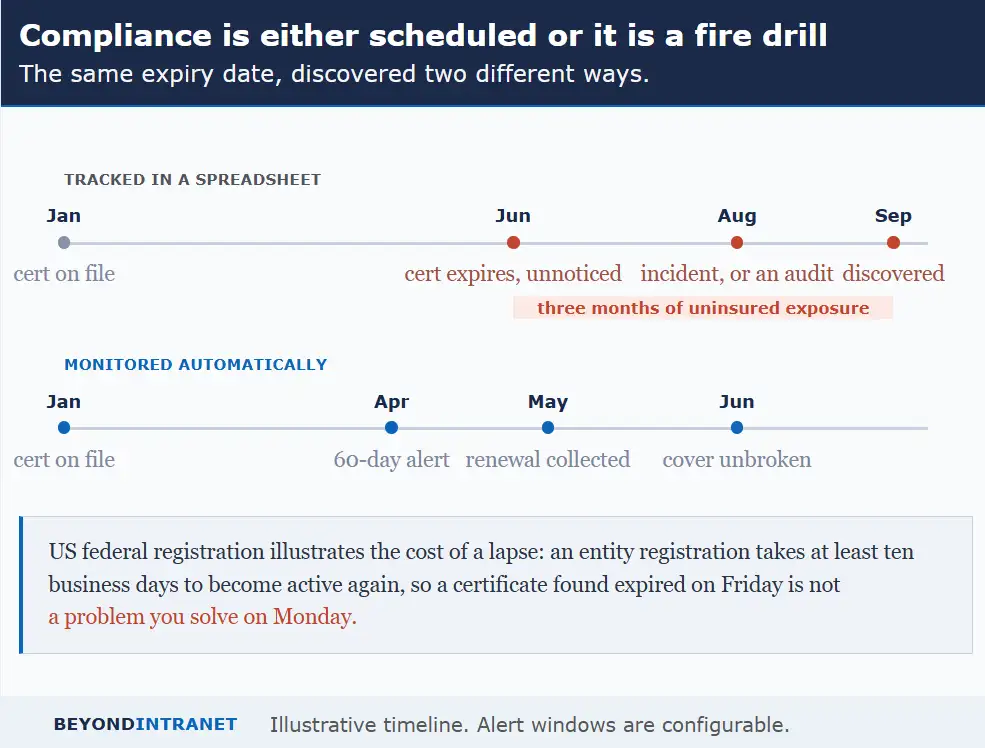
An expired certificate is discovered one of two ways. On a schedule, or during an incident.
Spreadsheet tracking depends on somebody remembering to check, and checking is unrewarding work that gets deferred whenever the week is busy. The expiry passes quietly. The gap becomes visible only in retrospect, when an auditor asks for current documentation or a claim exposes that cover lapsed in June.
The same expiry date, discovered two different ways.
Recovery time surprises people. US federal registration is a useful benchmark, since the government’s own guidance instructs entities to allow at least ten business days for a registration to become active. A document found expired on a Friday is not a problem resolved on Monday, and the supplier cannot trade with you in the meantime.
Automated compliance alerts invert the sequence. The system holds the expiry date, flags it with enough notice to collect a renewal, and the certificate is replaced before anybody needs to produce it. Beyond Intranet applies this against the centralized supplier record, so the alert reaches whoever owns the relationship rather than whoever last opened the file. The work is identical. The timing is not.
Performance conversations are based on memory, not data
Renewal season exposes this.
Somebody recalls the supplier was late twice last year. Somebody else remembers a quality issue but not the month. A third is fairly sure they improved after the site visit. The conversation is well-intentioned and entirely unfalsifiable, and a significant renewal decision gets made on it.
Recollection is biased in a specific direction. Recent and dramatic events dominate, so a supplier who caused one memorable problem in March outweighs one quietly mediocre all year. That bias consistently favors the wrong supplier.
Structured scorecards remove the argument by keeping the record as events occur. On-time delivery, quality incidents and resolution times logged against the supplier profile, surfaced through KPI dashboards, mean the renewal conversation starts from evidence. It also gives the supplier something to respond to, which is the difference between a complaint and a development conversation. The same discipline underpins strategic sourcing software built on Microsoft 365.
The sign
What it looks like day to day
What it costs
Different versions of the truth
Two records, two contacts, no owner
Reconciliation time and payment errors
Onboarding takes weeks
Nobody can say where a supplier is stuck
Delayed supply and supplier goodwill
Departments ask procurement
Four teams, four emails, one workbook
Standing interruption nobody scheduled
Reactive compliance
Expiry found during an audit or a claim
Exposure, plus a reinstatement wait
Performance from memory
Renewal decided on recollection
Wrong renewals, unwinnable negotiations
Chasing over strategy
Admin fills the week
Sourcing work that never gets started
Table 1. Six structural signs, and the operational cost attached to each.
The team spends more time chasing than strategizing
The final sign is a use-of-time problem, and the one procurement leaders feel most personally.
Chasing documents, sending reminders and reconciling versions are all necessary. None of it is sourcing. A team consumed by it is not underperforming, it is fully occupied doing work a system was supposed to absorb.
The opportunity cost is invisible on any budget line, which is why it persists. Supplier development that never starts and categories uncompeted for another year appear as an absence rather than a cost, and absences do not get escalated.
The real cost of waiting
When should a company move from spreadsheets to a supplier management system?
The trigger is usually cumulative rather than a single event. Growing supplier count, recurring compliance near-misses, or a procurement team spending more time on manual admin than on supplier strategy all signal that spreadsheets have become the bottleneck rather than the tool.
These signs compound.
Poor data slows onboarding, which increases the questions other departments ask, which consumes the time that would have maintained the data. Compliance gaps widen because nobody has capacity for preventive work, and performance records stay thin because logging feels optional.
Spreadsheet-based
Centralized system
Source of truth
Whichever file was opened last
One supplier record
Onboarding status
Reconstructed from an inbox
Visible to everyone involved
Other departments
Ask procurement
Check for themselves
Compliance
Checked when remembered
Flagged before expiry
Performance
Recalled at renewal
Logged as it happens
Table 2. The same five functions, handled two ways.
Key takeaways
Count your active suppliers and how many people maintain records about them. If the second number is above one and there is no shared system, reconciliation work is already happening somewhere.
Pick your last three onboardings and reconstruct how long each took and where the time went. The pattern will be approvals and document collection rather than supplier responsiveness.
Ask legal, finance and operations how they currently get supplier information. If the answer is that they email procurement, you have measured the visibility gap.
What comes next
Recognizing these signs is a first step rather than a decision. The useful next move is to examine what a purpose-built system would change about the week, rather than reading feature lists, and weigh that against the workarounds absorbing the team’s time.
Where supplier data already lives inside Microsoft 365, that evaluation is narrower than it first appears, because the question becomes what to add rather than what to replace. For a structured view of the wider decision, a closer look at choosing procurement software covers the ground this piece deliberately does not, alongside bid management software for the sourcing side of the same workflow.
Ready to see what changes when supplier data has one home?
We will walk through onboarding, compliance alerts and cross-department access against your own supplier base, inside your existing Microsoft 365 environment.