A practical, vendor-neutral guide for CIOs, IT directors, and digital workplace leaders evaluating SharePoint consulting partners in Australia — including a comparison...
Most evaluations spend four hours in feature demos and eleven minutes on the contract.
That ratio is understandable. The demo is where the product becomes real, the questions are easy to ask, and everyone in the room has an opinion. The agreement arrives later, as a PDF, at the point when the decision has effectively been made and nobody wants to reopen it.
But the demo governs a single afternoon. The contract governs every month afterward, including the ones where you want to leave. This is the part of an AI procurement software checklist that most buying guides skip.
Key takeaways
A useful AI procurement software checklist covers four things a feature comparison cannot: pricing and contract terms, data ownership and export rights, support commitments in writing, and what leaving would actually involve. Ask all four during evaluation, while you still hold something the vendor wants. Lock-in is rarely disclosed at the point of sale; it is discovered on the day you try to move.
Why feature lists aren’t the whole buying decision
What should be in an AI procurement software checklist?
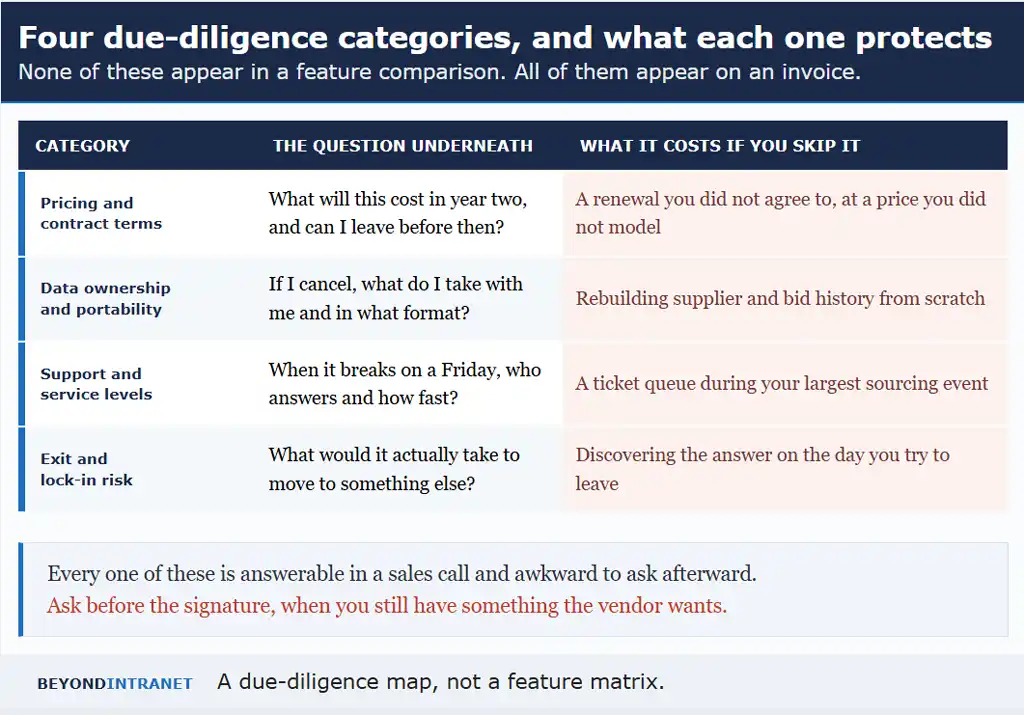
A useful checklist covers more than features. Pricing and contract terms including length, auto-renewal and price increases, data ownership and export rights, support response times and service levels, and exit terms. These determine what happens after you sign rather than what the platform can do.
A large enterprise has a procurement operations function and a legal team who read software agreements for a living. A ten-person procurement team usually has neither, which means the person who ran the evaluation is also the person who reads the terms, at the end of a process they are already invested in.
That is the structural problem. Due diligence has to happen during evaluation, while there is still a competitive alternative on the table, because afterward you are asking a supplier to renegotiate an agreement they have already won.
None of these appear in a feature comparison. All of them appear on an invoice.
There is a timing argument too. Gartner reported in July 2025 that generative AI for procurement has entered the trough of disillusionment, with many organizations seeing uneven returns. The same analysis projected that conversational AI in procurement will become obsolete before reaching productivity. Categories in this position consolidate. A long agreement is a bet on the vendor still being there, and on the product still being one you want.
Pricing and contract questions to ask
What should I ask an AI procurement software vendor before signing a contract?
Ask about contract length and auto-renewal terms, what happens to your data if you cancel, whether support is included or a paid add-on, and whether workflow changes require the vendor’s own consultants. These terms cost smaller teams the most later, and none of them appear in a sales demo.
Quote-based pricing is normal in this category. Beyond Intranet prices this way too. It is not itself a warning sign, and what matters is whether the quote holds, and for how long.
Ask this
A good answer sounds like
Worth pressing on
How long is the initial term, and what happens at the end?
A stated term with a named notice period
“It renews automatically” with no notice window given
How much can the price rise at renewal?
A cap, or an index, written into the agreement
“We review it annually”
Is there a minimum seat or spend commitment?
A number you can grow into
A floor set above your current need
What is bundled and what is an add-on?
An itemized list, including AI features
AI capability quoted separately after the demo
Can we start smaller and expand?
Yes, with pricing stated for both
Only the full tier is offered
Table 1. Five pricing and contract questions, phrased for a vendor call.
The renewal increase is the one small teams most often leave unasked, and the one that compounds. A first-year price agreed enthusiastically becomes a third-year price nobody modeled, and by then the switching cost is real.
Data ownership and portability
Three categories of data accumulate inside a sourcing platform, and they are not equally easy to retrieve.
Supplier records are the most portable, because they usually started somewhere else. RFQ and event history is harder, because it was created in the system. Bid history, scoring and award rationale are hardest of all, and they are also the records you would most want if a decision were ever questioned.
So the question is not whether you own your data. Almost every agreement says you do. The question is what ownership means in practice when the format is proprietary and the export produces a file nobody can read.
Ask this
A good answer sounds like
Worth pressing on
Which records can we export?
Suppliers, events, bids, scores and attachments
Current records only
In what format?
An open format you can open without their software
“We can arrange a data dump”
Can we export while the contract is live?
Yes, on demand, by ourselves
Only on request, or only at exit
What happens to our data after cancellation?
A stated retention window and a deletion commitment
Nothing written down
Where does the data physically live?
A specific answer about tenancy and location
A general reassurance about security
Table 2. Five data questions. The second one separates ownership from access.
That last question has a different answer depending on architecture. Some platforms hold your records in their own cloud. Others do not. Where a system is built natively on Microsoft 365 and SharePoint, as Beyond Intranet’s procurement management software, the records sit inside your own tenant rather than a separate vendor environment. That changes what cancellation means. Put the question to Beyond Intranet and to everyone else on your shortlist. The answers will differ more than the feature lists do.
Put these questions to us directly
Bring your shortlist questions on contract terms, data export and exit to a working conversation, rather than taking anyone’s word for the answers.
Support, SLAs, and what happens when something breaks
Support quality is invisible during evaluation. It becomes unmistakable during a live sourcing event.
The scenario worth planning for is narrow and specific. A supplier cannot submit, the event closes in two hours, and it is Friday afternoon. What you want to know is who answers, how quickly, and whether that commitment exists anywhere other than a sales conversation.
Three distinctions matter. Whether support is included in the price or sold as a tier. Whether response time is a target or a contractual commitment with a remedy attached. And whether uptime is stated as a number you could hold someone to, or described in general terms.
Ask for the service level document rather than a verbal summary. Published commitments arrive immediately. Where none exist, you will get a description of the support philosophy instead, which is a useful answer in its own right.
Red flags that signal vendor lock-in
How do I avoid vendor lock-in with AI procurement software?
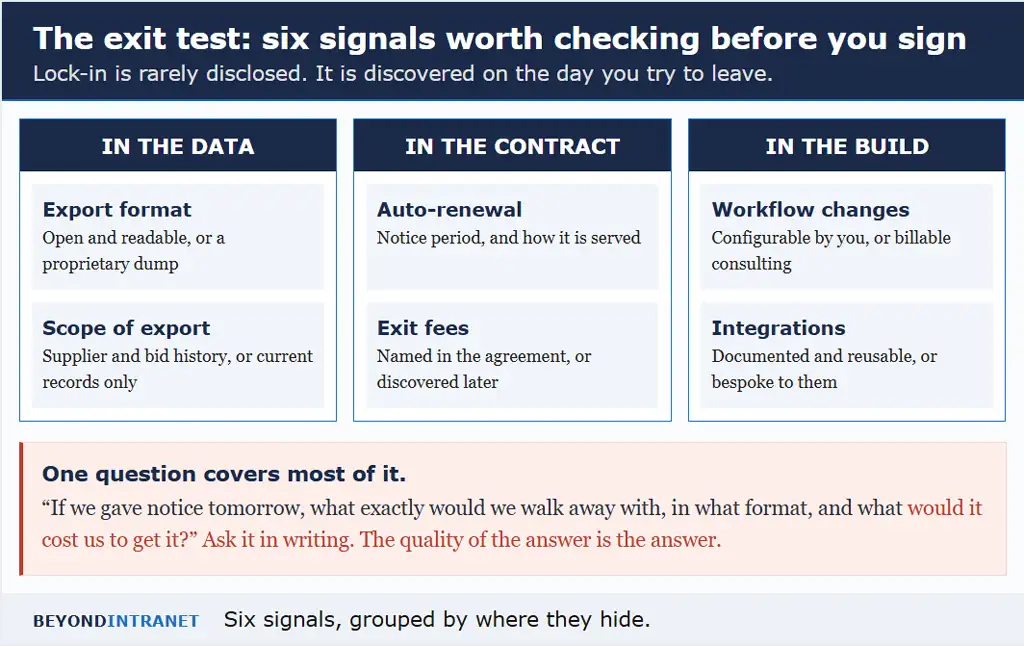
Confirm the platform exports your supplier, RFQ and bid data in an open, usable format, ask whether integrations use documented interfaces you could reuse elsewhere, and get exit terms in writing before signing. Lock-in usually is not disclosed upfront; it is discovered the day you try to leave.
Six signals, grouped by where they hide.
Lock-in is rarely deliberate. It accumulates through decisions that were reasonable one at a time. A bespoke workflow built by the vendor’s team. An integration written specifically for you. A data model that made sense inside their product and nowhere else.
The signal to watch for is who holds the ability to change things. If every workflow adjustment routes through the vendor’s paid consultants, you have bought a service relationship rather than a platform, and the cost of leaving rises with every change you make.
Configurability is the practical counterweight, and it applies to the ordinary things as much as the exotic ones. Multi-tier approval workflows, audit trails and document version control that your own administrators can adjust, across centralized supplier management, strategic sourcing software and purchase requisition software, mean the platform bends without an invoice attached.
Getting the most value from your vendor evaluation
One question does most of the work, and it belongs in writing rather than in a conversation.
If we gave notice tomorrow, what exactly would we walk away with, in what format, and what would it cost us to get it? Clean answers come back quickly. A request to check with legal has told you something before legal replies.
Ask it during evaluation. The same question after signature is a request for a favor, and the leverage that made it answerable has gone.
Where to start
Put the four categories in writing and send them to every shortlisted vendor as one document. Comparing written answers is more useful than comparing recollections of separate calls.
Ask for the service level document and the standard agreement before the final demo, so you read them while an alternative still exists.
Name the person who will read the contract. If that person is also the one who ran the evaluation, bring in a second reader who was not in the demos.
The terms outlast the demo
Feature comparisons answer whether a platform can do the work. Contract terms answer what the relationship costs when circumstances change, and circumstances change more often in an unsettled category than in a mature one. Ask the four question sets while you still have a choice, get the answers in writing, and the decision holds up long after the demo has been forgotten.
For the wider adoption picture that sits alongside this one, our roadmap for mid-market procurement transformation covers what to do after the contract is signed. This piece covers the contract you sign to get there.
See the platform, then ask the hard questions
Walk through the workflows with your own categories, and bring the contract, data and exit questions from this checklist to the same conversation.