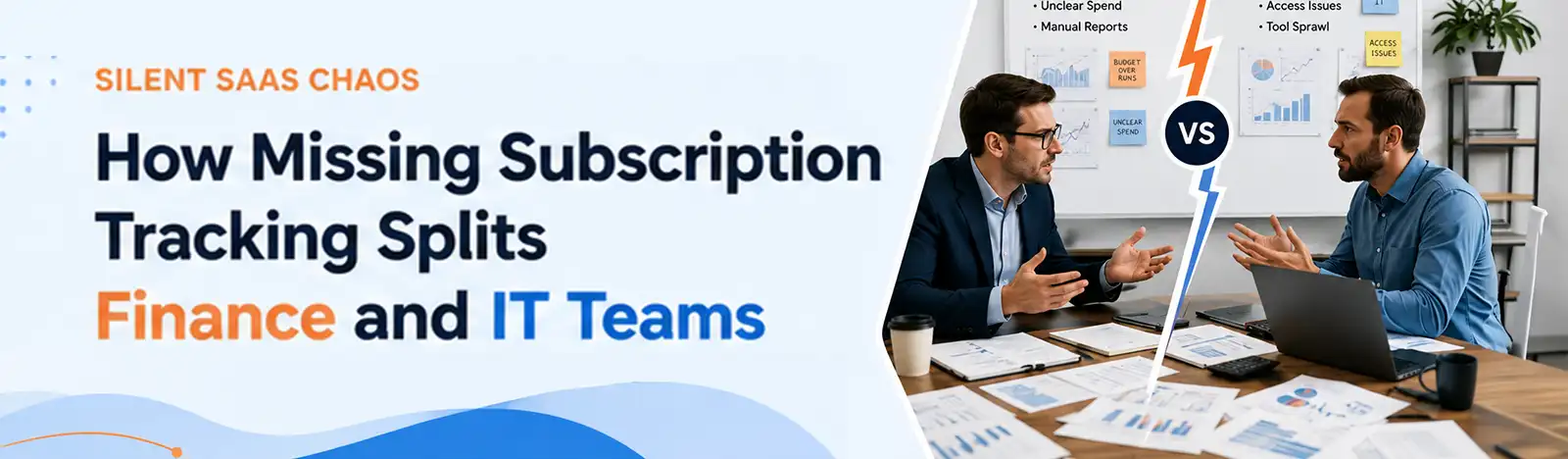
Picture this: It’s the last week of the quarter. The Finance Director is reconciling vendor invoices when she spots three billing line items for tools she’s never heard of. Meanwhile, the IT Director, two floors up, has just provisioned a fourth version of that same tool because nobody told him the other three already existed.
No one made a mistake. Everyone was doing their job. But without a shared system, two responsible departments quietly created a very expensive mess.
This is the reality of modern SaaS sprawl, and according to industry data, most teams discover that 15 to 30 percent of their software budget is going to unused or duplicate licenses. The cost isn’t just financial. It’s the friction, the mistrust, and the hours spent chasing down information that should have been visible all along.
The Core Conflict: Two Departments, Zero Shared Visibility
SaaS adoption doesn’t arrive in a single planned wave. It creeps in, a project management tool approved here, a design platform expensed there, a niche analytics subscription put on a team card. IT provisions access. Finance manages the billing. On paper, it’s a clean split of responsibility.
In practice, it creates a fault line.
The IT team mainly focuses on access, uptime, and security while keeping track of everyone that has access to licenses. They also maintain a list of which tools are active. While the finance team manages costs, contracts, and compliance via up-to-date invoices, approval records, and budget allocations. The main problem is that neither team has a complete view of what the other is working on, nor do they have a shared platform to close the visibility gap.
The result is “shadow IT”, software provisioned and actively in use, but completely invisible to budget owners. Finance ends up managing renewals through fragmented spreadsheets that no one fully owns. IT makes provisioning decisions without visibility into what’s already been purchased. And leadership gets surprised every quarter when the SaaS line item doesn’t match anyone’s expectations.
Misalignment here isn’t a people problem. It’s a systems problem.
The Cost of Inaction: Ghost Subscriptions and Renewal Shocks
When SaaS visibility breaks down, two painfully familiar problems emerge.
Ghost subscriptions are licenses that continue billing long after their purpose has ended. An employee leaves, their access gets deactivated, but their Salesforce seat, their Zoom Pro license, and their design tool subscription quietly keep renewing every month. Multiply that across a growing team and you have a real financial drain operating entirely in the background.
Then come auto-renewal surprises: Enterprise SaaS contracts are frequently renewed annually, with tight cancelation deadlines and severe penalties for missing them. Without cross-departmental insight, Finance has no means to identify forthcoming renewals for strategic review, and IT has no way to secure budget approval before a contract expires. One missed window locks the business into another year of software it was planning to replace.
Both problems share the same root cause: There is no single, authoritative place where Finance and IT can see what’s subscribed, who’s using it, what it costs, and when it renews. The fix isn’t more spreadsheets. It’s a purpose-built system that works inside the environment your teams already use every day.
How A Microsoft Built Subscription Software Manages Everything at One Place
Organizations running on Microsoft 365 have a meaningful head start here — because the foundation for a centralized subscription management system is already in place.
The Subscription Management software is built natively on SharePoint. You don’t have to switch to any new platform and get started on your Microsoft environment in minutes.
The software is built by Beyond Intranet that is trusted by 500+ Microsoft 365 organizations worldwide and is a Microsoft Gold Partner with 17+ years of experience. This is a solution designed specifically for the way Microsoft-first teams operate.
Must-Have Capabilities That Bridge the Finance–IT Gap
Beyond Intranet’s SaaS subscription management tool is built to serve every team that touches software spend, Finance, IT, HR, and Operations. Here’s what makes it genuinely effective across all of them:
Automated Renewal Reminders via Power Automate: Get automated alerts via Power Automation before every contract renews, keeping the right people in Finance and IT informed early so they can act fast.
Multi-Currency Spend Estimation: Set your organization’s base currency and let the tool handle the rest. When a requestor submits a license estimate in a different currency, the tool automatically converts it against your base, keeping budget tracking accurate across global teams without manual calculation.
Real-Time Spend Analysis and Budget Reporting: Before any new license is activated, Finance can check whether it falls within allocated budget limits. The tool surfaces a detailed budget report showing total allotted budget, total subscription spends, remaining budget, and average utilization, so there are no surprises at quarter end.
Version-Controlled Document Storage in SharePoint: Keep all invoices, vendor agreements, SLAs, and subscription documents securely stored in one SharePoint document library. With version history, audit tracking, and role-based access. So, your team always knows who changed what, and all sensitive documents stay visible only to the right people.
Enterprise-Grade Security via Azure Active Directory: The software uses Azure AD, MFA, SSO and role-based access, with all this it also offers Microsoft ensured security. Which means all your data stays safely stored in one place and only approved person has the right to access it.
Power BI Analytics Dashboard (Add-On): Get detailed analytics reports, so you can take data driven decisions. This will help the finance team stay updated on every expense and track the budget, overspending and remaining money to be used.
The Business Value: What Actually Changes
The outcomes of getting SaaS subscription management right are measurable from the first month.
Recovered Budget: Teams frequently discover that unused or duplicate licenses account for 15 to 30% of their software to spend. Centralized visibility and standardized approval of workflows help you identify and eliminate these expenditures.
Save up to 70% of your time on subscription management. Automated workflows, centralized renewal tracking, and real-time reporting reduce the manual overhead that Finance and IT departments face each month. That time goes back to work; that actually moves the business forward.
Predictable Financial Forecasting: When the finance team gets real time visibility into every spend, used budget against allotted budget. It becomes easy for them to take decisions, and they stay compliant ready with updated ready to download invoices.
Seamless Compliance and Audit Readiness: Get Full audit trails, version-controlled document storage, and organized approval workflows. So, when a sudden requirement for any document arise your team will be audit ready with the right information.
A Frictionless Relationship Between Finance and IT: When both teams work with the same data in the same environment, the questions disappear. IT stops hearing “where did this invoice come from?” and Finance stops hearing “that’s not something we manage.” Shared visibility creates shared accountability.
It’s Time to Close the Gap
SaaS sprawl isn’t going away. The average number of subscriptions an organization manages will keep growing, and the cost of managing them without a proper system will grow alongside it.
The good news is that for enterprises already using Microsoft 365, the solution does not necessitate a new vendor relationship, security review, or weeks of deployment. It deploys in minutes within your existing infrastructure, works with your existing Microsoft license, and begins generating value immediately.
The silence of SaaS chaos is deceptive. It doesn’t announce itself; it shows up in quarterly budget reviews, in auto-renewal shocks, in duplicate licenses, and in the slow erosion of trust between departments that should be natural allies.
Most teams discover they’re overspending 15–30% on licenses. Book a free demo or start your 7-day free trial to see exactly where your budget is going, and how to take it back.