A practical, vendor-neutral guide for CIOs, IT directors, and digital workplace leaders evaluating SharePoint consulting partners in Australia — including a comparison...
Three ways to get AI delivered on Microsoft 365, and the one question that separates them: who owns the outcome. A cost, role, and comparison guide for 2026.
When an enterprise decides to move an AI idea into production on Microsoft 365, it usually chooses between three delivery models: a forward-deployed engineer, a Microsoft implementation partner, or staff augmentation. They look interchangeable on a slide. They are not. The difference that matters is not skill or price. It is accountability, who owns whether the system actually works and gets used.
This guide defines each model, compares them on role and cost, and shows when to choose which. All three have a place. For AI work where the problem is not yet fully specified and adoption is the risk, only one of the three is built to carry the outcome.
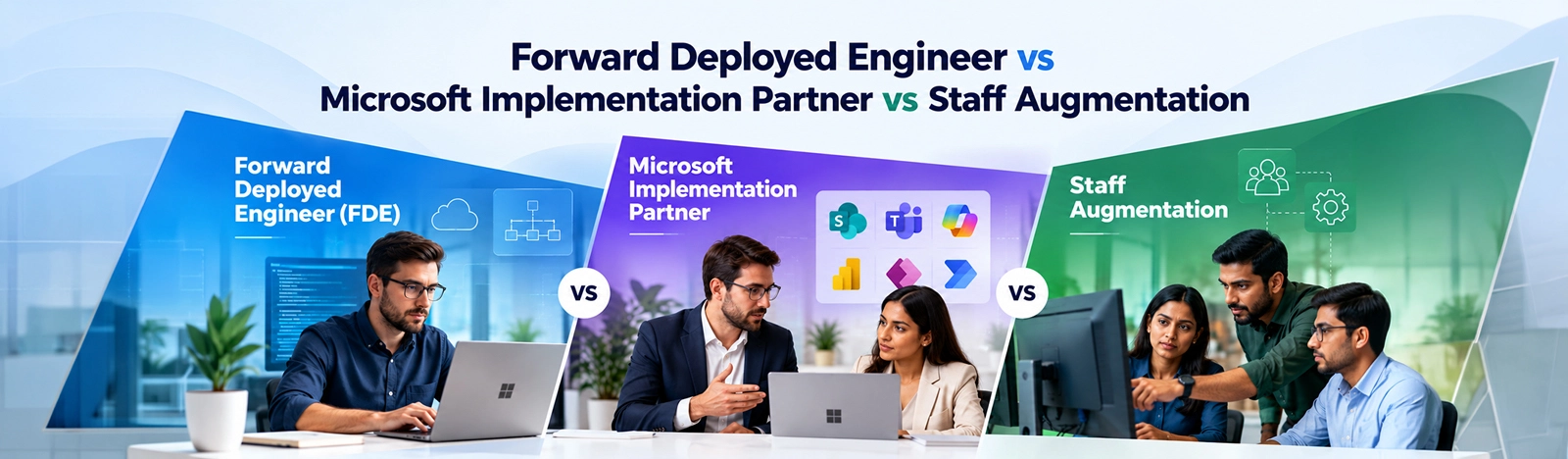
Forward Deployed Engineer vs. Microsoft Implementation Partner vs. Staff Augmentation
Forward Deployed Engineer (FDE)
A senior engineer who embeds inside your team and owns an AI project end to end, from framing the business problem to a system in daily production use. The FDE faces your executives, writes the code, ships it, and stays until it runs. You are buying an outcome, not hours or advice. The model began at Palantir and is now used by OpenAI, Anthropic, Google, Stripe, and Datadog.
Microsoft implementation partner
A partner that delivers a defined scope of work: standing up Copilot, configuring Microsoft 365, and deploying a solution to a specification. The work is milestone-based, and the deliverable is the system as scoped. It is strong for well-understood platform rollouts, and many partners bring real scale and governance strength. The distinction is where accountability stops: a partner’s accountability runs to the SOW’s acceptance criteria, not to the business outcome. Partners can scope adoption and change management, but it has to be bought and specified; with an FDE, carrying adoption is inherent to the model.
Staff augmentation
Rented capacity. You define the work, write the specification, and own the result; the augmented developers execute against it. It is efficient when you have a clear backlog and simply need more hands. It carries no accountability for whether the finished thing solves the business problem, because that was never its job.
The partner-versus-augmentation line is the simplest of the three. A partner sells a delivered project, its own team, its own management, and accountability to a SOW. Staff augmentation sells people into your project, under your management and your accountability. If you own the architecture and just need hands, augmentation suffices; if you need the project delivered, you need a partner.
Role and accountability of Forward Deployed Engineer Vs Microsoft Implementation Partner Vs Staff Augmentation
Forward Deployed Engineer
Microsoft implementation partner
Staff augmentation
Delivers
A working system in production, adopted
The solution as scoped in the SOW
Capacity to execute your spec
Accountable for
The outcome and its adoption
The agreed deliverable (SOW acceptance)
Task completion
Faces executives
Yes
Sometimes
Rarely
Writes code
Yes
Yes
Yes
Owns adoption
Yes
If scoped in the SOW
No
Who manages the work
The FDE, embedded in your team
The partner’s project manager
You
Typical duration
Weeks to months, per outcome
The project plan
Open-ended
Knowledge transfer at exit
Built into the engagement
A handover milestone
Leaves with the contractor
Team structure
A senior lead, often with build support
A delivery team across roles
Individual contributors
Speed to value
Weeks; prototype typically in month one
Tied to project plan
Depends on your spec
Best for
Stalled pilots and the strategy-to-production gap
Well-defined platform rollouts
Well-specified backlogs and extra capacity
How each model is priced, with real anchors
The pricing structures differ as much as the roles, and comparing them like-for-like is where buyers go wrong. Three published numbers anchor the decision.
The platform cost you already carry. Microsoft 365 Copilot is a documented $30 per user per month on an annual commitment, on top of a qualifying base license [4]. That spend runs whether or not the pilot reaches production, which is exactly why a stalled pilot is expensive: the licenses keep billing while nothing ships.
The talent cost behind an FDE. Public salary data puts a Forward Deployed Engineer around a $190,000 US median in 2026, well above $200,000 at senior levels and far higher at frontier AI labs, before benefits and equity [3]. Hiring one full-time for a single project rarely makes sense.
The delivery model. An FDE is priced by engagement, not by hour: a fixed-scope discovery or a two-to-six-week proof of concept first, then a dedicated or blended monthly rate (an onshore lead with offshore build support). An implementation partner is usually a fixed or milestone-based SOW for the defined scope. Staff augmentation is a daily or hourly rate per head, cheapest per person, but you own the specification and the result.
Model
How it is priced
What you are buying
Forward Deployed Engineer
Fixed-scope PoC, then dedicated or blended monthly
An outcome in production, and its adoption
Microsoft implementation partner
Fixed or milestone-based SOW
The solution as scoped
Staff augmentation
Daily or hourly rate per person
Capacity against your specification
The rule that keeps the economics in your favor: fund in stages, so budget follows the evidence from the last phase, and weigh the price against the cost of not shipping. A stalled pilot still burns the Copilot license spend above, plus team time and executive patience, with nothing to show.
Which model for which scenario
Criteria are easier to apply against concrete situations. Match the scenario, then compose where a project spans more than one.
Scenario
Best-fit model
Why
A stalled AI pilot that never reaches production
Forward Deployed Engineer
Ambiguity and adoption risk are exactly what it owns
An AI idea that needs framing before anyone builds
Forward Deployed Engineer
The problem is not yet specified
A well-scoped Copilot or Microsoft 365 rollout
Implementation partner
A defined deliverable a partner ships efficiently
A SharePoint migration or Power Platform rollout with a clear spec
Implementation partner
Standard delivery against a specification
A clear backlog that needs extra engineering hands
Staff augmentation
Capacity under your direction, cheapest per head
Scaling a delivered system with known patterns
Staff augmentation
Execution, not leadership, is what remains
These models combine, and sequencing them by phase is often cheaper than forcing one across the whole program. A common pattern is a partner-led platform rollout with an FDE-owned AI workstream on top; another is an FDE who proves and ships the outcome, then hands ongoing build to staff augmentation once the pattern is known.
When to choose which
Choose a Microsoft implementation partner when the scope is well understood, the outcome is a platform configured to spec, and your team can drive adoption afterward.
Choose staff augmentation when you have a clear, well-specified backlog and simply need more engineering capacity under your own direction.
Choose a Forward Deployed Engineer when the problem is not yet fully specified, when adoption and security have to be engineered in, and when the risk you are managing is a pilot that never reaches production. This is the AI-specific case.
When an FDE is the wrong choice
An FDE is built for ambiguity and adoption risk; absent those, simpler models win, and saying so is the point. Choose a partner when the scope is already well specified, they deliver it more efficiently. Choose staff augmentation when you need capacity, not leadership; it is cheaper and faster to start. And if the rollout is standard and your team can carry adoption, you do not need an FDE at all.
Why AI tilts the decision toward the FDE
AI delivery fails for organizational reasons, not technical ones. MIT’s Project NANDA found that 95% of enterprise generative AI pilots delivered no measurable P&L return, and attributed the gap to integration into workflows and processes rather than the models themselves [1]. Gartner separately predicted that at least 30% of generative AI projects would be abandoned after proof of concept by the end of 2025, citing poor data quality, weak risk controls, escalating cost, and unclear business value [2].
Read those failures back against the three models. A specification handed to staff augmentation does not fix unclear business value. A scoped rollout from an implementation partner does not, on its own, engineer adoption. Both gaps are exactly what an embedded engineer is accountable for closing. That is why enterprises stuck at the pilot-to-production line increasingly reach for the FDE model. For the full breakdown of why pilots stall and the roadmap across the gap, see our companion guide below.
Key takeaways
The dividing line is accountability: an FDE owns the outcome, a partner owns the deliverable, and staff augmentation owns the task.
Staff augmentation is cheapest per head but leaves the specification and the result with you.
Implementation partners suit well-defined rollouts; adoption usually returns to your team.
For AI, where 95% of pilots stall on delivery, not technology, the FDE model is built to carry the outcome [1].
FAQ on FDE Vs Microsoft Implementation Partner Vs Staff Augmentation
A partner or consultant delivers advice or a scoped solution and hands it over. A Forward Deployed Engineer embeds, builds the system, and stays accountable until it is in production and adopted.
No. Staff augmentation supplies capacity to execute your specification; you own the outcome. An FDE shares or carries the outcome, including whether the system is adopted.
It is priced by engagement, a fixed-scope discovery or proof of concept, then a monthly dedicated or blended model, rather than by the hour. Underlying FDE salaries sit around a $190,000 median in the US and higher at senior levels [3].
For a single project, usually. A senior FDE sits around a $190,000 US salary median before benefits [3], and the role is hard to hire and keep. Engaging a partner who already employs them, priced by engagement rather than salary, avoids that cost and ramp.
No. A solutions engineer supports sales or advises on design, and an architect designs. A Forward Deployed Engineer frames the problem, builds the system, ships it, and owns whether it is adopted, one accountable person across the whole arc.
By design, with knowledge transfer built in. The engineer documents the solution, trains your team, and hands over a running system with a named owner, rather than leaving a dependency. Some enterprises then scale the delivered pattern with staff augmentation or a partner.
Then scale the delivered pattern with staff augmentation or a partner.
Not sure which model fits? Book an AI Discovery Workshop.
Sachin Jain is a Solution Architect at Beyond Key, based in Dallas, Texas. He specializes in designing and delivering enterprise solutions using Microsoft 365, SharePoint, and the Power Platform. He has led numerous digital transformation initiatives focused on automating business processes, building modern intranet solutions, and integrating enterprise systems with Power Apps, Power Automate, and Power BI.
Passionate about innovation and problem-solving, Sachin focuses on creating scalable, user-friendly solutions that bridge technology and business needs.