A practical, vendor-neutral guide for CIOs, IT directors, and digital workplace leaders evaluating SharePoint consulting partners in Australia — including a comparison...
Ask who owns indirect spend and you will get four answers, none of them a name.
IT signs the software renewals. Facilities handles the cleaning contract. Marketing engages the agency. HR books the training. Every one of those decisions is defensible on its own, made by someone competent, inside a budget they control. Collectively they form the most scattered line on the P&L, and the only category where nobody can produce a complete picture on request.
Which is not a discipline problem. Nobody is being careless. The structure simply never existed, because indirect grew up in the gaps between functions that each had their own reason to buy something.
What follows is the practical version. Where the money actually sits, why the category shrugs off the controls that work elsewhere, and the four things that change it.
Key takeaways
Indirect procurement is everything you buy to run the business rather than to build what you sell. Some people call it indirect sourcing; the terms mean the same thing. In most organizations it lands in seven or so buckets, with IT, professional services and travel doing the most damage. The category is decentralized by design, so tracking it harder achieves very little. What works is naming an owner for the things you buy most often, competing the purchases that repeat, and getting requests approved before the money leaves rather than after.
What is indirect procurement?
What is indirect procurement?
Indirect procurement is what a business buys to keep itself running rather than to build what it sells. IT, facilities, professional services, travel, HR, office supplies. None of it ends up in the product. Some teams call it indirect sourcing, which means the same thing.
The definition is easy. The boundary is where it gets interesting.
A manufacturer buying steel is buying direct. The same manufacturer buying the lubricants that keep the press running is buying indirect, even though the press makes the product. A software company buying cloud hosting for its own product is buying direct; buying the same vendor’s tooling for the finance team is indirect. The test is not what the item is, but whether it ends up in what you sell.
There is a scale point buried in that distinction. Direct concentrates into relatively few supplier relationships, because a production line does not need forty vendors for one component. Indirect fragments across hundreds, because forty departments buying forty different things will find forty different suppliers, and each one arrived through a decision nobody recorded.
That test matters practically, because it determines who notices when the price moves. Direct spend sits in cost of goods and gets scrutinized every quarter. Indirect sits in operating expense, spread across departments, where a nine percent increase on a single line rarely triggers a conversation.
Indirect vs. direct procurement, in brief
The working difference is how each one behaves rather than what each one buys. Direct procurement is centralized and forecast-driven, because production volumes are known in advance and a shortage stops the line. Indirect is decentralized and request-driven, triggered by whoever needs something, usually without a forecast and often without procurement involved at all. That single distinction explains most of what follows in this guide. For readers who want the complete side-by-side treatment, there is a full breakdown of direct vs. indirect sourcing on this site.
Categories of indirect procurement
What are the most common indirect procurement categories?
Common categories include IT and software, facilities management, professional and marketing services, travel and corporate services, HR and training, and MRO and office supplies. This is spend typically spread across many departments rather than owned by one team.
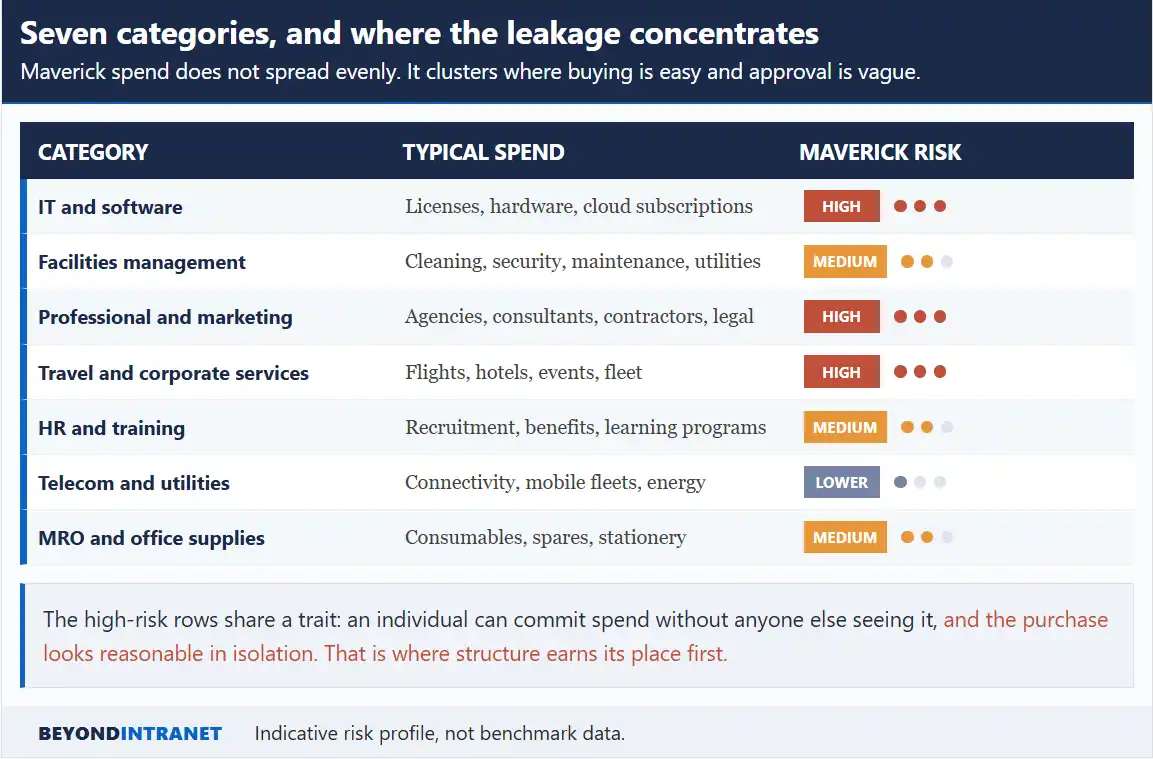
Seven categories cover most of what a mid-sized organization buys indirectly, and they do not carry equal risk.
Maverick spend clusters where buying is easy and approval is vague.
Category
What it typically covers
Where the leakage sits
IT and software
Licenses, hardware, cloud, support contracts
The renewal nobody read, and the tool a team bought on a card
Facilities management
Cleaning, security, maintenance, utilities
Long contracts that quietly roll over
Professional and marketing
Agencies, consultants, contractors, legal
Retainer scope that grew, and engagements never competed
Travel and corporate services
Flights, hotels, events, fleet, catering
Bookings made first, approved afterward
HR and training
Recruitment, benefits admin, learning
Placement fees negotiated one hire at a time
Telecom and utilities
Connectivity, mobile fleets, energy
Lines and handsets still billing years after anyone used them
MRO and office supplies
Consumables, spares, stationery
Small, frequent orders. Individually trivial, collectively not
Table 1. Seven categories, and the specific place value tends to escape in each.
Two of these deserve a caveat. Telecom and utilities show lower maverick risk because the buying is centralized by necessity, but they compensate with the opposite problem: long contracts that renew without anyone reading them. Low leakage at the point of purchase does not mean low leakage overall.
IT, professional services and travel carry the highest maverick-spend risk, and they share a trait worth naming. In each, an individual can commit real money without anyone else seeing the decision, and the purchase looks entirely reasonable in isolation. A single agency engagement, one conference booking, another software seat. Nothing in that list is wrong. The pattern is only visible in aggregate, which is exactly the view nobody has.
Why indirect spend is hard to control
Four things make this category resist the controls that work everywhere else.
The first is ownership. Direct materials have a supply chain function whose job is that spend. Indirect has budget holders, which is not the same thing, because a budget holder is accountable for a number rather than for how the number was arrived at. Nobody in the organization wakes up responsible for indirect procurement as a whole.
The second is visibility, and it follows from the first. Spend that flows through several departments, several approval paths and several payment methods produces no single view without deliberate effort. Most teams discover the shape of their indirect spend during a cost-reduction exercise, which is the worst possible time to be learning it.
Third is maverick spend. Purchases made outside the agreed process, or away from a supplier you already hold terms with. Rarely defiance. Usually someone who needed something on Thursday and could not find a faster route than a corporate card. Every one of those purchases erodes negotiated rates and removes volume that would have strengthened the next negotiation.
Fourth is tail spend, the long list of small, low-value purchases that individually never justify attention and collectively represent real money. Competing them takes time the team does not have, and the pressure is increasing. The Hackett Group projects procurement workloads rising 8% in 2026 while headcount and operating budgets both decline. Under that pressure, the categories that get deprioritized are the ones with no owner, which is a description of indirect spend.
How to bring indirect procurement under control
How do you control or reduce indirect procurement spend?
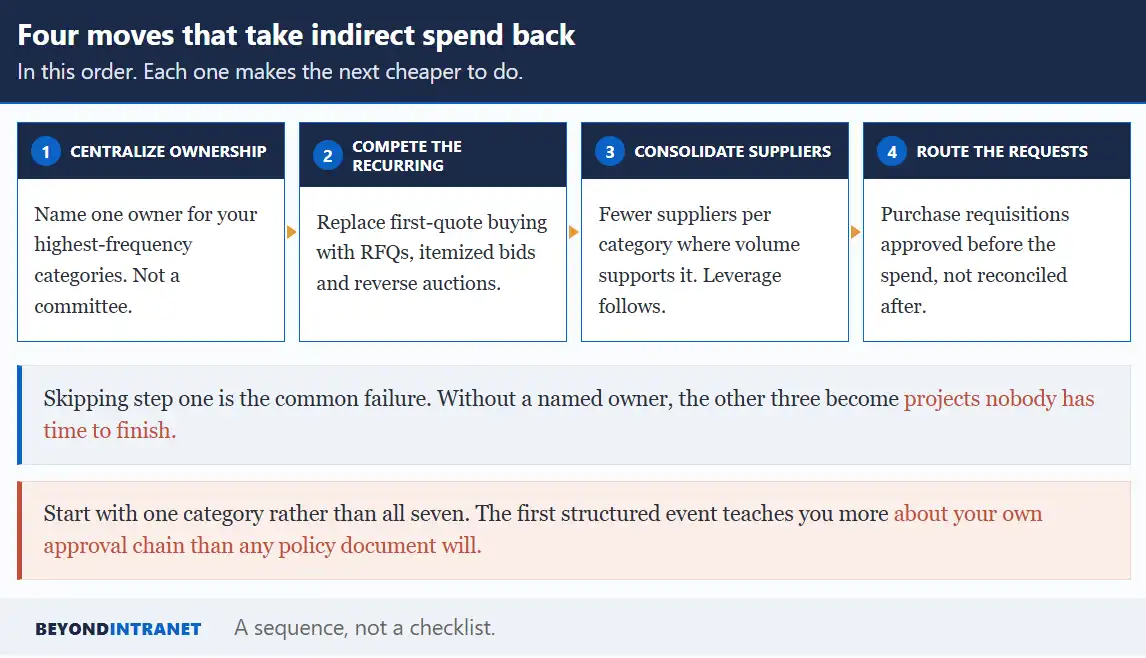
Give your highest-frequency categories a named owner. Compete the purchases that repeat, using RFQs, itemized bids or reverse auctions instead of taking whatever the incumbent quotes. Cut the supplier count where volume justifies it. Then put a requisition workflow in front of the spend, so approval happens before the commitment instead of during the monthly reconciliation.
Four moves. The sequence matters more than anyone admits, and most teams attempt them in reverse, starting with a supplier consolidation exercise before anyone has been made responsible for the category. That order produces a spreadsheet and very little else.
In this order. Each one makes the next cheaper to do.
Centralize ownership of your highest-frequency categories
Start by naming one person per category rather than forming a committee. Not all seven at once, and not the largest by value. Take the two or three you buy most often, because frequency is what makes structure pay back. An owner with three categories and a mandate will achieve more than a governance forum with all seven and a quarterly meeting.
Compete the purchases that repeat
Accepting the first quote is the default because it is fast, and it is fast because nothing structured is in place. Recurring categories deserve better than that. RFQ management turns a repeat purchase into a comparable event, itemized bidding lets you compare line by line rather than on a single total, and reverse auctions compress the negotiation into a scheduled window. Beyond Intranet publishes figures of 15 to 30 percent savings through reverse auctions without negotiation back and forth, and roughly half the manual sourcing effort through structured workflows. Those are our own published numbers rather than independent research, and they are worth testing against one of your own categories.
Consolidate suppliers where volume supports it
Fragmentation is the natural state of indirect. Four departments buying similar services from seven suppliers produces seven relationships, seven sets of terms and no leverage anywhere. Consolidating does not mean single-sourcing everything. It means enough volume per supplier that the relationship is worth managing, supported by supplier management so the record lives somewhere other than four separate inboxes. Fewer relationships, each one actually worth someone’s attention.
One practical note on running these events. Suppliers in indirect categories are often smaller and less accustomed to formal sourcing than the vendors on the direct side, so a process that assumes familiarity will thin the field. Keep the first event simple and the instructions explicit.
Route requests through approval before the money moves
This is the step that makes the other three durable. A purchase requisition workflow puts the request in front of an approver while the decision is still reversible, and requisitions can convert directly into RFQs so a request for something recurring becomes a competitive event instead of a purchase order. Without this, maverick spend returns within two quarters, because the fast route is still the unstructured one.
See how structured sourcing works on recurring indirect categories
Structured RFQs, itemized bids and reverse auctions applied to the categories you buy most often.
Four measures tell you whether any of this is working, and they are more useful together than individually.
Metric
What it tells you
Why it matters for indirect
Spend under management
The share of indirect spend running through a defined process
The single best proxy for whether ownership is real
Sourcing cycle time
Days from request to award
A slow process is what sends people back to the card
Cost savings and avoidance
Value delivered against a prior price or a market baseline
Separates negotiated wins from budget underspend
Maverick spend rate
Purchases made outside the agreed process
Rises quietly, and predicts the other three declining
Table 2. Four measures. Track the fourth even when it is uncomfortable.
Be wary of the savings number in isolation, incidentally. It is the easiest of the four to make flattering, because a category that was never competed has no baseline worth measuring against, and the first structured event on it will look spectacular. That is worth celebrating once. It is not a trend.
Spend under management is the one to lead with when reporting upward, because it measures coverage rather than outcome. A team can report savings on the categories it touched while the majority of indirect spend passed by untouched, and the savings number alone will not reveal that.
Cycle time deserves particular attention, because it is the one people treat as an efficiency metric when it is actually a compliance metric. A structured process that takes three weeks will be bypassed by anyone who needs something in one, and the bypass will be entirely rational.
Want requests routed and approved before the spend happens, not after?
Requisitions that reach the right approver first, and convert into competitive events when the purchase repeats.
Yes, in practice. Some organizations do draw a technical line, treating sourcing as the supplier selection step and procurement as everything from requisition to payment. Useful distinction on an org chart. Nobody applies it in conversation.
Direct is the material that ends up in the product. Indirect is everything that keeps the lights on so the product can be made. The more useful difference is behavioral: direct runs on forecasts through a central team, while indirect gets triggered by whoever needs something, whenever they need it.
Buying outside the agreed process, or away from a supplier you already have terms with. Skipping the approval route counts. So does paying a number nobody competed. In fifteen years I have met perhaps two people who did it deliberately; the rest were in a hurry.
Frequency beats value here. Take whatever you buy most often, even if the annual number looks unremarkable, because a process you run monthly repays its setup faster than one you run once. And the first structured event will teach you more about your own approval chain than any policy document ever has.
No, and it is worth being clear about that. Most of the gap here is process rather than software. Two things need to be true: requests visible before anyone commits, and repeat purchases actually competed. Both can sit on top of whatever a business already runs.
Where to start
List every indirect category you buy and mark the three you buy most often. Those are your starting point, regardless of which ones carry the biggest annual number.
Name an owner for each of those three. One person, not a working group, and give them the authority to change how the category is bought.
Take one recurring purchase from those categories and compete it properly instead of renewing on the incumbent quote. Then compare the two numbers.
Structure closes the gap, not more spreadsheets
Indirect spend adds up precisely because it never touches the product line. Nothing about it demands attention in the way a supply interruption does, so it accumulates in the space between departments where every individual decision looks sensible and no one sees the total. Better tracking does not fix that. Ownership, competition on the purchases that repeat, and approval before commitment do.
Ready to bring your highest-frequency indirect categories under structured control?
We will walk through how ownership, structured sourcing and requisition workflows apply to the categories you buy most often.