A practical, vendor-neutral guide for CIOs, IT directors, and digital workplace leaders evaluating SharePoint consulting partners in Australia — including a comparison...
Two stores, forty miles apart, paying different prices for the same box of nitrile gloves.
Neither manager did anything wrong. One called a local supplier who answered fast. The other used a vendor a previous manager set up in 2022. Both purchases were reasonable, both were inside budget, and nobody at headquarters saw either of them until the quarterly numbers arrived.
For one store, buying is a checklist. Across forty it turns into something else. Who holds authority. What controls apply. How much local speed you will trade for leverage. Strategy questions, and this piece is about answering them.
Key takeaways
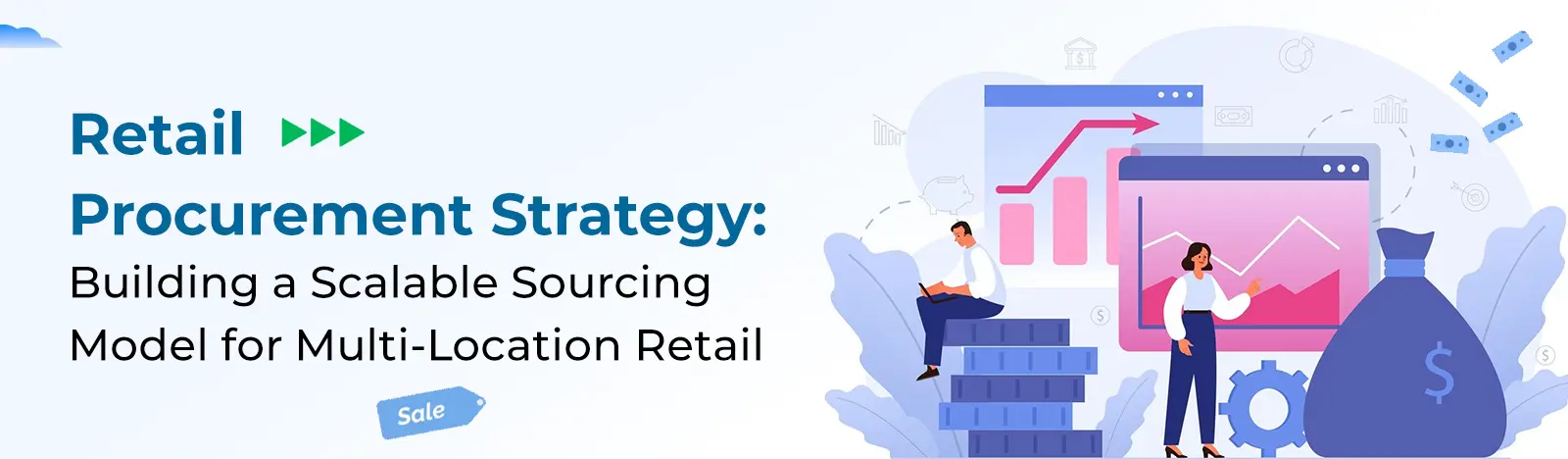
Retail procurement strategy is an operating-model decision before it is anything else. Centralize, decentralize, or run something in between. Most chains settle on a center-led arrangement, with contracts negotiated centrally and stores executing inside guardrails. A real strategy then rests on a handful of concrete pillars rather than an instruction to buy smarter. And the software should support those pillars. If you find yourself reshaping the strategy to fit a platform, something has gone backwards.
What is a retail procurement strategy?
What does a retail procurement strategy actually cover?
It is the operating model a retailer uses to structure buying across stores and headquarters. Who holds purchasing authority. Which suppliers everyone is allowed to use. What approval controls apply above a given amount, and how vendor performance gets tracked chain-wide. None of that is the day-to-day business of raising an order.
The distinction between strategy and process gets collapsed constantly, and it costs clarity.
Process is what happens when a store needs something. A request, then an approval, then an order that eventually arrives. Strategy is the set of decisions that determine what that process looks like in the first place, and who is allowed to deviate from it. A chain can have an immaculate process and no strategy at all, which usually shows up as forty stores each running that immaculate process against a different supplier list.
A second reason the distinction matters. Process problems get noticed, because somebody waits for an approval or an order arrives late. Strategy problems do not announce themselves at all. Nobody escalates the fact that four regions negotiated separately with the same supplier.
This guide assumes you already know the process side. What follows is the layer above it.
Centralized, decentralized, or hybrid
Should each store buy independently, or should headquarters run it?
Most land somewhere between. Headquarters negotiates the contracts and writes the policy. Stores buy locally inside that, from pre-approved suppliers and under set spend limits. Centralize fully and you gain leverage while slowing every store down. Decentralize fully and you keep the speed but hand back your volume discounts.
Three models, and the trade-off is the same one every time: leverage against speed.
Model
What it gets you
What it costs you
Fully centralized
Maximum volume leverage, one price, one supplier list
A store waiting three days for something it needs today
Fully decentralized
Local speed and managers who can solve problems
Nine suppliers for one category and no negotiating position
Center-led hybrid
Contracts and policy central, execution local
Guardrails that need maintaining, and a policy people can ignore
Table 1. The same trade-off, resolved three ways.
Full centralization looks attractive on a spreadsheet and struggles in a store. A district manager in Columbus with a broken freezer does not want to raise a request and wait. Push too hard and you do not get compliance, you get a corporate card and a receipt filed later.
Full decentralization is the opposite failure. Every store gets what it needs quickly, and the chain buys the same category from nine suppliers at nine prices, none of which reflect the volume the chain actually commands.
Worth saying that the right answer shifts with category. Uniforms and packaging suit central negotiation cleanly, since the specification barely changes between locations. Perishables and emergency maintenance do not, because the requirement is local and the clock is running. Chains that fail at this usually applied one model to everything.
So the center-led version wins on merit, not on compromise. Headquarters negotiates the contracts and defines who can spend what. Stores buy inside that, quickly, without asking permission for routine things. The work sits in defining the guardrails well enough that local speed survives.
Five pillars of a scalable retail procurement strategy
What holds a retail procurement strategy up?
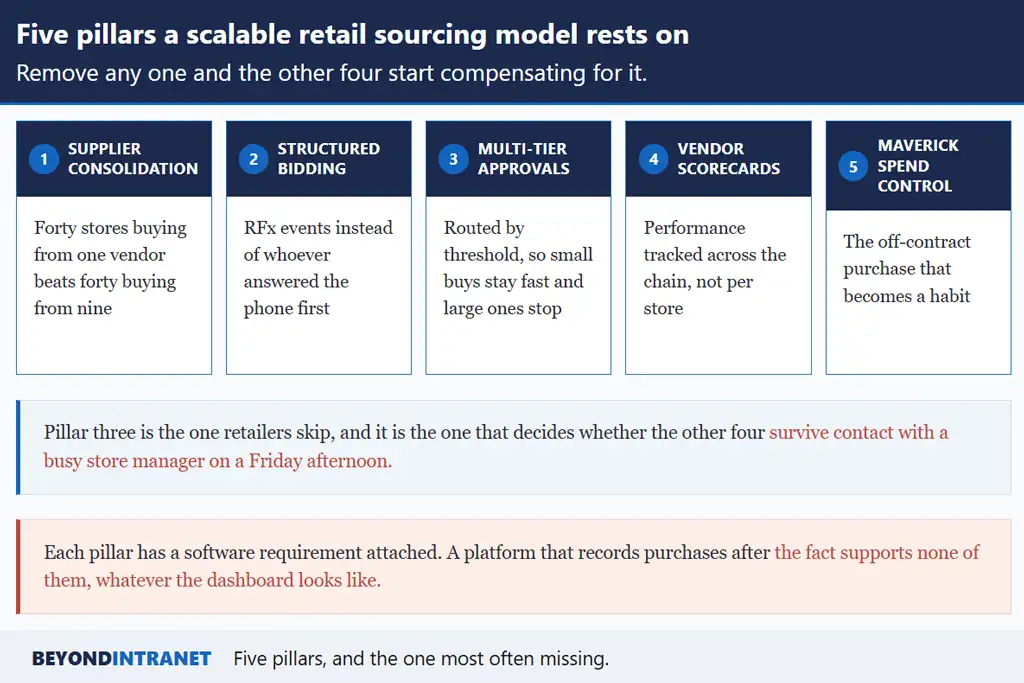
Five things. Consolidating suppliers so the chain’s volume actually buys you something. Running structured competitive events instead of collecting ad hoc quotes. Approval governance that routes by spend level. Vendor performance tracked continuously. Plus a real grip on off-contract buying at store level.
Remove any one and the other four start compensating for it.
Supplier consolidation
Forty stores buying from one vendor beats forty buying from nine. Simple as that, and stronger than it sounds because the leverage compounds. A supplier holding your entire chain’s volume has something to lose in a renegotiation. One holding four stores does not.
Consolidation does not mean one supplier per category nationally. Regional splits often make more sense in retail, where delivery economics vary and a vendor strong in the Southeast is unremarkable in the Pacific Northwest. What matters is that the count is deliberate. Some of the worst fragmentation hides in getting tail spend under control, where individual purchases are too small to notice.
One consolidation trap. Chains count suppliers per category and stop, when the number that matters is per category per region. Three national vendors can still mean nine relationships if every region negotiated separately.
Structured competitive bidding
Ad hoc quoting is the default because it is fast. Somebody calls two vendors, takes the better number, moves on. Also how a chain ends up paying above market for years without anyone noticing, since nothing was ever compared properly. Structured RFx events fix that, and reverse auctions as a cost-saving format retail teams already use suit the high-volume, well-specified categories retail buys constantly.
Multi-tier approval governance
This is the pillar retailers skip, and it is the one that decides whether the other four survive contact with a busy store manager on a Friday.
Routing by spend threshold is what makes speed and control coexist. Under a few hundred dollars, a store manager proceeds. Above it, a district approver. Above that, procurement. Nobody waits for approval they did not need, and nothing significant moves without one.
A practical note on thresholds. Set them from real purchase history rather than instinct. Pull last quarter’s transactions, find where the bulk of store-level buying sits, and put the first threshold above it. Guardrails that catch most routine purchases are not guardrails; they are a queue.
Vendor performance tracking
Scorecards only work chain-wide. A supplier who is excellent in Dallas and unreliable in Memphis looks acceptable when each store judges them separately, and the pattern only appears when the record is pooled. Track on-time delivery and fill rates. Log the quality problems. Note how quickly they answer the phone. All of it as things happen rather than recalled at renewal, which is the same argument behind what to look for in a vendor management system.
Retail adds a wrinkle. Scorecard data arrives per location, so the chain-wide view depends on stores logging consistently, and nobody has any incentive to file paperwork about a delivery that eventually turned up. Keep it to a few fields, or the scorecard measures diligence instead of suppliers.
Maverick spend control
Off-contract buying at store level is rarely rebellion. Usually somebody needed something and could not find a faster route than a card. Every instance chips away at the volume you negotiated with, and the erosion is invisible because each purchase looks fine on its own.
Putting these pillars into practice starts with a system that can run them
Structured approvals and supplier consolidation need a platform that does more than record purchases after the fact.
What to look for in retail industry procurement solutions
Which capabilities matter most in a retail procurement platform?
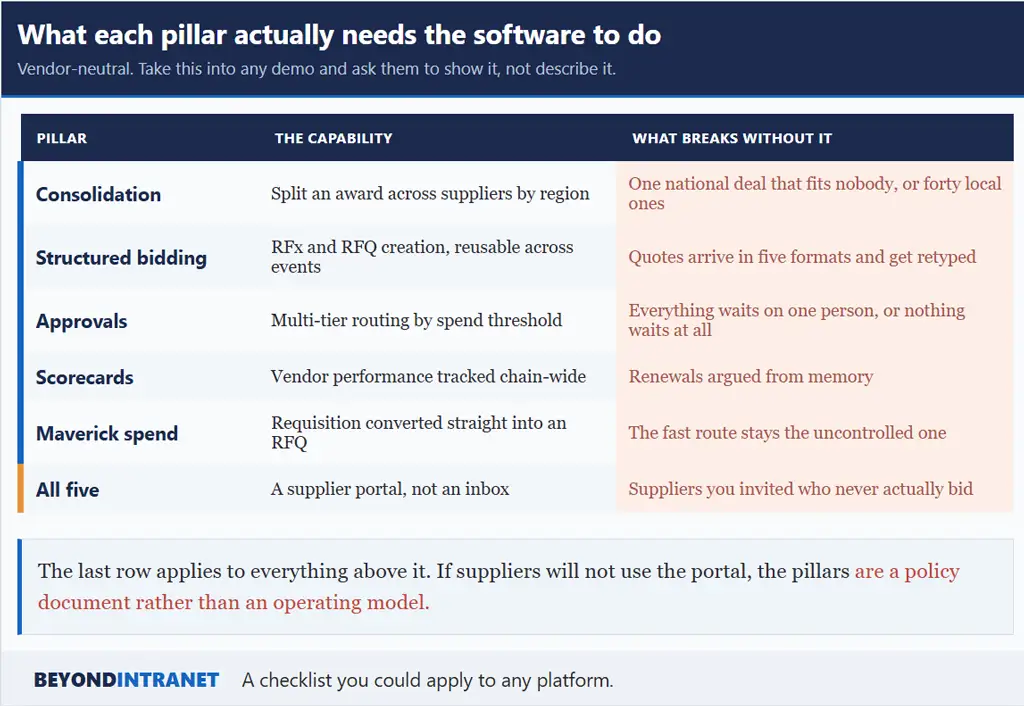
It has to build structured RFx and RFQ events. Approvals need to route by spend level rather than sitting with one person. Suppliers need a real portal, not an inbox. You should be able to split an award between vendors. Then a store requisition should convert into a competitive event without anyone retyping it.
Each pillar has a software requirement attached. Map them directly and the shortlist gets considerably shorter, usually because two or three platforms turn out to be built for recording purchases rather than running competitions.
Take this into any demo and ask them to show it, not describe it.
Capability
Why retail specifically needs it
How to test it in a demo
Structured RFx and RFQ creation
Categories repeat monthly across every location
Ask them to build one, then clone it for next quarter
Multi-tier approval routing
A single threshold cannot serve a flagship and a kiosk
Set three thresholds and watch a request route
Supplier self-service portal
Regional vendors will not learn a complicated system
Register as a supplier yourself and submit
Split awards across suppliers
Delivery economics differ by region
Award one event to two vendors by territory
Requisition to RFQ conversion
A store request should become a competitive event
Raise a requisition and follow where it goes
Table 2. Five capabilities, and how to verify each one rather than accept it.
One capability deserves separate mention because retail exposes it harder than most industries. Splitting an award across suppliers is not an edge case when your locations span time zones and delivery lanes. That is the normal outcome of a sensible event. A platform that forces a single winner per event will push you toward one national deal that fits nobody particularly well. The general shape of this decision sits in comparing procurement software options.
Running structured RFx consistently across locations is easier with a dedicated platform
Competitive bidding, split awards and requisition conversion in one place, inside Microsoft 365.
Common pitfalls when scaling procurement across locations
Where does scaling procurement across locations usually go wrong?
Central policy lands without any store buy-in. The software chosen turns out to have no structured bidding in it. Supplier scorecards get filled in once a year instead of maintained. Then a one-off exception granted to a single store quietly becomes how everybody buys.
Four failures, and all four are execution rather than strategy. The thinking was usually fine. What happened in the six months afterward was not, and none of it showed up in a report until it was habit.
Policy without buy-in is the most common. A central team designs sensible guardrails, sends them out, and discovers six months later that stores treat them as advisory. The fix is not enforcement. Involve two or three store managers in setting the thresholds, because people follow rules they helped write.
Choosing spend-management tooling with no bidding capability is the expensive one. Software that categorizes and reports on spend after it happens will show you the problem in high resolution and give you nothing to do about it. Competitive events are the lever, which is worth reading alongside the basics of strategic procurement.
One version of this looks like success. Compliance reports come back high, because stores stopped raising requests rather than started following process. The purchases still happen. They just stopped appearing where anyone measures.
Annual scorecards are barely scorecards. A record assembled from memory in the week before a renewal tells you what people remember. Not what happened. And exceptions become default quietly: one store gets permission to use a non-contracted vendor for a genuine reason, three others hear about it, and within two quarters the exception is how everyone buys.
Fewer than you have, almost certainly, and more than one in most cases. Enough that each relationship carries real volume, and enough redundancy that a single supplier problem does not close a region. Two or three per category is a common landing point.
Not if the guardrails are set well. Stores keep autonomy over what they buy and when. What changes is the supplier list they buy from and the threshold above which somebody else approves. Most managers find that easier, not harder.
Make the compliant route the fast one. Policy loses to convenience every time, so if buying from the contracted supplier through the approved system takes longer than a phone call, expect the phone call. Involve managers in setting thresholds too.
Purchasing is the transaction. Procurement is everything around it. Finding suppliers and negotiating with them, then managing how they perform and how buying happens across the chain. Purchasing is a task inside procurement rather than a synonym for it.
With the category every store buys most often. Consolidate suppliers there first, run one structured event, and set a single spend threshold. One category done properly is more persuasive internally than a policy document covering all of them.
Where to start
Pull last quarter’s purchases for one high-frequency category and list every supplier used across your locations. The number is usually higher than anyone expects, and it is your business case.
Pick one spend threshold and test it against real purchase history. If most store buys fall under it, your guardrails will not slow anybody down.
Bring two store managers into the room before writing any policy. They will tell you which controls are workable and which will be routed around by March.
Structure is what lets a chain scale without losing control
Retailers who treat procurement as a series of purchases end up with forty versions of the same decision. Those who treat it as an operating model get one decision, applied consistently, with local speed preserved where it matters. The difference is not effort or headcount. It is whether somebody has decided who buys, from whom, and inside what limits.
Have questions about structuring procurement across multiple store locations?
We will walk through operating models, approval thresholds and structured bidding against your own store footprint.