A practical, vendor-neutral guide for CIOs, IT directors, and digital workplace leaders evaluating SharePoint consulting partners in Australia — including a comparison...
Quick answer: A SharePoint AI Readiness Assessment is a structured evaluation of a Microsoft 365 tenant’s governance, information architecture, content...
Most hiring budgets stop tracking the moment an offer is signed.
Recruiting spend gets scrutinized carefully. Job board fees, agency costs and recruiter time all sit somewhere in a spreadsheet. Then the candidate accepts, the requisition closes, and the next eight to twelve weeks of expense simply disappear into general overhead. Equipment gets bought. HR spends hours on paperwork. A manager loses a chunk of every week. None of it carries a label.
What follows separates onboarding cost from cost per hire, walks through the five buckets that make up the figure, and gives you a formula you can put in a spreadsheet this afternoon.
Key takeaways
Cost of onboarding and cost per hire are sequential figures, not interchangeable ones. The first covers everything before an offer is accepted. The second covers everything after it, through to full productivity. Five buckets make up the onboarding number, and the two largest never appear on an invoice. No reliable published benchmark exists for onboarding specifically, which is exactly why the formula below matters more than any figure you could borrow.
What’s actually included in the cost of onboarding?
What is the difference between cost of onboarding and cost per hire?
Cost per hire covers recruiting spend up to an accepted offer. Job advertising and recruiter time. Interviews and screening. Cost of onboarding begins after that point and runs until the new hire reaches full productivity. The two are sequential stages of one process, and adding them together produces the total cost of getting somebody working.
Scope is where most calculations go wrong.
Onboarding cost starts the day an offer is accepted and ends when the person is producing at the level the role expects. Everything in between belongs in the figure. Paperwork and compliance handling. Equipment and software. Training. The hours spent by HR, by IT and by the hiring manager. And the productivity gap while somebody learns the job.
That last item is the one that separates a serious calculation from a rough one. A new hire draws full salary from day one and produces full output considerably later, and the difference is a real cost that appears nowhere in any budget line.
Cost per hire
Cost of onboarding
When it starts
Job posted
Offer accepted
When it ends
Offer accepted
Full productivity reached
Main components
Advertising, agency fees, recruiter and interviewer time
Paperwork, equipment, training, internal hours, ramp gap
Where it shows up
Recruiting budget, usually tracked
General overhead, usually untracked
Who owns it
Talent acquisition
Nobody, in most organizations
Table 1. Two sequential figures. Most published numbers merge them, which is why they vary so widely.
What the benchmarks say, and why they mislead
What is the average cost of onboarding a new employee?
No dependable published benchmark exists for onboarding on its own. Widely circulated figures around four thousand dollars trace back to older cost-per-hire research, not to onboarding studies. Cost-per-hire benchmarks are real and useful. Applying them to onboarding is a category error.
This deserves stating plainly, because the misattribution is widespread.
The Society for Human Resource Management has published cost-per-hire benchmarking for years. An earlier cycle of its Human Capital Benchmarking Report put the average cost per hire at $4,129, and more recent benchmarking cycles have reported higher figures as recruiting costs rose. Every one of those numbers measures recruitment. None of them measures onboarding.
Somewhere in the repetition between blogs, a figure close to that older cost-per-hire number began appearing as an onboarding benchmark. It is not one. Anyone budgeting against it is using recruitment data to forecast a different stage of the process.
What SHRM’s current work does establish is that hiring costs vary enormously by role and seniority. Its recruiting benchmarking research reports executive hires costing multiples of nonexecutive ones, and finds that most organizations continue to struggle filling open positions. Averages hide that spread, which is the second reason to calculate your own number.
So treat published figures as context and nothing more. Your onboarding cost depends on your salaries, your equipment standards, your ramp period and how much manual work your process still involves. Those five variables move the answer by a factor of several.
The hidden costs most companies forget to count
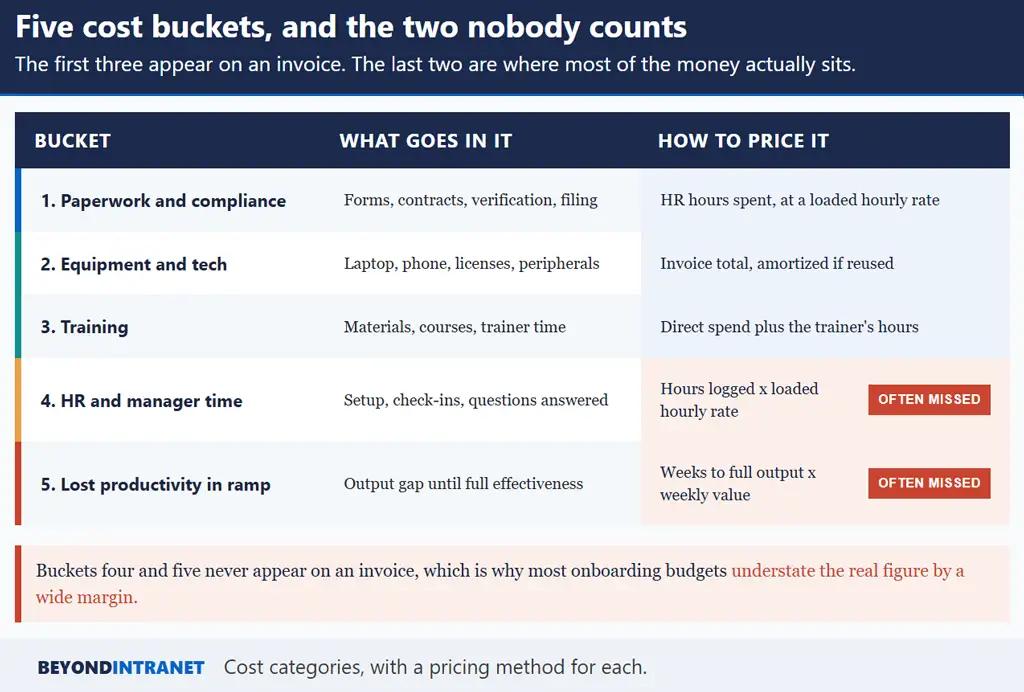
Five buckets make up the total. The first three are visible because somebody invoices for them. The last two are where most of the money sits.
The first three appear on an invoice. The last two are where most of the money sits.
HR, manager and IT time
Every hour spent setting up an account, walking somebody through a policy, answering the same first-week question or chasing a signed form is a real cost carried at somebody’s loaded hourly rate. It feels free because those people are salaried, and it is not free at all. That is capacity spent on this hire instead of something else.
Price it the same way you would price any labor. Log the hours honestly, apply a loaded rate including benefits and overhead, and the number stops being invisible.
The productivity ramp
Somebody new is paid in full and producing partially, and the gap between those two states is the largest single line in most onboarding calculations. Ramp length varies enormously with role complexity. A support role may reach full output in weeks. A technical or client-facing role can take considerably longer.
Estimate it. Do not try to measure it precisely. If somebody takes roughly two months to reach full effectiveness and averages half output across that period, you have lost about a month of their contribution while paying for two. That figure belongs in the model.
One practical caution on estimating it. Ask the hiring manager, not HR. Managers observe output directly and give sharper answers, while HR tends to estimate from the calendar and assume the ramp ended when formal training did.
Team disruption
Colleagues absorb the questions a new hire has to ask. Individually those interruptions are trivial. Across a team over several weeks the cumulative loss is real, and it lands on the people already carrying the workload the new hire was meant to relieve.
Neither cost is recoverable, which is worth noting when weighing process improvements. Hours already spent stay spent, so the return on fixing onboarding comes entirely from future hires.
Repeating the whole thing after early attrition
The most expensive scenario is the one where onboarding fails and the person leaves inside six months. Every cost above gets incurred twice, plus the recruiting spend, plus the vacancy period in between. Weak onboarding is the mechanism, which makes it the highest return item on this list to fix.
How to calculate your company’s onboarding spend
How do you calculate the cost of onboarding a new employee?
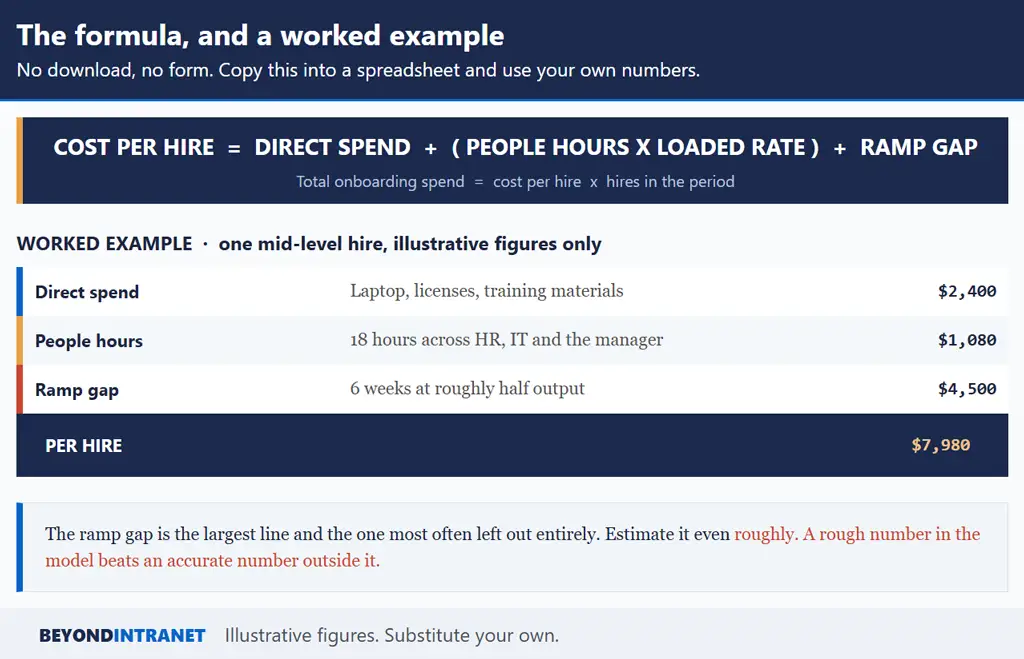
Add three things. Direct spend on equipment and software, plus training materials. Internal hours from HR, from IT and from the manager, multiplied by a loaded hourly rate. Then the productivity gap, estimated as weeks to full output multiplied by the weekly value of the role. Multiply the total by your hiring volume.
Four steps, and none of them requires a downloadable calculator.
No download and no form. Copy this into a spreadsheet and use your own numbers.
Do it once for a single recent hire before attempting an average. A specific example produces defensible numbers, and the average across roles becomes meaningful only after you have two or three worked properly.
Step 1. Total the direct spend
Laptop and phone. Peripherals and software licenses. Training materials, plus any external course fees. Use the invoice amounts. Where equipment gets reused, divide the purchase price across its expected life instead of charging the whole thing to one hire.
Step 2. Tally the internal hours
Ask HR, then IT, then the hiring manager to estimate hours spent on a single recent hire. Include the setup work before day one, which people consistently forget. Multiply by a loaded hourly rate covering salary and benefits, plus overhead. Fully loaded cost typically runs well above base salary, so using base salary alone understates the figure.
Step 3. Estimate the productivity gap
Decide how many weeks a role takes to reach full output and roughly what proportion of normal output the person delivers during that period. Multiply the shortfall by the weekly value of the role. A rough estimate belongs in the model. An accurate number that stays outside it helps nobody.
Step 4. Sum and scale
Add the three figures for a per-hire cost, then multiply by hires per year. That annual number is what makes the case for process improvement, because a saving of a few hundred dollars per hire looks trivial until it is multiplied by forty.
Why the number looks different for small teams
Why is onboarding more expensive per hire for a small business?
Because the fixed work gets repeated. Larger organizations design training once and reuse it across hundreds of hires. Smaller teams rebuild much of it manually each time, without dedicated onboarding staff or software. The effort per hire stays high because nothing amortizes.
Two forces pull the small-business figure in opposite directions.
Direct spend is usually lower. Fewer software licenses, simpler equipment standards, less formal training infrastructure. On the invoice side, a small company genuinely spends less per hire.
Internal time is usually higher, and it dominates the total. A founder or office manager handling onboarding personally is spending expensive hours on work that a larger organization has systematized. Those hours rarely get logged, which is why small teams underestimate their onboarding cost more severely than anybody else.
The comparison that matters is the ratio, not the total. A small business spending less in dollars and more in founder hours is frequently paying more in economic terms, because those hours have the highest opportunity cost in the organization.
There is also a concentration effect. When a company of twenty adds one person, that hire represents five percent of headcount. A poor onboarding experience affects a meaningfully larger share of the organization, and an early departure hurts proportionally more.
Practical ways to reduce onboarding costs
How can companies reduce onboarding costs without cutting quality?
Target the time costs and leave the experience alone. Standardize with reusable checklists and templates. Move paperwork to digital collection with electronic signatures. Automate reminders and welcome messages. Shorten the ramp with a structured plan for the first three months.
Every item on that list attacks buckets four and five, which is where the money is.
Standardize what you repeat
Rebuilding the same onboarding sequence for every hire is the single largest source of avoidable internal hours. A structured onboarding checklist turns a remembered process into a documented one, and the second version takes a fraction of the time the first did.
Templates are the compounding version of the same idea. Written once and reused, they convert a recurring design task into a retrieval task, and the saving grows with every hire rather than staying flat.
Digitize the paperwork
Forms printed and signed, then scanned and filed, consume HR hours at every step and produce errors that consume more. Going paperless with onboarding documents removes most of that handling, and electronic signature collection removes the chasing that surrounds it.
Automate the reminders
Much of what HR does during onboarding is prompting other people. Automated welcome email templates and scheduled reminders handle that without anybody watching a calendar.
One caution on automation. Removing a manual step only saves time if the step was genuinely being done. Automating a reminder nobody was sending changes nothing, so audit what actually happens before deciding what to replace.
Shorten the ramp deliberately
The productivity gap responds to structure more than to effort. A 30-60-90 day onboarding plan gives a new hire explicit milestones instead of leaving them to work out what good looks like, and reaching full output two weeks sooner is worth more than most of the direct spend combined.
Most of the line items above are exactly what onboarding software is built to automate
Checklists, reminders and document collection are where the biggest time savings usually come from.
How onboarding software reduces the time and people costs
Software does not reduce equipment spend or make training free. What it addresses is the paperwork bucket and the internal hours bucket, which is where the avoidable cost concentrates.
Checklists and task management assign onboarding steps to the right person automatically, so nobody spends time working out who does what. Automated welcome emails and reminders remove the prompting work. A candidate portal lets a new hire complete forms before day one instead of during it. Centralized document management keeps everything in one place. Microsoft Entra ID integration, previously named Azure Active Directory, creates the user account automatically, which removes a step that otherwise waits on somebody in IT. Those capabilities sit inside Beyond Intranet’s employee onboarding software alongside a template hub for reusable materials.
The account-creation point deserves emphasis because it sits on the critical path. A new joiner without system access cannot start work, so a step that waits in an IT queue converts directly into ramp days lost, which is the most expensive bucket on the list.
Worth being clear about what this does not do. It will not calculate your onboarding cost for you, and it does not forecast savings. The formula earlier in this article is how you arrive at your number. What software changes is the input, by reducing the hours the calculation is counting.
The measurement question stays yours either way. Reporting and dashboards show where tasks stall and which steps take longest, and pairing that with building a repeatable onboarding process is how the hours actually come down instead of moving somewhere else.
If your team is still tracking onboarding tasks across spreadsheets and email threads
A short walkthrough is the fastest way to see which steps automation would take off your plate.
No, though plenty of published figures merge them. Cost per hire measures recruitment up to an accepted offer. Onboarding cost measures everything after it. Adding the two gives you the full cost of getting somebody productive, which is the figure most useful for budgeting.
Until the person reaches full productivity in the role. That varies from a few weeks to several months depending on complexity. Pick a defensible cutoff, apply it consistently across roles, and the comparison between hires stays meaningful even if the estimate is imperfect.
The productivity ramp, in most calculations. Paying full salary for partial output over several weeks usually exceeds equipment and training combined, with paperwork on top. It is also the line also gets omitted most often, which is why so many onboarding budgets look implausibly small.
That depends entirely on your hiring volume and how many internal hours your current process consumes. Run the formula above with your own numbers, estimate the hours automation would remove, and compare. Any vendor answering that question for you is guessing at your inputs.
Where to start
Ask three people involved in your last hire to estimate the hours they spent. The total is usually higher than anyone expects, and it is the fastest way to make the internal cost visible.
Pick one ramp estimate and apply it to every role for now. Consistency matters more than precision when the goal is comparing hires against each other.
Multiply your per-hire figure by last year’s hiring volume before deciding anything. Process improvements that look marginal per hire rarely look marginal per year.
The cost of onboarding badly is the larger number
Onboarding has a cost whether or not anybody measures it. The organizations that measure it tend to find the figure sits mostly in hours and lost output rather than in equipment, which changes what they do about it. And the comparison worth holding in mind is not onboarding cost against zero. It is the cost of onboarding well against the cost of doing it badly and paying for the whole thing again six months later.