A practical, vendor-neutral guide for CIOs, IT directors, and digital workplace leaders evaluating SharePoint consulting partners in Australia — including a comparison...
Our VP of People said something last quarter that stuck with me. She was looking at ramp-up data for 14 recent hires and noticed a pattern: the ones who received a written 30-60-90 day onboarding plan with clear milestones were productive two full weeks before the ones who got the usual first-day orientation and a “let me know if you need anything” from their manager.
Two weeks might not sound dramatic. But multiply that by a team of 10 and you’ve recovered nearly five months of collective productivity. SHRM reports that a third of new hires leave within 90 days. Gallup says only 12% think their employer handles the ramp-up well. And according to Brandon Hall Group, when organizations actually put structure around the first three months, retention improves by 82%.
M365 teams will find a section near the end on getting the logistics out of a spreadsheet and into SharePoint.
What Is a 30-60-90 Day Onboarding Plan?
So what is a 30 60 90 day plan? It spells out what the first three months should look like before the new person shows up.
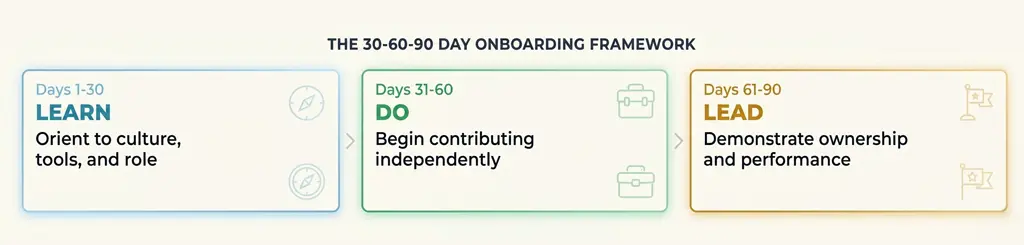
The first 30 days are about absorbing. How does this place actually work? Who makes decisions? What actually matters to this team that wasn’t in the posting? Days 31 through 60 flip the dynamic. Real projects. Real meetings where your opinion is expected, not just your attendance. Feedback that has some teeth to it. Days 61 through 90 are the proving ground. Can this person drive work without someone checking on them every afternoon? The table below works as a 30 60 90 day plan template your team can adapt by role.
We revise ours after every cohort. The version we used in January had gaps we didn’t see until March, when two new engineers told us the codebase walkthrough was scheduled too early. So we pushed it to Week 2. That single adjustment cut early confusion in half.
The Structure That Actually Survives Month One
At the 30-day mark, the manager pulls up the plan, scans the metrics, and immediately knows where the conversation needs to go. No interpretation. No debate about whether someone is “settling in.”
PHASE
GOAL
KEY TASKS
MILESTONES
SUCCESS METRIC
Days 1-30: Absorb
Get the new person grounded in how things work here
Finish the onboarding checklist, meet the team, sit in on key meetings, get every system login sorted
All access provisioned by Day 5; first real conversation with manager by Day 10
30-day check-in completed
Days 31-60: Contribute
Shift from watching to producing
Take on a real project, speak up in meetings, work across teams, act on feedback received
First piece of work submitted and reviewed; Day 60 conversation completed
Feedback session logged
Days 61-90: Lead
Show ownership and perform at the level the role requires
Drive a project start-to-finish, propose at least one improvement, set quarterly goals with manager
Performance conversation scheduled; first quarterly objectives locked in
90-day goals self-assessed
That rightmost column is the whole point. Every metric there has a yes-or-no answer. The manager doesn’t interpret anything. “Getting settled” is not measurable. “Check-in completed” is. That binary quality is what keeps people using the plan instead of abandoning it.
That consistency pays off down the road. When your CHRO asks why one department onboards faster than another, you’ll point to data instead of shrugging.
Building the Plan From Scratch
I’ve watched a lot of HR teams try to build these. The pattern is almost always the same: someone opens a blank doc and starts listing everything the new person needs to learn. That approach produces a training calendar. Not an onboarding plan. Here’s how to create a 30 60 90 day plan that doesn’t collapse after the first Monday.
Step 1: Start With the Finish Line
Before the new person’s first morning, sit down with whoever hired them. Thirty minutes. One question: “When this person is absolutely nailing it at the three-month mark, what does that look like?”
Step 2: Make Every Goal Pass the Yes-or-No Test
“Understand the product” showed up as a goal in the last plan I reviewed. Sounds reasonable until you sit down at the 30-day mark and realize the manager and the new hire have completely different definitions of “understand.” Rewrite it: “Complete the product certification module. Score 80% or higher by Day 25.” Now there’s nothing to argue about.
Step 3: Name an Owner for Every Single Task
The manager takes care of role-specific ramp. Project assignments. Introductions that go deeper than “team, meet Sarah.” Performance expectations get set early so nobody is blindsided at the Day 60 review. The buddy? Their job is the invisible stuff. The person who actually approves expenses quickly. The channels that matter versus the ones that are pure noise. The lunch spots. And the new person? They own their own momentum. Raise problems early. Don’t wait for someone to notice.
Step 4: Put the Check-Ins on the Calendar Now
Day 30 conversation: “Are you oriented? Do you have what you need? Anything bugging you that we should fix now?” Day 60 conversation: “Are you contributing? Where do you want coaching?” Day 90 conversation: “Can you do this job at the level we need? What does next quarter look like?”
Put these on the calendar. Mark them as recurring. Because the teams that skip the Day 30 conversation? They’re always the ones shocked when the person quits at month four. The warning signs were there at Week 3. Nobody checked.
Step 5: Get the Plan Out of a Document and Into a System
Here’s what kills plans in practice. Not bad goals. Not missing steps. Coordination. You’ve got 40 tasks, three phases, four people responsible. If those assignments sit in a pinned doc that nobody revisits after orientation week, the plan evaporates. Onboarding software fixes the logistics: right task, right person, right time. Day 1 assignments fire on the start date. Day 31 tasks appear when Phase 1 wraps. Manager sees a dashboard. HR sees the same view company-wide.
Three Roles, Three Very Different 90-Day
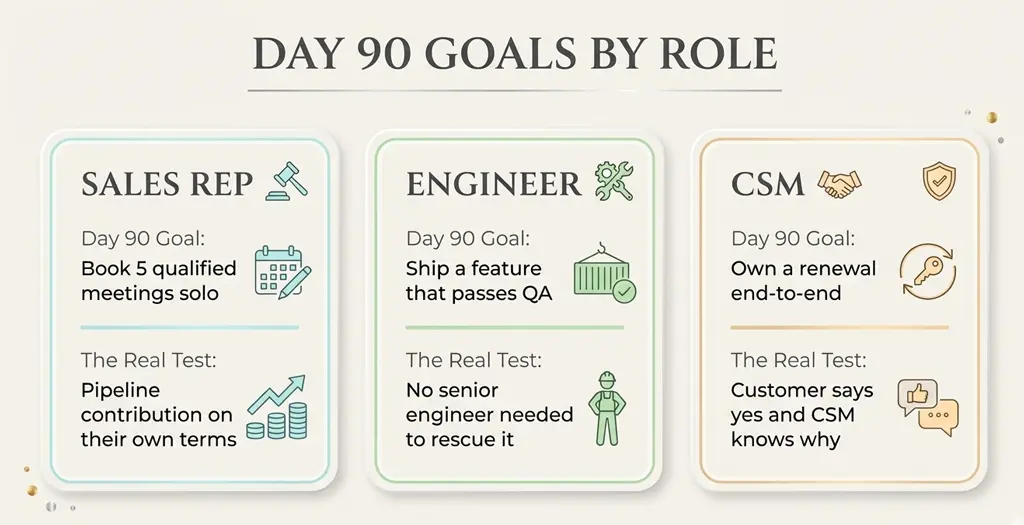
Same three-phase arc. Completely different content depending on who you hired. Here are three new employee 30 60 90 day onboarding plan examples we’ve actually used:
Sales Development Rep
For a sales development rep, the first month is training and shadowing. Product certification. Sitting in on five discovery calls. Passing the lead qualification assessment. Month two, the phone starts ringing. Fifty outbound calls, three meetings booked with the team lead coaching in real time. Month three is sink-or-swim. Five qualified meetings without anyone holding their hand. A territory plan presented to the sales manager. The question at Day 90: did this rep book a meeting that actually turned into pipeline?
Software Engineer
Software engineers need a different rhythm. Month one is environment setup, codebase walkthrough, and shipping a first pull request. Could be a bug fix. Could be a docs update. Point is getting code through the review process and surviving the feedback loop. Month two means owning a feature from spec to production and presenting the work at sprint demo. Month three, they’re leading a feature end-to-end and pairing with someone more junior. The Day 90 question: did they ship something to production that worked without a senior engineer jumping in to save it?
Customer Success Manager
Customer success managers have a slower ramp because the relationships take time. Month one: product certification, shadowing three customer calls, reading through the renewal playbook until it makes sense. Month two: running the first customer health review with the manager sitting in. Completing a retention case study from the existing book. Month three: owning a renewal end-to-end and proposing one change to the CS playbook based on what they’ve noticed in 90 days. Day 90 question: did the customer renew, and can the CSM explain exactly why?
Running plans like these across multiple roles and departments is where spreadsheets fall apart.
Beyond Intranet’s Employee Onboarding Software automates the phase-by-phase task delivery so each role gets the right plan without HR rebuilding it from scratch.
The Hidden Risk: Why New Hires Disengage After Day 90
There’s a conversation that almost never happens during the planning phase. What comes after Day 90? In most companies: nothing. Check-ins quietly stop. The buddy moves on. The person who had weekly touchpoints for three months wakes up on Day 91 with an empty calendar.
And it’s completely predictable. Most companies treat Day 90 as the finish line. It’s not. It’s the highest-risk moment. The person knows the job mechanics. But they haven’t built the network, the instincts, or the political awareness that only comes from real tenure. Take away the structure at exactly that moment and disengagement follows within weeks.
SHRM data shows that 40% of first-year departures happen within the first 90 days. The risk peaks right at the transition point. For a deeper look at why, read our post on the 90-day onboarding cliff. Don’t end the programme cold. Shift the person into a quarterly rhythm. A mentor helps. So does a recurring calendar hold, even if it’s just 15 minutes biweekly. The goal is making sure the person doesn’t wake up one Monday with zero scheduled support after three months of structured attention.
Is the Plan Actually Doing Anything?
Your plan is running. New hires are moving through the phases. But is any of this producing results, or is it just organized busywork? We look at five things.
First: how many weeks until a new hire is performing at the level the role requires? Track that across cohorts. If the number isn’t dropping quarter over quarter, the plan needs surgery.
Second: how many people are still here at Day 90? If you’re losing more than 15% before the three-month mark, something in the plan is broken. Don’t guess what. Audit it.
Three: pulse the new person directly. An eNPS survey at the 30, 60, and 90 day marks tells you what they’re experiencing in real time. If the score is strong at 30 and tanks at 60, the jump from learning to producing is too steep. You can adjust mid-cycle instead of reading about it in an exit interview.
Fourth: what does the manager think? A simple 1-to-5 rating at each checkpoint. When engineering managers consistently rate their new hires higher than sales managers do, the plan isn’t the issue. The implementation in that one department is.
And finally, completion. Are the assigned tasks actually getting done? When fewer than 70% of first-phase tasks are finished, the tracking method is usually the problem. We switched from a spreadsheet to automated task delivery and completion rates jumped from 58% to 91% in one quarter.
How Beyond Intranet’s Employee Onboarding Software Automates the 30-60-90 Plan
Writing the plan? Writing the plan takes an afternoon. Keeping it running across 10 people in three departments without balls getting dropped? That’s the hard part. And that’s what employee onboarding software solves.
Beyond Intranet’s onboarding software does the chasing for you. Each person sees their tasks based on the phase, the role, and their specific responsibilities. Nothing falls through because nobody has to remember to send a reminder.
It sits inside SharePoint and M365. Same login everyone already uses. Everyone involved sees their tasks inside the tools they already use every day. No new platform to learn. No adoption problem to solve.
A written plan covering the new person's first three months on the job. The first phase is about absorbing the environment: team, tools, how decisions actually get made around here. The second phase is producing: real projects, real deadlines, real accountability.
Tie your answer to the specific company. Talk about what you'd spend the first few weeks learning about their product and customers. Then pivot to what you'd take ownership of once you had enough context. Close with a tangible result you'd aim to deliver by the 90-day mark.
Start by defining what "fully ramped" looks like at the 90-day mark for this specific role. Then map backward from that picture to figure out what needs to happen at each stage. Section 3 of this article walks through the full process.
Manager should have a proper one-on-one by Day 10. Not Day 30. Waiting that long means you've already missed early warning signs. A simple task checklist prevents the small things from slipping: access requests, compliance modules, team introductions. Without that list, people spend their third week chasing a login that should have been ready on Day 1.
We wrote a separate piece on why this happens and what to do about it: the 90-day onboarding cliff
If there’s one thing your HR team can build this quarter that will move the needle on new hire retention and ramp speed, it’s a 30-60-90 day onboarding plan with specific goals, named owners, and check-ins that actually happen. See how Beyond Intranet’s Employee Onboarding Software turns that plan into an automated workflow inside SharePoint.
Automate Your 30-60-90 Day Onboarding Plan
Phase-based task delivery, manager dashboards, completion tracking. All inside SharePoint and Microsoft 365.