A practical, vendor-neutral guide for CIOs, IT directors, and digital workplace leaders evaluating SharePoint consulting partners in Australia — including a comparison...
A new analyst asked her manager where to find the expense policy. He sent her to the wiki. The wiki version was two years old. She filed the wrong form, finance bounced it, and her second week began with the conviction that she had already made a mistake.
No one handled that badly. HR ran the paperwork properly, the manager was welcoming, and the laptop arrived on time. What failed was the new employee onboarding process around all three, because no single practice covered the gap between what she needed and where it lived.
This guide covers the practices that hold that gap closed. It works as a companion to the stage-by-stage version rather than a replacement for it.
Key takeaways
The new employee onboarding process runs from pre-boarding through roughly the first 90 days, and it covers considerably more ground than a day-one orientation. Six practices carry most of the result. Get somebody productive before day one, give the buddy an actual agenda, and keep the structure running past the first month. The four mistakes below undo good intentions more often than bad process does. You will also find a short checklist snapshot here, with the full version linked.
What is the new employee onboarding process?
What does the onboarding process actually cover?
It is the structured set of activities that carries a new hire from pre-boarding paperwork through role training and check-ins, until they become a confident and productive team member. Most programs run that over roughly 90 days. Orientation sits inside it and covers only day-one logistics.
Those two words get used interchangeably in most organizations, and they describe genuinely different things.
Orientation is a single day. Onboarding is the months around it. If you want the deeper breakdown of how the two differ and what belongs in each stage, the full stage-by-stage playbook for scaling onboarding walks through that sequence properly. This piece takes a different angle. Rather than asking what happens when, it asks which practices decide whether any of it works.
Why a structured onboarding process matters
The case for structure rests on something more concrete than engagement language, and the most useful source on it predates most of the HR-tech marketing around the topic.
The SHRM Foundation published a research guide on onboarding by Talya Bauer of Portland State University, and its framing is still the most useful one available. Bauer’s point, quoted by SHRM, is that new hires get roughly 90 days to prove themselves in a new job. The faster they feel welcome and prepared, the faster they contribute. That window is shorter than most onboarding programs assume.
That same guide organizes onboarding around four things, known to HR practitioners as the four C’s. Compliance handles the legal and policy basics. With clarification, your new hire comes to understand the role and what good performance looks like inside it. Culture is where they pick up the unwritten norms, and connection gives them the relationships that make the other three usable.
Most programs handle compliance well and stop there. The paperwork gets done, the systems get provisioned, and no one ever explicitly explains what success looks like in the role or who to ask when something is unclear. That gap is where a competent hire starts to look uncertain, and it is entirely fixable. The cost of skipping structure lands in two places. A hire leaves early and you repeat the recruitment spend, or somebody stays and takes considerably longer to reach full output. Both outcomes trace back to the same missing thing.
Onboarding best practices that actually work
What are the best practices for onboarding new employees?
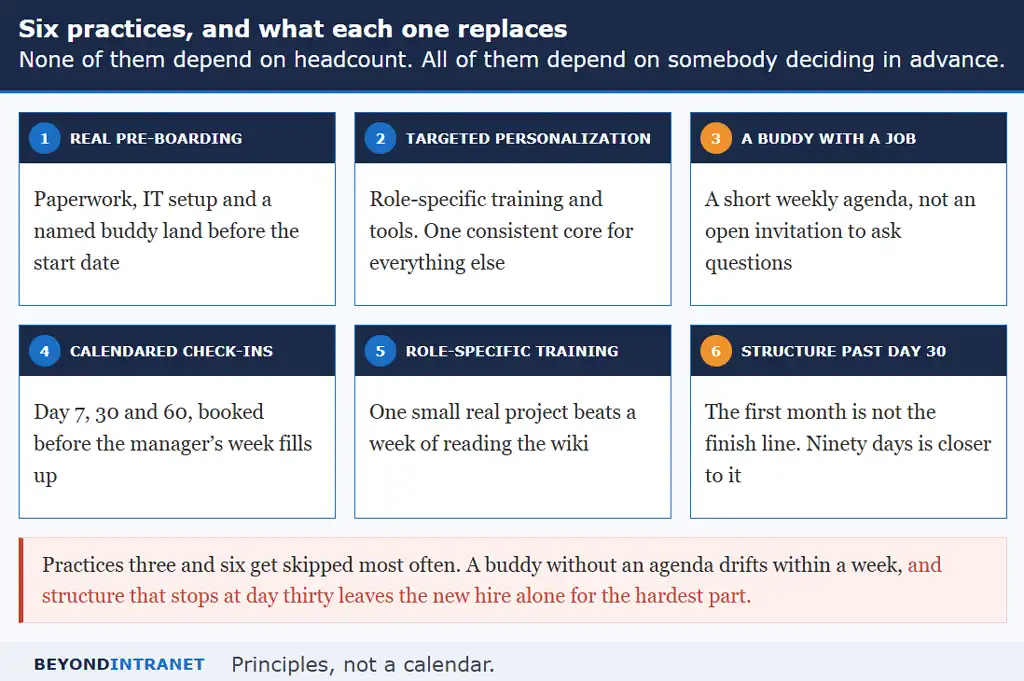
Six carry most of the result. Complete paperwork and IT setup before day one. Give the buddy real weekly responsibilities. Personalize role-specific training while keeping the core experience consistent. Hold manager check-ins on day 7, then day 30 and day 60. Extend the structure past the first month.
These apply whether you hire four people a year or forty. Headcount changes nothing here, and no budget line is required.
None of these depend on headcount. All of them depend on a decision made in advance.
1. Start before day one with real pre-boarding
The gap between an accepted offer and a start date is the cheapest time you will ever have. Use it. Get the paperwork completed, the laptop provisioned and the accounts created while the new hire is still working out their notice elsewhere.
Name the buddy in that window too, and tell both people who the other is. A buddy assigned on the morning of day one is a stranger with an obligation.
One practical marker for whether pre-boarding worked. Ask the new hire on day one whether they had anything left to fill in. A yes means the window went unused, and you have spent their first morning on admin you had two weeks to finish.
2. Personalize the experience without overengineering it
Role-based customization matters where it changes the work. An engineer and a customer success hire need different training tracks and different tools, so build those separately and keep them current.
Everything else should stay identical. Teams that customize too far end up maintaining nine variants of a process, none of which anybody trusts, and the maintenance burden quietly exceeds the benefit.
3. Assign a buddy with actual responsibilities
Telling a colleague to be available produces very little. Hand the buddy a short weekly agenda instead. In the first week they walk the new hire through the informal map of who actually does what, and the second week covers the tools and shortcuts that never get written down anywhere. By week three the conversation can be open-ended, aimed at whatever still feels confusing.
Keep the role distinct from the manager and from a mentor. The manager evaluates. A mentor advises on a career. The buddy answers the small questions your new hire feels awkward raising with either of them, which is exactly why the role has value.
Buddies also need a limit on the commitment. Three weeks of short conversations is something a colleague will genuinely do. An open-ended arrangement with no end date is something they will quietly stop doing around week five.
4. Make manager check-ins non-negotiable
Book day 7, day 30 and day 60 in the calendar before the new hire starts. Managers rarely skip these deliberately. Their week fills, the conversation feels less urgent than whatever is on fire, and by day 45 no one has asked how things are going.
Those conversations are where a struggling hire either gets help or quietly decides the role was a mistake. For prompts and structure around them, how to enhance new hire onboarding experiences has practical material.
Book them as recurring calendar items owned by the manager, because a reminder in an HR system that manager never opens achieves nothing. The difference in follow-through is larger than it sounds.
5. Build role-specific training instead of generic orientation
Reading the wiki teaches a new hire very little. One small real project teaches them a great deal, and it does something a training module cannot: it proves to the new hire that they can do the job.
Pick something genuinely useful with a low blast radius. A report a colleague needs, a small fix, a customer question with a known answer. Competence and confidence arrive together, and the order matters less than most training programs assume.
6. Keep going past the first 30 days
Most onboarding programs thin out around week four, which is roughly when the new hire starts encountering the genuinely hard parts of the role. The early support arrives when they need it least.
Bauer’s 90-day framing is the useful correction here. Structure that runs to day 90 covers the period where your new hire is expected to perform independently, and that is precisely where a check-in changes an outcome. Worth saying plainly that these six vary in difficulty. Pre-boarding and calendared check-ins need only a scheduling decision, while role-specific training takes real design effort that most teams underestimate.
Common onboarding mistakes that undo good intentions
Four failures show up repeatedly, and every one of them happens inside a process somebody designed with care.
The mistake
What it looks like
The fix
Information overload on day one
Nine policies, four system logins and a tour, all before lunch
Spread the same content across two weeks and let day one be about people
Leaving the manager out of the loop
HR runs everything while the manager appears on day three
Assign the manager named tasks with dates, so the process expects them
Treating day 90 as the finish line
Structure stops the moment the review is signed
Book one six-month conversation before day 90 arrives
Documentation across four tools
A wiki, a shared drive, an inbox thread and one colleague’s memory
Put what a new hire needs in one searchable place
Table 1. Three of these four fixes cost nothing. They are scheduling and ownership decisions.
The manager one causes the most damage per occurrence. Somebody whose manager appears on day three has already formed a view about how much this role matters, and that view is difficult to revise later.
The documentation one deserves a note, because it produced the expense-policy problem in the opening. Your new hire cannot tell which of four sources is current. They pick one and act on it, and learn the hard way that it was stale.
Employee onboarding checklist: a quick-reference snapshot
What should an employee onboarding checklist include?
At minimum, cover pre-boarding paperwork and IT setup. Day-one logistics come next, followed by first-week training with the check-ins around it. You will want reviews scheduled at 30 days, at 60 and again at 90, with buddy or mentor touchpoints running throughout.
Phase
One-line summary
Before day one
Paperwork completed, equipment provisioned, accounts created, buddy named
Day one
Workspace ready, introductions made, first-week plan shared
Week one
Role expectations set, systems access confirmed, first small task assigned
Day 7
Manager check-in on how the first week actually went
Weeks two to four
Role-specific training, buddy sessions, first real project underway
Day 30
Manager review covering progress, blockers and clarity on the role
Days 31 to 60
Wider team exposure, deeper responsibilities, feedback in both directions
Day 60
Second manager check-in before the pattern sets
Days 61 to 90
Independent work with support available, goals for the next quarter
Day 90
Formal review, plus a date booked for the six-month conversation
Table 2. A snapshot only. Each line expands considerably in the full checklist.
Read that as a map of where the effort sits. The work itself lives underneath it. Every line above expands into several tasks with owners and dates attached.
Skip the dashboard for a moment. Ask people questions instead, because the answers tell you more than a completion percentage does.
At day 30, ask your new hire whether they knew what to do on their first morning without having to ask anyone. The day 60 question is different. Who do they go to when they get stuck, and do they name a person or hesitate? Then at day 90, find out what they wish somebody had told them during week one. Write that answer into the process for the next hire.
Those three questions take a few minutes each and produce material you can act on. A completion percentage tells you a task was ticked, and tells you nothing about whether the person on the receiving end understood any of it.
Ask the manager two questions as well. Did the new hire have what they needed on day one? And at what point did you stop worrying about whether this hire would work out? That second answer, tracked across several hires, tells you more about ramp speed than any survey.
Software is optional for all six practices. Each one gets considerably easier when the logistics stop depending on memory.
Teams already running on Microsoft 365 rarely need a separate onboarding platform. The checklists, the reminder emails and the document storage can all live where the work already happens.
Beyond Intranet’s Employee Onboarding Software handles the logistics behind the six practices. Onboarding checklists give every hire the same starting framework. Automated welcome and reminder emails handle the chasing that otherwise consumes an HR afternoon. Azure Active Directory integration provisions accounts without a separate ticket, which is what makes practice one achievable.
The candidate portal lets a new hire complete their pre-start tasks before day one, and a centralized document repository puts what they need in one searchable place, which addresses the fourth mistake directly. A dashboard tracks progress across onboarding and crossboarding, offboarding too, and a template hub holds the email and task templates so nothing gets rebuilt each time. Data handling follows GDPR-aligned practice. For the email side specifically, onboarding email templates covers what to send and when.
If pre-boarding, checklists, and reminder emails still run on spreadsheets and memory, Beyond Intranet’s Employee Onboarding Software handles the logistics automatically inside your existing Microsoft 365 tenant.
No separate environment to administer and no new login for anybody to remember.
Most structured programs run 90 days. They cover pre-boarding and the first week, then the first month, and they close with a 90-day review. Check-ins and informal support often continue well past that, and the better programs treat day 90 as a milestone instead of an ending.
Orientation is a single-day event covering paperwork and policies, plus a tour of the building. Onboarding is the months-long process running from pre-boarding through the 90-day review that gets a new hire to full, confident productivity.
HR owns the framework and the compliance side. The hiring manager owns role clarity, check-ins and the first real project. Programs that leave the manager as a passive participant tend to produce a new hire who is administratively set up and professionally adrift.
The practices hold, though the informal parts need deliberate scheduling. A remote hire will not absorb the unwritten norms by sitting near people, so the buddy agenda and the manager check-ins carry more weight than they would in an office.
Where to start
Ask your three most recent hires what they wish a colleague had told them in week one. Their answers are your process gaps, described by the only people who experienced them.
Book the day 7, 30 and 60 check-ins for your next hire before their start date. That single change removes the most common failure in this list.
Write your buddy agenda this week. Three weeks, three short conversations, one page. It converts a vague assignment into something a colleague can actually do.
A small number of practices, applied every time
Good onboarding is not a longer checklist. It is a handful of decisions your team makes in advance and then holds to for every hire. Pre-board properly, give the buddy a real job, and book the check-ins early. Then keep the structure running past day 30. Teams that do those four consistently outperform teams with far more elaborate programs applied unevenly, and the analyst chasing a stale expense policy never has that second week.
Ready to see what a structured, automated onboarding process looks like for your team?
We will walk through the checklists, the templates and the tracking against your own setup.