A practical, vendor-neutral guide for CIOs, IT directors, and digital workplace leaders evaluating SharePoint consulting partners in Australia — including a comparison...
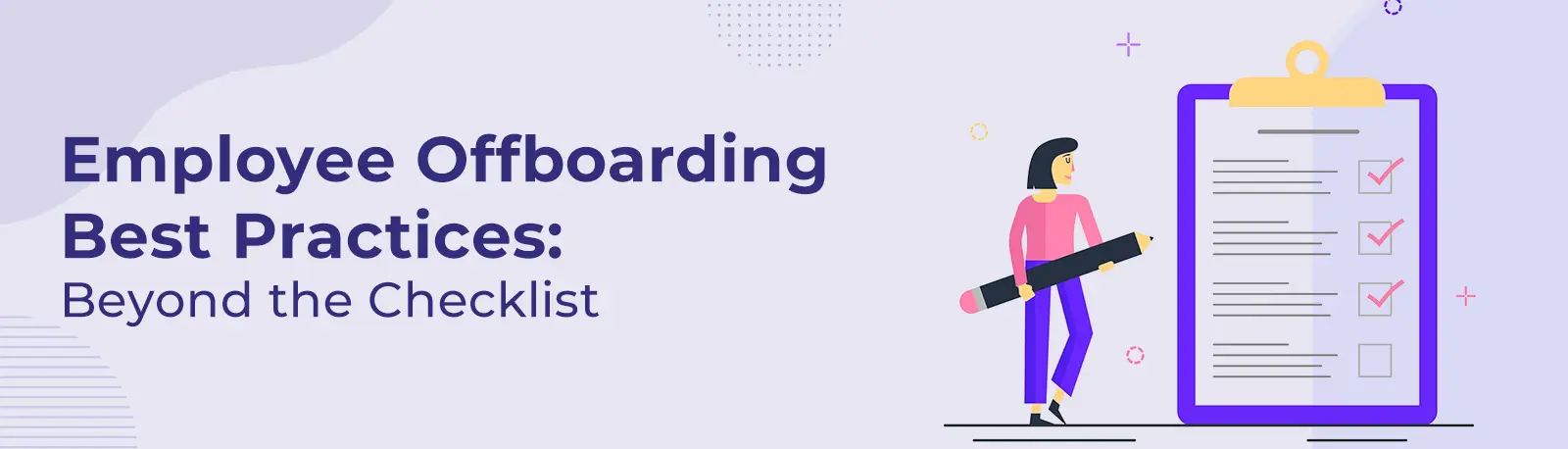
Your checklist is probably fine. Ask who owns line four and the room goes quiet.
Most HR teams reach a point where the document exists. A colleague built it two years ago, and every departure still feels improvised. The manager finds out on Tuesday. IT finds out when the laptop appears. And the person leaving spends nine days doing their job, then compresses a decade of context into one afternoon.
Key takeaways
Run offboarding as one designed process instead of reacting to each departure on its own terms. Start knowledge transfer the day an employee gives notice. The last afternoon is where institutional memory disappears. Give HR, the manager and IT a defined part each, agreed before anyone resigns. You will find a ready-to-use checklist and the IT access side of offboarding on their own linked pages rather than repeated here.
What is employee offboarding?
What is employee offboarding?
Offboarding is the structured process a company follows when an employee leaves. It applies whether they resign, get terminated, are laid off or retire. You handle knowledge transfer and team communication through it. Final pay and documentation sit inside it, along with recovering system access and company property.
That definition is deliberately brief, because this piece assumes you already run some version of it.
Why is a consistent offboarding process important?
A consistent process means you handle every departure the same way, whatever the reason for it. That reduces legal and perception risk, and it stops institutional knowledge or access details from slipping through the cracks when your team improvises case by case.
Think about how two departures in the same quarter actually get handled.
A well-liked senior engineer resigns and everyone rallies. The manager schedules a proper handover, colleagues take notes, HR runs a thoughtful exit interview. Six weeks later you let go of a colleague on the same team, and the process shrinks to a badge collection and an awkward email. Nobody decided to treat those two people differently. Your process simply had no shape, so the emotional temperature of each exit filled the gap.
Two problems follow. The first is fairness, and it becomes a legal question the moment a departing employee compares their experience to a colleague’s. The second is quieter. When a step goes unowned, it depends on whoever happens to remember it, and memory makes a poor control.
SHRM’s guidance on managing separations makes the same underlying point: treat the exit as a defined process with assigned responsibility, not as a series of one-off reactions. That principle sits behind the four practices below.
Four practices that make offboarding consistent
Each one addresses a different failure mode, and none of them requires you to rewrite the checklist you already have.
1. Build one framework for every type of departure
A resignation and a layoff should run through the same underlying framework, and so should a termination or a retirement. The same triggers fire, the same people get notified, and the same documentation flows through. Tone and timeline will differ, though those are execution decisions inside one process.
Most teams do the opposite. They build a resignation path by accident, then improvise a termination path under pressure, then improvise a layoff path again six months later. Three processes, none written down, each one reflecting whoever ran it.
Departure type
Notice you get
What changes
What stays identical
Resignation
Two to four weeks
A working handover window
Every task, owner and document
Retirement
Months
Longer knowledge capture, ceremony
Every task, owner and document
Layoff
Little to none
Compressed timeline, careful comms
Every task, owner and document
Termination
Same day, usually
Immediate access review, tighter tone
Every task, owner and document
Table 1. The right-hand column is the point. One framework, four tempos.
Build the framework once and adjust the tempo per departure. If you want a model for what a designed people process looks like end to end, the onboarding process this framework mirrors follows the same logic in the opposite direction.
2. Assign clear ownership across HR, managers, and IT
Who should own the offboarding process?
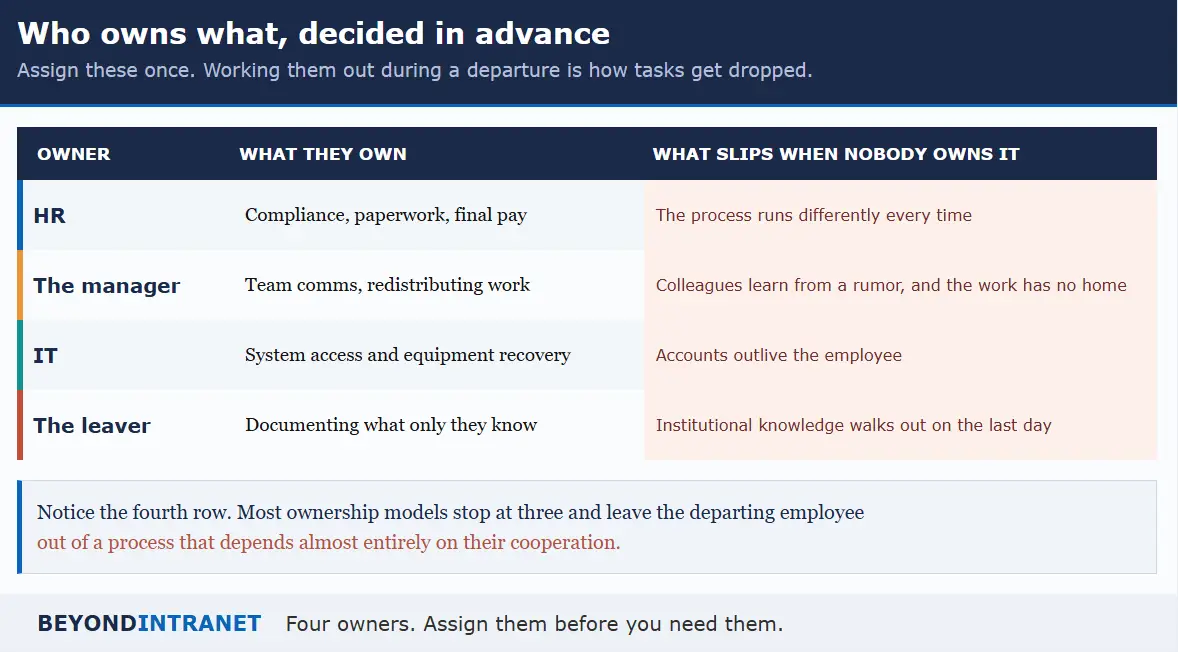
Treat offboarding as a shared responsibility with clearly assigned parts. HR owns the compliance and paperwork, plus final pay. The employee’s manager owns team communication and redistributes the work. IT owns system access and recovers the equipment.
Assign these once. Working them out during a departure is how tasks get dropped.
Write that division down before you need it. Teams that decide ownership during a departure are deciding under time pressure, with an incomplete picture, about work nobody wants to volunteer for.
Add a fourth owner most models leave out: the person leaving. They hold the knowledge the whole process is trying to preserve, and treating them as a subject of offboarding rather than a participant in it is why the handover so often produces a document nobody can use.
3. Start knowledge transfer the day notice is given
How can companies avoid losing institutional knowledge when an employee leaves?
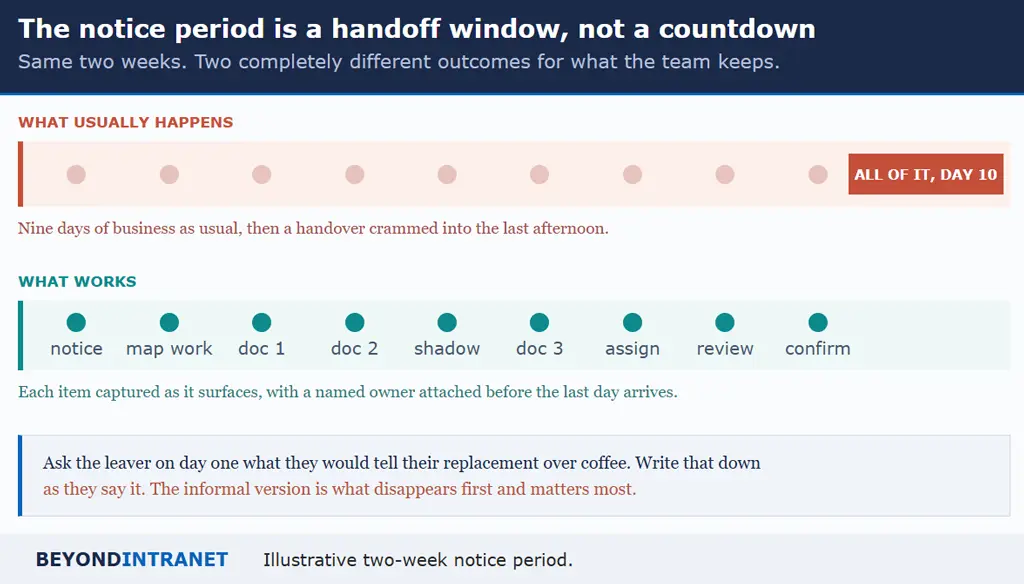
Begin the transfer as soon as your employee gives notice, well before the last day. Document responsibilities and undocumented processes as they surface, give each piece of transferred work a single named owner, and use the whole notice period as a working handoff window.
Same two weeks. Two completely different outcomes for what the team keeps.
Here is the pattern almost every HR team recognizes. Somebody resigns on the first, works normally for nine days, and hands over on the tenth. The handover produces a document. The document is accurate and nearly useless, because it records the process as the leaver believes it works rather than as they actually do it.
Run it differently. On the day notice lands, sit with the person and map what they own. Recurring responsibilities, the systems only they touch, the vendor contact who only ever replies to them. Then capture each item as it surfaces across the following two weeks, while they are still doing the work and can show you rather than describe it.
Give every captured item a named successor at the moment you capture it. Knowledge assigned to a team belongs to no one. Assign it to Priya in accounts payable and she is the person who will notice when the detail turns out to be wrong.
Ask one question on day one: what would you tell your replacement over coffee? The informal answer is what disappears first and matters most, and it rarely makes it into a formal handover template. Where your team already practices centralizing institutional knowledge before someone leaves, this becomes a top-up rather than an excavation.
4. Track offboarding as an ongoing process
Treat offboarding like any other HR process and give it a feedback loop. Most teams run it, close the file, and never look at how it went.
Watch three things over a year. How often tasks finish on time. Whether exit interview themes repeat. And whether the same knowledge gaps reappear after certain roles turn over.
What to watch
What it tells you
What to do about it
Task completion against the last day
Whether ownership is real or theoretical
Reassign the step that keeps slipping
Repeating exit-interview themes
A retention problem, not an offboarding one
Route the theme to somebody who can act
Recurring knowledge gaps by role
Documentation is thin in a specific area
Fix it before the next person in that seat leaves
Table 2. Three signals. The third one is where offboarding stops being reactive.
That third signal is the useful one. When the same gap appears every time a particular role turns over, you have found a documentation problem that exists whether or not anybody is leaving.
How Beyond Intranet supports a structured offboarding process
Each practice above needs something to hold it in place. Employee offboarding software within Beyond Intranet handles the parts that otherwise depend on memory.
Checklist and task templates give every departure type the same starting framework, which is practice one made operational. Task assignment and tracking across roles and departments makes ownership explicit instead of implicit, which is practice two. An automatic offboarding trigger after the termination date starts the process without waiting on anyone to remember. And reporting on open and overdue tasks, plus completed ones, hands you the data practice four asks for.
Two boundaries worth stating. This product manages the checklist and the tasks around it, while your IT team still performs the actual access revocation. Knowledge centralization sits in a separate Knowledge Management product.
A shared checklist template and task assignment across HR, managers, and IT is what turns these practices into something your team actually follows every time.
See how the templates, task tracking and automatic triggers work together.
Plan for the full notice period plus about a week afterward. Access revocation happens on the last day. Knowledge transfer runs across the whole notice window. Records archiving and exit-interview follow-up can trail slightly, provided one person owns the deadline.
The framework does. The timeline and tone do not. A termination compresses everything into a single day and needs a tighter approach to access, while the tasks themselves, the owners and the documentation stay identical to any other exit.
Somebody outside the departing employee's direct reporting line, usually in HR. A manager interviewing their own report rarely gets a candid answer, and candor is the entire reason for holding the conversation.
Cooperation drops when people feel the exit was handled badly, which makes it a symptom worth reading. Ask early, keep the request specific and small, and accept partial capture. Something written down on day three beats nothing written down on day ten.
Where to start
Pull your last three departures and check whether each followed the same steps. Wherever they diverged, your framework has a gap that improvisation filled.
Write the ownership split for HR, the manager and IT this week, before your next resignation lands. Deciding it under pressure is how tasks get dropped.
On the next resignation, book thirty minutes on day one to map what the person owns. That single meeting changes what your team keeps.
The process is what protects you, not the document
Every organization can produce an offboarding checklist. Far fewer can say who owns each line, when the handover starts, and whether the last three departures ran the same way. That gap is where institutional knowledge disappears and where inconsistency turns into risk. Design the process once, assign it properly, and each departure stops being a small crisis your team improvises through.
Ready to give every departure the same consistent, well-owned process instead of rebuilding it each time?
We can walk you through the templates, the task assignment and the reporting on your own setup.