A practical, vendor-neutral guide for CIOs, IT directors, and digital workplace leaders evaluating SharePoint consulting partners in Australia — including a comparison...
Somebody left in March. Their Slack account was still active in July.
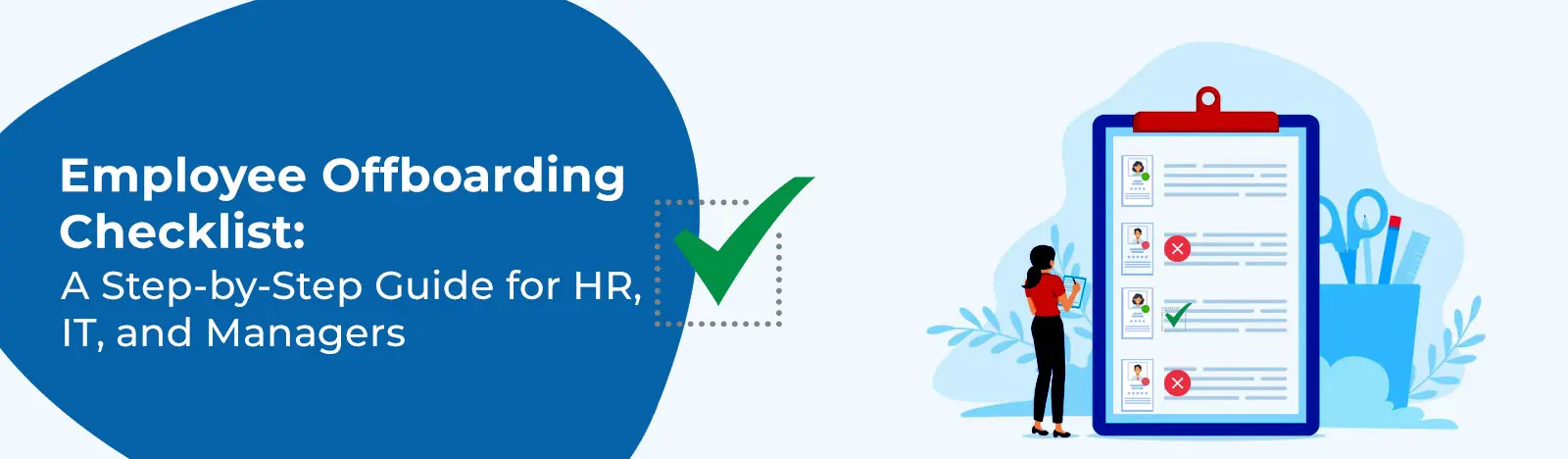
Nobody was careless. HR closed the file, the manager ran a handover, IT collected the laptop. The account simply belonged to a tool nobody had on a list, and no single person owned the job of checking. That is what an undocumented offboarding process looks like from the inside, and it is why this checklist is organized two ways at once.
Key takeaways
This checklist is organized by phase and by owner, because most offboarding gaps happen where those two axes meet. Three phases cover it: before the last day, the last day itself, and afterward. Four functions own tasks inside those phases. HR runs the process. IT holds access and devices. The manager holds the handover. Payroll holds final pay and benefits. Get the ownership right and nothing needs chasing.
What is an employee offboarding process?
What are the steps in the offboarding process?
Offboarding is the sequence that runs from the moment somebody gives notice through to final access revocation and records closure. Confirm the departure. Plan the handover. Revoke access and collect equipment on the last day. Close out pay and benefits afterward, then the records.
The reason for departure changes the tone and the timing, not the task list. A resignation gives you weeks. A termination may give you an afternoon. A retirement gives you months and usually the best knowledge transfer you will ever get.
This piece is the tactical companion to the wider argument. If you want the case for why offboarding deserves attention at all, along with the culture and exit-interview side, employee offboarding best practices covers that ground. What follows is the list itself.
Why a documented offboarding checklist matters
Three reasons, and the first one is the one auditors ask about.
Undocumented access is a security exposure
Every account that outlives an employee is a way in. The risk is rarely the departing person, who has moved on and forgotten the password. It is the account sitting unmonitored and unpatched, outside anybody’s review cycle, which is precisely the kind nobody notices until something uses it.
Timing matters as much as completeness here. An account closed on the last day is housekeeping. The same account closed in month four is an incident report, and the difference is entirely process, not intent.
Knowledge leaves faster than people do
A departure that nobody planned for takes institutional knowledge with it. Who the escalation contact was at that vendor. Why the process has an exception for one client. The notice period is the window in which that either gets captured or disappears, and a documented checklist is what makes somebody responsible for capturing it.
There is a compliance dimension too. Employment records carry retention obligations that survive the employment itself, and an exit handled from memory rarely produces the documentation somebody will ask for later.
The exit shapes what people say afterward
Departing employees talk to candidates, to former colleagues and to review sites. A messy final week costs more in employer brand than the process would have cost to run properly. Some of those people also come back, and a clean exit is what makes that conversation possible two years later.
The employee offboarding checklist, by phase
What’s included in an employee offboarding checklist?
Six things. Access revocation across every system. Return of company equipment and badges. Final pay and unused PTO. Benefits continuation information. Knowledge transfer and handover documentation. Then the exit interview and records closure.
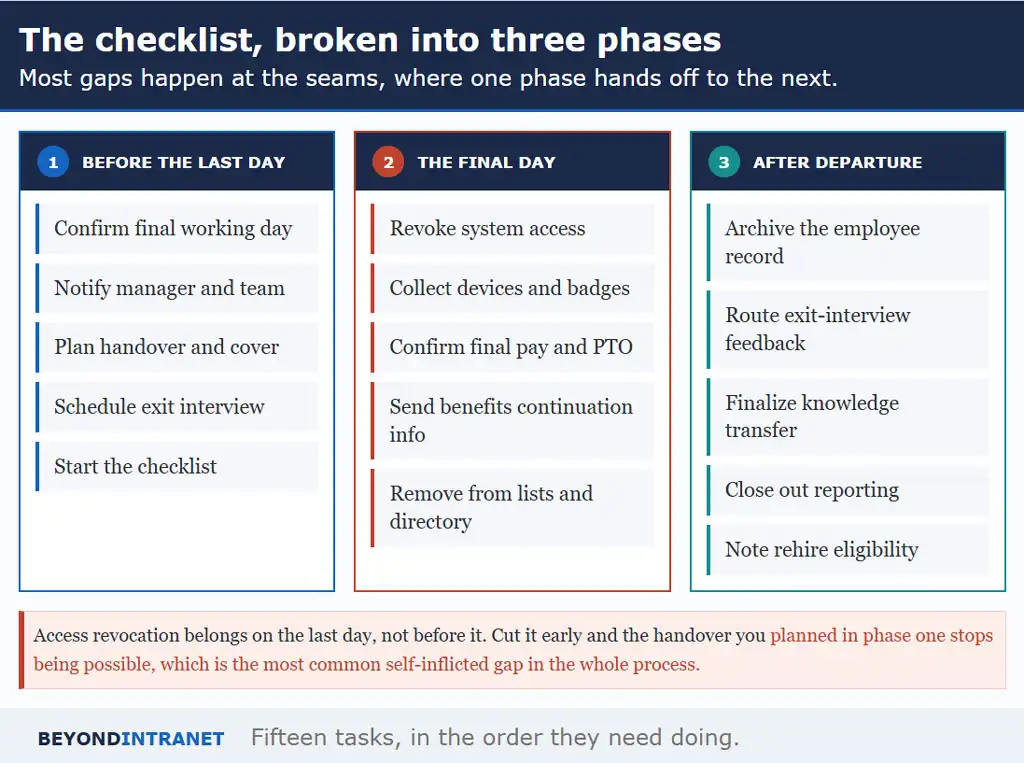
Leading offboarding guides now organize this by phase and by owner at the same time. The phase view is below. The ownership view follows it.
Most gaps happen at the seams, where one phase hands off to the next.
One structural note before the tasks. Assign every line to a named person, not a function. HR as a department cannot be chased. A person can.
Phase 1: before the last day
Start the moment notice is given, because everything downstream depends on the lead time you have here.
Confirm the final working day in writing so payroll and IT are working from the same date as the manager. Notify the manager and the immediate team, and agree who covers the work. Build the handover plan while the person is still available to explain things, which is the single highest-value task in the whole process.
Schedule the exit interview now, not in the final week, when calendars fill. And open the offboarding checklist in whatever system HR uses, so tasks have owners from day one instead of accumulating in somebody’s head.
One practical note on the handover. Ask the person to write down what they would tell their replacement over coffee, not what belongs in a process document. The informal version is where the useful knowledge lives, and it is the version that disappears first.
Phase 2: the final day
This is the compressed one, and the phase where things get missed.
Revoke system and application access. Email and collaboration tools. The CRM and the finance system. File shares. Every third-party SaaS tool the person was provisioned into. That last category is where accounts survive, because the list is rarely maintained anywhere central.
Collect company equipment and access badges. Laptop and phone. Peripherals. Keys and parking pass. For remote employees this needs a prepaid shipping label and a tracked return date, arranged in phase one, not improvised on the day.
Settle the final paycheck and any unused PTO payout, and send benefits continuation information. In the US that means COBRA, and the deadlines are firm. The Department of Labor requires employers to notify the plan administrator within 30 days of a qualifying event such as termination, after which the plan has 14 days to issue the election notice. The departing employee then gets at least 60 days to decide. Missing the first deadline is an easy way to create a compliance problem out of an administrative one.
Remove the person from distribution lists, shared calendars and the employee directory. Then close out any NDA or non-compete paperwork that needs acknowledging on the way out.
A note on sequencing within the day. Collect equipment before revoking access, not after. Somebody locked out of their laptop cannot help you wipe it, and the last hour is a poor time to discover that.
Phase 3: after departure
The quiet phase, and the one most likely to be skipped because nobody is waiting on it.
Nothing here is urgent, which is exactly why it slips. Put dates against these tasks in the same system that held the first two phases, or they become work somebody intends to do and never schedules.
Archive the employee record according to your retention policy instead of deleting it, since employment records carry retention obligations that outlast the employment. Route exit interview feedback to somebody with the authority to act on it, because feedback filed without an owner is just a document.
Finalize the knowledge transfer documentation while the handover is fresh enough to check. Close out reporting so the departure appears in headcount and turnover figures. And record rehire eligibility, which is a two-minute note that saves an awkward conversation if the person applies again.
Following this checklist manually works, but it relies on every task actually getting done and logged.
Task assignment, reminders and reporting remove the part where somebody has to remember.
HR owns the process end to end. Everyone else owns specific tasks inside it. IT handles access revocation and devices. The direct manager handles handover and knowledge capture. Payroll handles final pay and benefits continuation. Facilities handles badges and physical space.
Owner
Their tasks
The one they miss
HR
Runs the checklist, exit interview, records closure and archiving
Handover plan, successor coverage, knowledge capture
Writing down what only the leaver knew
Payroll
Final paycheck, unused PTO, benefits continuation
The COBRA notice deadline
Facilities
Badge return, desk and locker release, parking
Remote leavers with equipment at home
Table 1. Five owners. The right-hand column is where undocumented processes fail.
Facilities is the function most often left off the list entirely, because in an office the badge simply stops working and nobody thinks of it as a task. Desk release, locker clearance and parking allocation all need somebody named, particularly where space is booked instead of assigned.
Ownership on paper is not the same as ownership in practice. The tasks in that last column all have an owner in theory and nobody chasing them in reality, which is a coordination problem more than a diligence one. For the cross-functional version of that argument, coordinating offboarding across HR, IT, and workspace management goes into it properly.
Common offboarding mistakes to avoid
Six patterns account for most of what goes wrong.
The mistake
What it looks like
The fix
No documented process
Every departure handled from memory, differently
One checklist, applied to every exit
Access revoked too late
Accounts live for weeks after the last day
Same-day revocation, scheduled in advance
Access revoked too early
Handover becomes impossible mid-week
Cut access on the last day, not before it
No knowledge-transfer plan
The successor learns by discovering gaps
Handover documented during the notice period
Skipping the exit interview
The reason for leaving stays unknown
Scheduled in phase one, not the final week
Treating every exit the same
A layoff run like a resignation
Same task list, different tone and timeline
Table 2. Six patterns. Two of them are opposite errors on the same task.
The two access errors are worth pausing on, because they are opposite mistakes on the same task and organizations usually make one consistently. Teams that have been burned by a lingering account cut too early. Teams that have been burned by a broken handover cut too late. Both are solved by scheduling revocation for a specific date instead of reacting.
The remote and hybrid case deserves separate attention, because the physical steps stop being automatic. Equipment return needs a shipping arrangement, not a desk visit. Device deprovisioning needs to happen without anybody handing over a laptop in person. Neither is difficult. Both get forgotten by checklists written for an office.
How offboarding software helps you stick to the checklist
The checklist above works on paper. What it depends on is every task actually getting done and logged, by somebody who knew it was theirs.
That is the specific gap software closes. Employee Offboarding Software within Beyond Intranet handles offboarding as a module alongside onboarding, with task checklists and reusable templates so the list does not get rebuilt from memory each time somebody leaves.
Tasks get assigned across HR and IT, and to admin, instead of sitting in one person’s inbox. Real-time notifications and reminders handle the chasing, which is most of what HR does during an exit. A template hub holds the offboarding task templates so each departure starts from a known-good list.
Reporting with Excel export shows which tasks completed and which are outstanding, which is the view nobody has when the process runs on email. The employee record is removed automatically after the termination date, and data handling follows GDPR-aligned practice.
Worth being clear about scope. This is a module inside the onboarding product rather than a standalone offboarding platform, and it manages the checklist without performing technical access revocation itself. IT still executes the deprovisioning. What changes is that somebody is assigned to it, reminded about it, and visibly accountable for closing it.
What the software does not do is worth saying twice, because vendors in this space routinely blur it. The checklist gets managed. The technical work still gets executed by the people who own those systems.
Most tasks complete within one to two weeks of the last working day. Access revocation is the exception and should happen same-day. Records archiving and exit-interview follow-up can run slightly longer, provided somebody owns the deadline.
No, unless the circumstances of the departure require it. Cutting access early makes the handover you planned impossible to finish, and handover is the highest-value task in the process. Schedule revocation for the last day and confirm it happened.
Termination is one reason somebody leaves. Offboarding is the process that runs regardless of reason, covering resignations and retirements, layoffs too. The task list stays the same. The timeline and the tone change.
Set an auto-reply naming the new contact, then convert the mailbox to a shared or delegated one for a defined period before archiving. Forwarding to a colleague indefinitely is the common shortcut and creates a record nobody is accountable for.
Yes, and it is skipped more often here than anywhere else. Contractors accumulate system access the same way employees do, and their departures rarely trigger the same process. A shortened version of the same checklist covers it.
Audit the accounts of three people who left in the last six months. Whatever is still active is the size of the gap you are actually closing.
Write the ownership table for your own organization before writing any tasks. Most checklists fail on ownership, not on content.
Add a line to your current process for remote equipment return. It is the step written for offices that stops working the moment somebody is not in one.
The checklist is the easy part
Every organization can write an offboarding list. Far fewer can say who owns each line and prove it got done. That gap is where accounts stay open, knowledge disappears and somebody spends July wondering why a departed colleague still shows up in a channel. Organize by phase and by owner, and the process stops depending on anybody remembering.
If you’d rather not rebuild this checklist from scratch every time someone leaves
We can show you how it runs inside Beyond Intranet, with task assignment and reporting built in.