A practical, vendor-neutral guide for CIOs, IT directors, and digital workplace leaders evaluating SharePoint consulting partners in Australia — including a comparison...
Everything else had gone well. A strong hiring process, a warm offer call, a manager who genuinely wanted this person. Then the first morning arrived and there was no machine, no system access, and a well-meaning colleague explaining that IT usually takes a few days. By lunchtime the new hire had learned something about the organization that no careers page had told them.
That is employee experience. Not the annual survey score. The accumulated evidence of how a place actually works, gathered one ordinary moment at a time.
Key takeaways
Employee experience is everything a person perceives and encounters across their time with an organization. It runs from first contact as a candidate through to alumnus. Engagement is not the same thing; it is one measurable outcome that sits inside EX. Most frameworks divide EX into three pillars covering the physical workspace, the digital tools, and the culture. And the business case is now well documented, with Gallup putting global engagement at 20 percent and McKinsey linking positive experience to sharply higher engagement and retention.
What is employee experience?
What does employee experience actually mean?
The complete set of perceptions and interactions a person has with an organization, from recruitment through offboarding. Three things shape it. The physical workplace they occupy. The digital tools they use to get work done. And the culture they encounter in colleagues and managers.
Two words in that definition carry most of the weight, and both are easy to skim past. Complete, and interactions.
Complete means the whole arc rather than the parts HR happens to run. A candidate forms impressions during a recruitment process months before anyone becomes an employee. A leaver forms them again during an exit that may be handled well or handled badly. Alumni talk. Both ends of the lifecycle shape what people outside the organization believe about working there.
Interactions means the things that happen, not the things that are said. A values statement describes an intention. A manager cancelling a one-to-one for the third week running is an interaction, and it is the one people believe.
Employee experience vs. employee engagement
How is employee experience different from engagement?
EX is the full relationship across the entire lifecycle. Engagement is narrower. It measures how committed and motivated people feel, and it sits inside EX as one outcome among several. You can improve engagement scores briefly without changing the underlying experience at all.
The confusion is understandable, because organizations measure engagement and rarely measure experience. Think of it as cause and symptom. Experience is what happens to someone across their time with you. Engagement reads how that has landed. A rising score tells you something is working. It does not tell you what, and it will not survive if the underlying conditions stay the same
Employee experience
Employee engagement
What it is
The whole relationship, end to end
One measurable emotional outcome
Time span
Candidate through alumnus
A point in time, usually a survey window
What it covers
Workspace, tools, culture, management
Commitment, motivation, discretionary effort
How you change it
Redesign the moments that matter
Usually by improving the underlying experience
Who owns it
HR, IT, facilities and line managers together
Frequently HR alone, which is part of the problem
The core components of employee experience
What are the three pillars of employee experience?
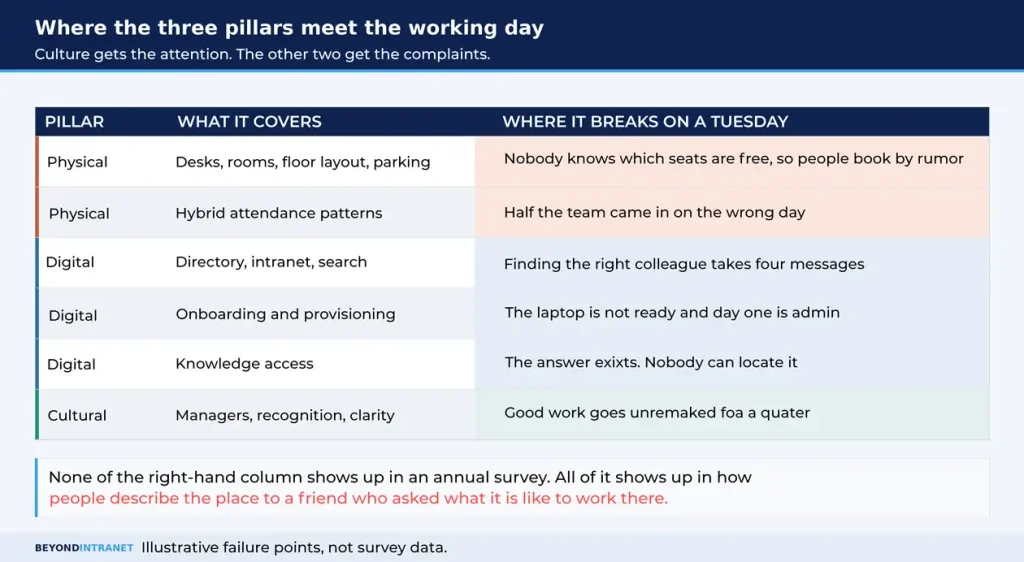
Most established frameworks split EX into physical, digital and cultural. Physical covers the workspace and equipment. Digital covers the software people use hourly. Cultural covers values, leadership and relationships. Together they determine how work feels on an ordinary day.
Each pillar fails differently, which is why treating EX as a single programme rarely works.
Culture gets the attention. The other two get the complaints.
A useful diagnostic before reading further. Ask which of the three your organization measures. Most measure culture, some measure digital adoption, and almost nobody measures the physical pillar beyond occupancy. That gap tends to match where the unaddressed frustration sits.
The physical workplace
Desks and meeting rooms. Floor layout and parking. Whether any of it can be found or booked without asking somebody. Hybrid work made this harder rather than simpler. A team that comes in on different days needs to know who will be there and where they will sit, and most organizations answer that question with a group chat and a certain amount of hope.
The digital workplace
People encounter this pillar most often and complain about it most quietly. The intranet. The directory. The onboarding process. The search that does or does not find the policy document. Each is a small tax on the working day, paid many times over, and none of it appears in a values statement.
The cultural environment
Managers and recognition. Psychological safety. Clarity about what good looks like. This pillar receives most of the attention and most of the budget, and it deserves both. But it cannot compensate for the other two. Warm culture does not offset a week spent chasing system access.
A fourth lens is worth adding to the three. Rather than pillars, some frameworks map EX across journey stages and look for the moments that matter, meaning the handful of points where the experience genuinely changes someone’s view. First week. First promotion. First time they need something and cannot work out who to ask. Those moments are unevenly distributed, and the pillars view can hide that.
Why employee experience matters
The business case has moved from intuition to evidence over the last few years.
Start with the scale of the problem. Gallup’s State of the Global Workplace 2026 report found that 20 percent of employees worldwide were engaged at work in 2025, with 64 percent not engaged and 16 percent actively disengaged. Read the middle number carefully. Two thirds of the workforce is not hostile. Simply present, doing the job, having formed no particular attachment either way.
The multiple matters less than the direction. What it says is that experience is not a soft adjacent concern to engagement. Closer to the input that produces it.
Retention is where the arithmetic gets concrete for most organizations. Replacing somebody costs recruitment fees, manager time, lost institutional knowledge and a ramp period during which output is below normal. None of that appears as a line item called turnover, which is exactly why it goes unmanaged.
There is a second-order effect worth naming. People who cannot get their own work done smoothly rarely deliver smooth work to customers. The connection between internal experience and external service quality is not mystical. Same people, same day, same systems.
How to build an employee experience strategy
What does building an EX strategy actually involve?
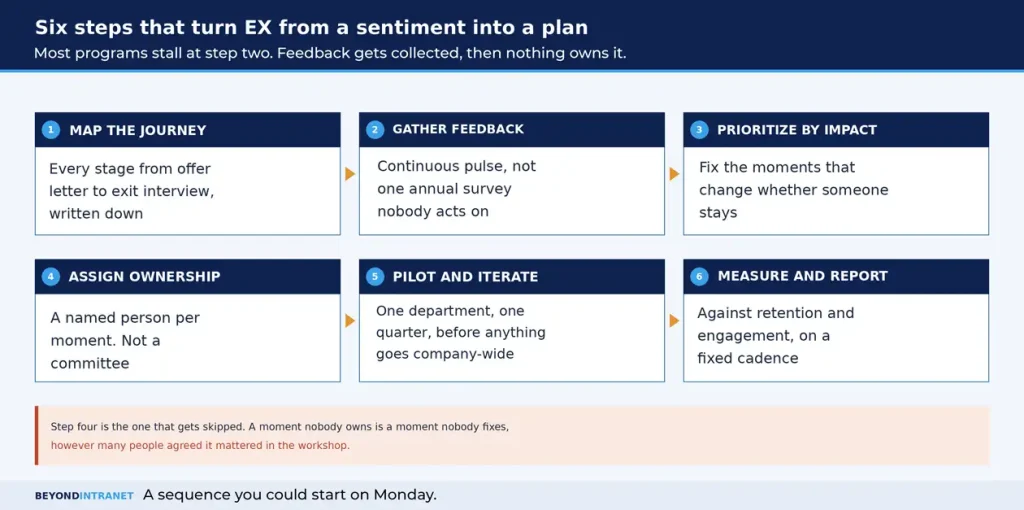
Six things, in order. Map the employee journey to find the moments that matter. Gather feedback continuously. Prioritize the fixes with real impact. Give each one a named owner. Pilot before you scale. Then measure against retention and engagement rather than activity.
Most EX programs do not fail at the idea stage. They fail somewhere between step two and step four, in the gap where good intentions meet nobody’s actual job description.
Most programs stall at step two. Feedback gets collected, then nothing owns it.
1. Map the employee journey
Write down every stage from offer letter to exit interview. Not the process as documented, but the process as experienced, which is usually longer and has more waiting in it. Involve people who joined in the last six months, because they still remember.
2. Gather feedback continuously
An annual survey tells you how people felt during one week in March. Short, frequent pulses tell you what changed and roughly when. The cadence matters less than the follow-up. Asking repeatedly without visibly acting is worse than not asking.
3. Prioritize by impact
You will surface more problems than you can fix. Rank them by whether they affect the decision to stay. A frustrating expenses process irritates people. A first month with no clarity about the role changes what they do next year.
4. Assign clear ownership
Step four gets skipped constantly, and skipping it is why so many EX initiatives produce a deck rather than a change. Each moment needs a named person, not a working group. Onboarding usually spans HR, IT and facilities, so somebody has to hold the whole thing rather than their portion of it.
5. Pilot and iterate
One department, one quarter. A pilot gives you evidence before you spend political capital, and it surfaces the practical objections that never appear in a workshop. It also gives you an internal reference point, which is more persuasive than any external case study.
6. Measure and report
Set the measures before you start, not after the results arrive. Report on a fixed cadence to the same audience. An EX program that reports only when the numbers are good has quietly become a communications exercise.
Turning a strategy into daily practice is easier with the right tools behind it
See the SharePoint HR apps built to support every stage of the employee journey.
EX and the employee workplace: tools and technology
How do workplace tools affect employee experience?
They set the friction level of the working day. Physical tools decide whether someone can find a desk or a colleague. Digital tools decide how long a routine task takes. Neither creates a good experience by itself, but both can quietly ruin one.
Here is the part of EX that gets the least strategic attention and generates the most daily irritation.
Take onboarding, since it sets the tone for everything after it. A structured employee onboarding software process means paperwork, equipment and system access are sequenced before day one rather than discovered on it. The difference between a first week spent working and a first week spent waiting is almost entirely operational.
Then finding people. A current employee directory sounds administrative until you count how often someone needs to identify the right colleague and cannot. In a distributed organization that lookup happens several times a day. Each failure costs a message, a wait, and a little goodwill.
Hybrid working put the physical pillar back on the agenda. Workspace management software and desk booking software answer a question employees now ask weekly. Will there be somewhere to sit, and will the people I need be there. Interactive floor plans turn that from a guess into a glance.
And then knowledge. Most organizations already have the answer to most internal questions written down somewhere. Knowledge management determines whether anyone can find it. The experience gap is rarely missing information. It is information nobody can locate.
If hybrid seating and space utilization are part of your workplace experience gap
A dedicated workspace tool can close it fast, inside the Microsoft 365 environment your teams already use.
Three composite patterns, drawn from what tends to work rather than from any single organization.
A mid-sized professional services firm rebuilt onboarding after noticing that voluntary departures clustered in the first eight months. The change was unglamorous. Equipment provisioned before the start date, a named buddy for the first month, and a thirty-day check-in that someone actually owned. The measure they watched was not satisfaction. It was how long until new hires reported feeling productive.
A distributed technology company tackled recognition. Good work was being noticed by immediate managers and by nobody else, which meant people in quieter teams felt invisible. Making recognition visible across the organization cost almost nothing and changed how people described the place.
A regional healthcare group approached it from the physical side. Staff across several sites could never tell who was working where on a given day, so coordination happened by phone and guesswork. Shared visibility of schedules and space removed a daily frustration nobody had ever raised formally, because it had always simply been how things were.
None of the three began with a survey result. Each began with somebody noticing a pattern in ordinary operational data, then asking why it was happening. That order is worth copying.
Notice what these have in common. Each one fixed something specific that people encountered regularly, rather than launching a program with a name.
How to measure employee experience
Which metrics actually track employee experience?
Five carry most of the signal. Employee Net Promoter Score for overall sentiment. Pulse survey trends for direction of travel. Voluntary turnover rate for the outcome that costs money. Time to productivity for new hires. And internal mobility, which shows whether people see a future with you.
Metric
What it tells you
Watch out for
eNPS
Whether people would recommend working here
A single number that hides team-level variation
Pulse survey trend
Direction of travel between annual surveys
Survey fatigue if you ask without acting
Voluntary turnover
The outcome that carries real cost
Lagging by months, so it confirms rather than warns
Time to productivity
How well onboarding and enablement work
Needs a consistent definition or it drifts
Internal mobility rate
Whether people see a future internally
Low rates can mean satisfaction or resignation
Table 2. Five measures. Read them together, because individually each one misleads.
Resist the temptation to build a composite EX index out of these. Blended scores feel rigorous and behave badly, because a strong number in one area masks a weak one in another and the aggregate stops pointing anywhere useful.
One practical note. Segment everything by team and tenure before drawing conclusions. A healthy company average frequently conceals one department where the experience is poor enough that people are leaving.
Usually HR leads it, but ownership has to be shared. The physical pillar sits with facilities, the digital pillar with IT, and the cultural pillar largely with line managers. Programs that give HR sole responsibility tend to stall on the parts HR cannot change alone.
No. Satisfaction is a snapshot of contentment at a moment. Experience is the whole accumulated relationship. Someone can be satisfied this week and still be quietly planning to leave, which is why satisfaction on its own is a weak predictor of anything.
Sentiment measures can move within a quarter. Turnover takes longer, often six to twelve months, because people leave on their own timelines rather than yours. Plan the reporting cadence accordingly and resist judging the work too early.
It matters more, and it is usually measured less. Frontline workers often have the least access to the digital tools that smooth the working day, and the most exposure to the physical conditions. Any EX program that only reaches desk workers has missed most of its audience.
Where to start
Take your last ten leavers and mark which stage of the journey their frustration began at. The pattern is usually narrower than expected and points at your first fix.
Time one routine task end to end. Finding a colleague, booking a room, locating a policy. Whatever it takes is what everyone pays daily.
Pick one moment that matters and give it a named owner this quarter. Not a committee, and not a program. One person, one moment, one deadline.
Experience is built from ordinary moments
Employee experience resists grand gestures. Did the laptop arrive. Was the right person easy to find. Had the manager remembered. Was the space usable on the day someone came in. Organizations that treat it as a strategic system rather than an annual score tend to fix the things people actually encounter. That is the whole discipline, and it is more operational than it sounds.
Ready to talk through what a stronger employee experience could look like on Microsoft 365?
Our team can walk you through where the tooling fits and where it does not.