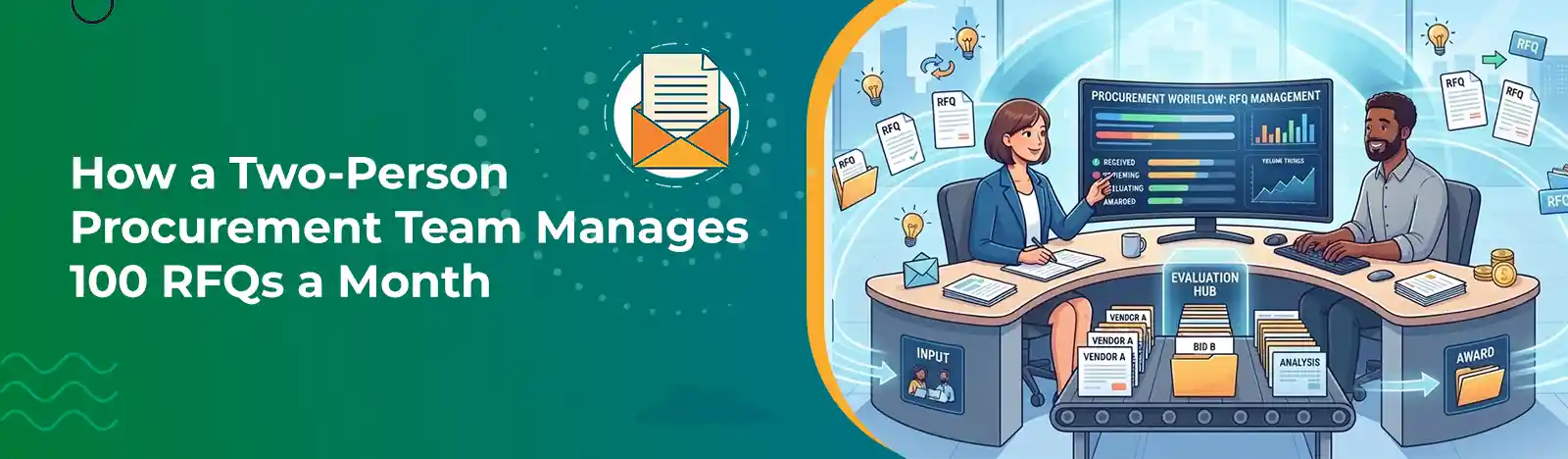
Every single one of those procurement sourcing events needs a written spec, a list of suppliers to invite, a submission deadline, at least one round of follow-up, a structured bid collection, a comparison that’s defensible, and a decision someone signs off on. Try running that workflow manually five times a day and by week three either the quality of your evaluations falls off a cliff or your team is working past 7pm to keep things honest.
Neither outcome is acceptable. And yet this is exactly the volume a surprising number of procurement teams handle. Not with armies of analysts. With two or three people who figured out which parts of the workflow belong to software and which parts belong to humans.
The Reality of a Lean Procurement Team
A two-person team managing 100 RFQs a month doesn’t have time for manual processes that should be automated. They also don’t have time for automation tools that require three months to configure. The margin for waste is zero. Every hour spent reformatting a bid comparison spreadsheet is an hour not spent negotiating with a supplier who just quoted 15% above market on a $200K logistics contract in Dallas.
The pressure isn’t the RFQ volume itself. It’s the invisible overhead: chasing suppliers for responses, rebuilding evaluation templates from scratch because nobody saved the last one, routing approvals through email and then following up when someone forgets, and reporting on pipeline status by manually updating a tracker that’s already out of date by the time it reaches the procurement director’s inbox.
Why More RFQs Don’t Require More Headcount
Redesign how the work flows and two people absorb volume that used to need four. The trick is knowing which lever to pull. Some steps should be fully automated because no human judgment is involved. Others follow a repeatable pattern and belong in a template. And a handful require the kind of supplier knowledge and negotiation instinct that only a person with category experience can bring.
Three levers do the heavy lifting: automation for the steps that don’t need human judgment, templates for the decisions that follow a pattern, and clear rules about where manual work is still essential. The split matters. Automate the wrong things and you lose control. Keep the wrong things manual and you lose speed.
What to Automate, What to Template, What to Keep Manual
| APPROACH | WHAT BELONGS HERE | WHY |
|---|
Automate | RFQ creation from intake data. Supplier notifications and deadline reminders. Bid collection through a portal. Score calculation against weighted criteria. Status dashboards. | These steps follow rules. AI assists by handling them faster and without forgetting, while the team stays in control of the final call. |
Template | Evaluation criteria by category. Approval workflows by spend tier. Supplier onboarding checklists. Standard RFQ sections and scoring matrices. | The decision framework stays the same. Only the specifics change. Templates keep the structure without starting from zero. |
Keep Manual | Supplier negotiation. Relationship calls when a bid doesn’t make sense. Strategic sourcing decisions on high-value categories. Exceptions that don’t fit a template. | These require judgment, context, and the kind of supplier knowledge that only comes from working the category. |
The automation layer is what turns two people into a team that operates like six. RFQ documents generate from intake data in minutes. Suppliers get invited through a portal, not individual emails. Bids arrive in a structured format that’s comparable without someone rebuilding the comparison from scratch. Scoring runs against weighted criteria automatically. For how itemized bid comparison works at the line-item level, see BMS’s Itemized bidding.
The approval chain for a $50K services contract doesn’t change much either. Build each template once. Use it 20 times a month. That’s 30 minutes saved per event, which across 100 RFQs adds up to 50 hours recovered. Two and a half weeks of effort that your team gets back without hiring anyone.
Manual work stays where it should: negotiation, relationship management, and the strategic calls that require judgment. A two-person team that automates the mechanics has time to actually negotiate. A two-person team that does everything by hand negotiates under time pressure, which means the supplier wins.
Managing 100 RFQs Without Losing Control
When you’re running 100 events simultaneously, the procurement director’s morning question shifts. It’s no longer “what’s happening?” It’s “which five events need my attention before noon?” That question only gets answered if every active RFQ, its current stage, and its deadline are visible in one place, updated live. Not in a spreadsheet someone refreshes on Friday. Supplier management handles the vendor side: pre-qualified suppliers organized by category so the team doesn’t waste cycles figuring out who to invite for each new event.
Governance matters at scale too. At 20 RFQs a month, one person can keep track of who approved what. At 100, that falls apart unless every approval is logged automatically with a timestamp and the approver’s name. The audit trail builds itself or it doesn’t exist.
How BMS Helps Two People Run Like a Team of Six
BMS was built for exactly this scenario. A lean procurement team that needs to scale sourcing without scaling headcount. RFQ creation from templates with AI-assisted descriptions. A supplier portal Live dashboards so both team members and their manager see the same picture without a status meeting. The whole thing runs inside Microsoft 365. No new vendor to evaluate. No separate login. No three-month IT approval process.
What changes for the two people doing the work: they stop spending their week on document formatting, email chasing, and spreadsheet consolidation. That time goes to supplier negotiation, relationship calls, and the category decisions that actually move cost. The mechanical 70% of the workload runs on software. The strategic 30% stays with the humans.
100 RFQs a month with two people isn’t a fantasy. It’s a math problem. Automate the steps that follow rules. Template the decisions that repeat. Keep the human judgment for negotiation and strategy. And put the whole thing on a system that gives you visibility without requiring a third person whose only job is updating a tracker.
Scale Sourcing Without Scaling Headcount
RFQ automation, supplier portal, AI scoring, approval chains. All inside Microsoft 365.
Book a Demo