A practical, vendor-neutral guide for CIOs, IT directors, and digital workplace leaders evaluating SharePoint consulting partners in Australia — including a comparison...
A procurement team in Dubai issued a $1.8M IT infrastructure tender last year. Twelve suppliers responded. The evaluation committee needed to score technical capability separately from pricing because the category was complex enough that the cheapest supplier was almost certainly not the best choice. But the bids arrived as single documents. Technical specs and pricing sat on the same page. The first evaluator opened the file, saw the price column before reading the methodology section, and the scoring was compromised before it started.
That scenario plays out constantly in mid-market procurement. The evaluation needs structure that the submission process didn’t provide. Multi-envelope and multi-round auctions exist because single-round, all-in-one bid packages cannot handle the complexity that serious sourcing categories demand.
What Makes Bidding Complex in Procurement
The challenge is not collecting bids. Any team with email can do that. The challenge is evaluating them fairly when the category requires more than a price comparison. A $200K managed services contract in Houston has technical requirements, commercial terms, SLA commitments, and pricing components that all need separate attention. Lumping everything into a single response and sorting by cost misses the point of a structured procurement process.
And then there’s transparency. When a losing supplier asks why they weren’t selected, the answer needs to stand up to scrutiny. If the evaluation was a spreadsheet that three people edited with no record of who scored what, that’s a compliance exposure the organisation cannot afford.
What Is Multi-Envelope Bidding?
Suppliers submit their response in two separate sealed sections. The first envelope contains the technical bid: capability, methodology, experience, certifications, team composition. The second envelope contains the commercial bid: pricing, payment terms, discount structures.
The critical principle is sequencing. Technical evaluators score the first envelope without knowing what any supplier charged. Only suppliers who clear the technical threshold, say 70 out of 100, get their commercial envelope opened. A supplier who quoted 25% below market but lacks the certifications for the work? Their pricing never enters the conversation.
This matters most in regulated procurement. Government tenders across the Middle East require multi-envelope separation by policy. But the principle applies equally to any category where technical qualification is as important as cost. An IT infrastructure bid in Melbourne, a construction subcontractor in Dallas, an engineering services RFP in Riyadh. The format fits when you need to prove that capability was assessed before price influenced the decision.
What Is Multi-Round Bidding?
Multi-round bidding takes a different approach. Instead of one submission window, the process runs in stages. Round one collects initial bids from all qualified suppliers. The procurement team reviews, shortlists the strongest contenders, and invites them to round two with clarified requirements or feedback. Suppliers revise their offers. A third round, often called Best and Final Offer (BAFO), asks the remaining shortlist for their absolute last price.
We’ve seen this produce significant movement. A packaging category where the round-one lead came in at $410K. By BAFO, the winning bid was $348K. Same spec. Same supplier pool. The structured competition across rounds created pressure that a single-round process would never generate. Think about it: a supplier who knows they’re one of three still standing in round two finds room to move that they wouldn’t have offered upfront.
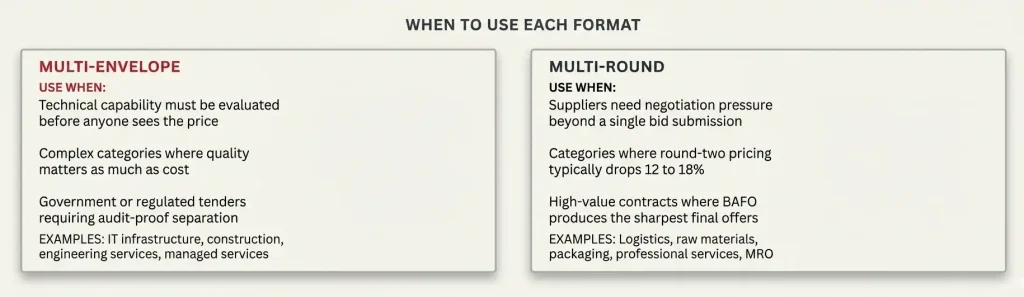
When Should Procurement Teams Use Each Format?
MULTI-ENVELOPE
MULTI-ROUND
Best for
Categories where technical qualification determines who should compete on price
Categories where negotiation pressure across rounds produces sharper pricing
Typical categories
IT infrastructure, construction, engineering, professional services
Packaging, logistics, raw materials, MRO, managed services
Key advantage
Eliminates pricing bias from technical evaluation
12 to 18% price improvement between round one and BAFO
Compliance value
Audit-proof separation required by government and regulated tenders
Documented shortlisting and progression at each stage
The two formats are not mutually exclusive. A complex tender can use multi-envelope separation for the initial evaluation and then run multi-round negotiation with the technically qualified shortlist. That combination is common in high-value government and infrastructure procurement.
What Goes Wrong When This Runs Manually
Running multi-envelope bidding through email requires somebody to physically separate technical and commercial files before distributing them to evaluators. We’ve seen cases where a reviewer accidentally opened the pricing document before completing the technical score. The evaluation had to restart because the process was compromised. On a $1.5M tender, that cost two weeks and the goodwill of the evaluation committee.
Multi-round bidding manually is a tracking nightmare. Which suppliers are still in? Who was eliminated in round one? What were the revised prices in round two? Did everyone submit their BAFO on time? When that tracking lives in email threads and spreadsheets, the team spends more time managing the process than evaluating the bids. For how structured RFQ management eliminates that overhead, see our product page.
How Beyond Intranet BMS Supports Multi-Envelope and Multi-Round Auctions
Bid Management System was designed to handle both formats natively. For multi-envelope events, the platform enforces separation at the system level. Technical evaluators literally cannot access the commercial envelope until the technical review is marked complete. No workaround exists. No accidental access is possible.
For multi-round events, the platform manages shortlisting, bid revision collection, round progression, and BAFOsubmission in a single workflow. Suppliers see their updated brief for each round, submit revised pricing through the portal, and the AI-powered evaluation engine recalculates weighted scores automatically as bids arrive. The procurement team watches rankings shift in real time instead of rebuilding a spreadsheet after each round closes.
Everything runs on Microsoft 365. Same tenant, same credentials, same security policies. The decision trail from first envelope to final award is recorded automatically. When the audit question comes, the answer takes seconds.
Three Things to Do This Quarter
1. Identify your top three categories by spend where technical evaluation currently happens alongside pricing in the same document. Those are your candidates for multi-envelope separation.
2. Pick one category and run a two-round process. Collect initial bids, shortlist the top four, then ask for revised pricing. See what happens to the numbers between rounds.
3. Measure the result against your last single-round event on a comparable category. The price movement will show you exactly what the structured approach is worth.
Multi-envelope bidding keeps evaluation honest by separating what a supplier can do from what they charge. Multi-round bidding sharpens pricing by giving qualified suppliers structured opportunities to compete. Most mid-market procurement teams know these approaches exist but don’t use them because the manual process is too heavy. The right sourcing platform removes that barrier. BMS removes it on M365.
Run Multi-Envelope and Multi-Round Events on Beyond Intranet
Enforced envelope separation. Automated round progression. Full audit trail. All on Microsoft 365.