A practical, vendor-neutral guide for CIOs, IT directors, and digital workplace leaders evaluating SharePoint consulting partners in Australia — including a comparison...
Quick answer: A SharePoint AI Readiness Assessment is a structured evaluation of a Microsoft 365 tenant’s governance, information architecture, content...
A People Ops director at a 200-person company in Dallas told us something last quarter that I haven’t stopped thinking about. “We didn’t have an onboarding problem until we did.” Their employee onboarding process had run fine for years. Then they hired 23 people in a single quarter and the whole thing came apart. The HR coordinator who’d been tracking everything in a spreadsheet went on vacation for two weeks. Nobody picked it up. Three people started during that stretch. One waited until Wednesday for a laptop. Another never got a buddy assigned. The third couldn’t access Slack for five days because the IT request sat in an inbox nobody was monitoring.
That company is now a customer. But the story stuck with us because we hear versions of it constantly. Every HR team has a threshold where the informal approach collapses under its own weight. This playbook is built around the lessons from teams that hit that wall and rebuilt: the stages, the practical steps, the places it breaks at scale, and how to move the coordination into SharePoint if your company runs on M365.
Onboarding Is Not Orientation. That Distinction Changes Everything.
I get asked to explain the difference between orientation and onboarding at least twice a month. Here’s the fastest way I’ve found. Orientation is what happens on Day 1. The tax forms, the office tour, the compliance video nobody remembers. It’s an event. It takes a morning. And it accounts for maybe 5% of what actually gets a new hire productive.
Onboarding is the other 95%. What is employee onboarding when it’s working properly? It’s the months-long arc that carries someone from “I just accepted this offer” to “I’m delivering real work independently.” Pre-boarding before Day 1. A structured first week. Role training that’s specific to the actual job. Guided integration with the broader team. Check-ins at meaningful intervals. And a 90-day review that formally transitions the person from new to contributing.
HR owns the architecture. The hiring manager owns the role-specific ramp. IT provisions the tools. L&D delivers the training content. And the new person’s buddy handles the things that never make it into an official document: who to cc on certain emails, which meetings actually matter, and where people go for lunch when they want to talk honestly. The rest of this article walks through five stages that hold this together.
Orientation vs. Onboarding: The Difference in Practice
ORIENTATION
ONBOARDING
What it covers
Benefits forms, compliance video, office tour
Pre-boarding through 90-day performance review
Training
Generic company overview in one session
Role-specific training spread across 4 weeks
Who runs it
HR alone, one morning
HR + manager + IT + buddy across 3 months
Timeline
Finished by lunch on Day 1
Day 7, 30, 60, 90 check-ins throughout
Success metric
Forms completed, badge printed
Independent performance at role standard
Ends when
The new person leaves the conference room
90-day review transitions to ongoing development
Why 2026 Is the Year Your Employee Onboarding Process Either Scales or Snaps
The frustration is always the same. The process that worked beautifully at 20 employees is falling apart at 80. Remote starts wiped out the in-person orientation. Hybrid schedules made buddy pairing unpredictable. The hiring pace went from a few people a quarter to a few people a month.
The math is brutal. When you’re onboarding five people at the same time, every manual step runs five times. Sending welcome emails. Chasing paperwork. Checking whether IT provisioned the laptops. If one of those five has a bad first week because a task slipped, your retention risk for the entire cohort just went up.
A structured employee onboarding process solves the multiplication problem. New hires ramp faster because the Week 2 agenda exists before they arrive. The experience is consistent regardless of which manager the person reports to. The compliance trail is clean without somebody rebuilding it from forwarded messages. And maybe most importantly for the HR coordinator who’s been spending every Monday morning writing the same follow-up emails to the same three departments: you get your Mondays back.
Five Stages of the Employee Onboarding Process
The onboarding process for new employees breaks into five stages. Your company might name them differently, but the shape is going to look familiar. What separates the teams that scale from the ones that burn out are the bottlenecks they catch early inside each stage.
Before Day 1: The Window Nobody Uses Well
Two weeks between the signed offer and the start date. Sometimes four. Most companies treat this window as dead time. It isn’t. The new person is forming opinions about your organization before they walk through the door. Get the welcome email out within a day of acceptance. Paperwork and ID documents need to come back before the week is out. IT needs the setup request with enough lead time to actually do something with it. And the new person should know what Monday looks like before the weekend starts. And the buddy assignment should be confirmed, not vague. If your team runs a structured Employee Onboarding Checklist, this is where it starts.
Where this cracks: HR sends the paperwork. The IT ticket gets buried in a forward chain. Nobody notices until Monday morning when the new person is standing at a desk with no laptop and a badge that hasn’t been printed. I stopped being surprised by this. The cause is always the same: the handoff between HR and IT happened in an email that one of them skimmed and forgot about.
Day 1: You Get One Shot at This
The new person walks in (or logs on, for remote hires) and within a single day forms a judgment about whether this company knows what it’s doing. Office tour or virtual welcome. Team introductions that feel personal, not performative. Someone walks them through the tools they’ll use every day. The hiring manager sits down for a real conversation about expectations, not fifteen minutes of “so, how are you feeling about things?” And lunch with the team. Not a six-hour slide deck. The strongest orientations we’ve observed finish by mid-afternoon and leave the last two hours open for the person to absorb.
I heard one company admit that fewer than half their new hires met their own manager on Day 1. The rest waited until Day 3 or later. That’s not onboarding. That’s abandonment.
The First Month: When Training Needs to Match the Actual Job
This is where the new person stops being a visitor and starts learning their actual job. Role-specific training begins. They get assigned a first project, something small enough to complete within the month but substantive enough that the team uses the output. Telling someone to “read the wiki” is not assigning work. Asking them to draft a competitive summary of one product feature is. The second one produces something the team actually uses. Weekly one-on-ones with the manager are happening. Cross-functional introductions are being made to the people they’ll collaborate with regularly.
The breaking point: training materials are scattered across four tools. Benefits overview in SharePoint. IT setup guide in Confluence. Role training in a Google Doc that the last L&D manager created and nobody has updated since. Nobody can point the new person to one location and say “everything you need is here.” So Week 2 becomes a treasure hunt across four platforms.
Months 2 and 3: The Quiet Drift Nobody Catches
By month two, the new person should be producing. Their first independent project gets delivered and reviewed. The 60-day check-in happens. OKRs or quarterly goals are set together with the manager. They’re building working relationships across teams without someone brokering every introduction.
The quiet risk at this stage: the check-in calendar goes informal. The Day 30 conversation happened, maybe. The Day 60 one slipped because the manager’s week got chaotic. The new person’s engagement is drifting and the only way HR would know is if somebody remembered to ask. By the time the drift becomes visible, the person has already mentally moved on.
Day 90: Don’t Declare Victory and Walk Away
Day 90. The performance conversation. New hire fills out a feedback survey. Next-quarter goals get set. The onboarding workflow officially closes out.
In practice? The review happens, the file closes, and then nothing replaces the structure that was holding things together. No more check-ins. No more buddy. The person who had a weekly touchpoint for three months is suddenly operating without a net. That drop-off is directly connected to the engagement dip that shows up at months four and five. A biweekly manager conversation through month four would cost nothing and catch problems before they become exits.
How to Onboard a New Employee: The Practical Sequence
The stages above describe the journey. This section covers how to onboard a new employee in the sequence your team should follow for every hire.
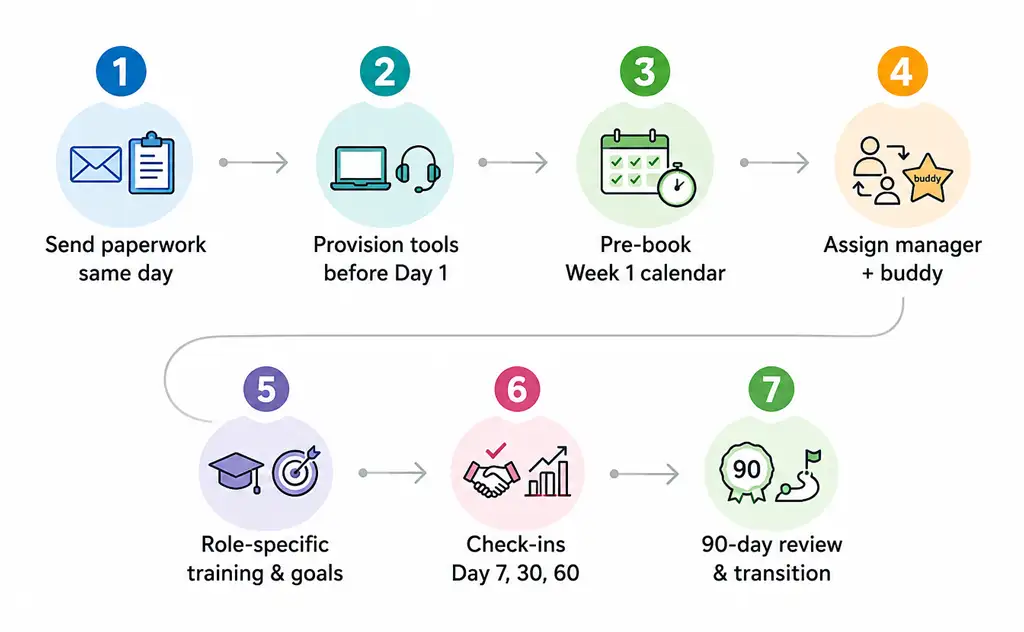
Get the paperwork moving on the same day they accept
After someone signs an offer, silence is your enemy. A week with no communication and they start wondering whether the company has its act together. Paperwork, welcome note, first-day schedule, and buddy contact should all land within hours of acceptance.
Have IT provision everything before the start date
Laptop. Email. Building badge. Software licenses. All of it needs to be ready before the person arrives. If your provisioning process relies on a manager forwarding a request to the IT queue, it’s already fragile. At 10 hires a month, fragile becomes unreliable.
Pre-book the entire first week on the calendar
Manager one-on-one. Team lunch. Tool walkthroughs. Buddy check-in. If it’s not on the calendar when they start, the manager fills those slots with their own meetings and the new person sits idle. We block everything before the start date and mark it as protected time.
Match them with a buddy who has a reason to show up
The buddy system works when the buddy has a short weekly agenda. Three things to cover each week. Keeps the relationship purposeful. It stops working when the buddy is told to “just be available” and doesn’t hear from anyone after Day 3.
Deliver training that’s specific to the actual job
What neither of them needs is two hours on the company origin story. That’s orientation filler, not role training.
Three conversations that are not optional
Day 7 is fast: anything stuck, anything missing? Day 30 gets more substantive: pace okay, gaps to close before month two? Day 60 is the tougher conversation: is this person producing at the level the job requires, and what would help them in the final 30 days? Calendar these. Protect the time. Don’t let them slip. The teams that skip these are always the teams shocked when someone quits at month four.
Close with the 90-day review and transition to ongoing development
The new employee onboarding process flow ends here. Performance review. Feedback survey from the new hire. Quarterly goals set. But don’t just close the file and walk away. Build a handoff into whatever development rhythm your organization uses. The worst thing that happens at Day 90 is silence.
Four Places the Onboarding Process Breaks When You Grow
When I talk to HR teams that have outgrown their setup, the complaints are remarkably consistent.
Task assignment falls apart. When one person is manually emailing stakeholders to remind them about onboarding tasks, their entire week becomes project management instead of HR work. Past 10 hires a month, there isn’t enough time.
Documents live everywhere. The benefits overview is in SharePoint. The IT guide is in Confluence. Role training is in a Google Doc from two years ago that a former employee created. New hires waste days trying to find the right version of the right material in the right tool.
Handoffs get buried. HR emails the manager: “your new hire starts Monday, here’s the checklist.” The manager reads it on Thursday and forgets by Monday. The checklist was a PDF attachment. Nobody knows whether it was opened or ignored.
HR is flying blind. Which new hires are on track? Which ones are struggling? You’d have to call each manager and ask, and that call keeps getting bumped to next week.
If more than two of those sound familiar, it’s worth seeing how automated onboarding handles them. Beyond Intranet’s Employee Onboarding Software was built for exactly this breaking point.
Moving the Employee Onboarding Process Into SharePoint
Here’s what keeps surprising the HR teams we work with. They’re already paying for SharePoint. Already paying for Microsoft 365. They use it for email, documents, meetings, Teams. But the onboarding process still runs on a spreadsheet and manual messages while the M365 environment sits there with capacity to spare.
SharePoint-native employee onboarding software changes the equation. Beyond Intranet’s tool sits inside your M365 tenant and automates the four bottlenecks described above.
Checklists get assigned by role automatically. A sales hire and an engineering hire receive different task lists without HR building them from scratch each time. Timed emails fire at Day 1, Day 7, and Day 30 without someone pressing send. Managers see which of their new people have completed tasks and which are behind. And every document sits in SharePoint with version control, so the multi-tool scavenger hunt is over.
Your team still owns the relationships and the culture. The software owns the logistics and the reminders.
Knowing Whether Any of This Is Working
Ramp speed. Measured in weeks. How long from Day 1 until the person is performing at the standard the job actually requires? If that number isn’t dropping quarter over quarter, the process needs surgery.
Retention at 90 days. Above 85% is solid. Below that, something in the first three months is pushing people out and the onboarding process is where I’d start looking.
New hire sentiment. A short eNPS survey at the 30, 60, and 90 day marks does the job. When the score is strong at Day 30 and drops at Day 60, that’s actually useful: the shift from learning to producing is too jarring. You can smooth it before the person starts updating their resume.
Manager confidence. A 1-to-5 rating from each manager at every checkpoint. Compare across departments. When engineering consistently scores higher than sales, the plan is fine but the sales implementation isn’t. Task completion. If fewer than 70% of first-phase tasks are done, the tracking method is the bottleneck. One customer told us completion was stuck at 55% on spreadsheets. It jumped to 90% the quarter they switched to automated task delivery
Offboarding Runs on the Same Rails
The employee onboarding and offboarding process use the same machinery. One brings people in. The other moves them out. Onboarding opens access, assigns training, delivers documents. Offboarding does the reverse: closes system access, pulls knowledge out of the departing person’s head before they leave, and makes sure the exit interview actually happens.
When someone leaves, three things need to fire without anybody remembering to trigger them: access gets revoked across every tool (IT handles it, but only if the ticket generates itself), the person’s knowledge gets transferred to their replacement or their manager, and the exit interview gets scheduled and logged. Most onboarding tools handle both directions in one workflow. A separate offboarding spreadsheet is a red flag that the system isn’t doing its job.
Everything that happens between "we'd like to offer you the job" and the point where the person is performing independently. Pre-boarding handles paperwork and IT setup before Day 1. Orientation covers the first day. Role training fills the first month. Integration carries through months two and three. The 90-day review wraps it up. HR and the manager co-own the process.
Paperwork and welcome email go out the day they accept. IT provisions everything before their start date. The first week's calendar is pre-booked with orientation, manager meetings, and buddy time. Role-specific training starts with clear first-month goals. Check-ins happen at Day 7, 30, and 60. The 90-day review closes out the onboarding. The full walkthrough on how to onboard a new employee is in Section 4 of this article.
Give it 90 days. Month one is absorbing: the role, the team, how things actually run around here. Month two is contributing: real projects, real deadlines, manager coaching. Month three is proving: independent performance and goal-setting for the next quarter. Teams that compress this into 30 days end up wondering why retention drops at month four.
Same workflow, reversed. Onboarding opens system access, assigns training, brings the person in. Offboarding revokes that access, transfers their knowledge to someone else, and runs the exit process. Most onboarding platforms handle both because the task structure is nearly identical.
The logistics absolutely can. Task assignment by role, timed email triggers at each milestone, manager dashboards for progress tracking, and version-controlled documents in one place. Beyond Intranet's Employee Onboarding Software does all of this inside Microsoft 365 and SharePoint. The human stuff (mentorship, culture, relationships) stays human.
Every employee onboarding process is two problems stitched together. The human side (relationships, culture, mentorship) needs real attention from real people. The logistics side (tasks, documents, reminders, access) should run on autopilot. See how Beyond Intranet’s Employee Onboarding Software handles the second half inside SharePoint.
Move Your Onboarding Process Into SharePoint
Task automation, check-in scheduling, manager dashboards. One workflow for onboarding and offboarding.