A practical, vendor-neutral guide for CIOs, IT directors, and digital workplace leaders evaluating SharePoint consulting partners in Australia — including a comparison...
Start with high-friction areas and scale gradually
AI in employee onboarding is reshaping how organisations welcome, train, and retain new hires and the need for change is more urgent than many HR teams realise. According to Gallup, only 12% of employees strongly agree their organisation does onboarding well. At the same time, SHRM reports that companies with structured onboarding processes improve new hire retention by up to 82%.
This disconnect highlights a persistent challenge: most onboarding processes are designed to scale operations, not experiences.
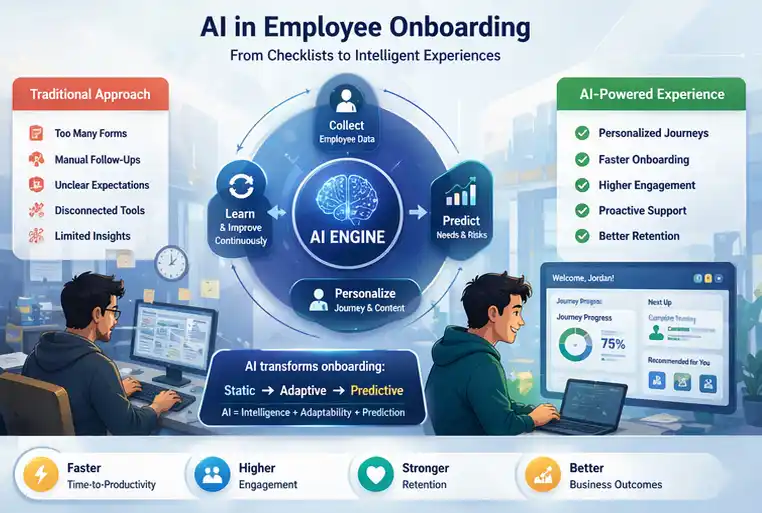
In practical terms, AI in employee onboarding refers to the use of artificial intelligence technologies such as machine learning, natural language processing, and predictive analytics to personalise and optimise onboarding journeys. Instead of static checklists and manual coordination, AI enables onboarding experiences that adapt to each employee’s role, behaviour, and needs.
For HR leaders evaluating AI, the question is no longer whether onboarding needs improvement, but how to improve it without adding complexity.
This guide provides a clear, practical breakdown of what AI in onboarding looks like in real organisations, where it delivers measurable value, what risks to consider, and how to implement it effectively especially within Microsoft 365 environments.
What Is AI in Employee Onboarding?
Traditional onboarding processes are often outlined in and are designed around predefined workflows. These workflows ensure that tasks are completed, but they do not adapt based on individual employee needs.
AI in employee onboarding changes this fundamentally.
Instead of treating onboarding as a linear process, AI introduces dynamic decision-making. It analyses data points such as role requirements, department, geographic location, prior experience, and engagement levels to personalise onboarding journeys in real time.
This enables personalised onboarding, where:
Content is tailored to the employee’s role
Training adapts to progress and performance
Communication is contextual rather than generic
The distinction between automation and AI is critical for HR teams evaluating solutions:
Automation
AI
Executes predefined tasks
Makes decisions based on data
Same workflow for all
Adaptive workflow per employee
Rule-based
Context-aware
Reactive
Predictive
This is where AI employee onboarding moves beyond operational efficiency and begins to improve employee experience and outcomes.
It also introduces capabilities that traditional systems cannot deliver such as natural language interactions through chatbots, intelligent recommendations, and early detection of onboarding risks.
6 Ways AI Is Used in Employee Onboarding Today
This section outlines the most practical and widely adopted applications of AI in onboarding. Each use case focuses on how AI is applied.
1. Personalised Onboarding Paths
One of the most impactful applications of AI is the ability to create tailored onboarding journeys.
In traditional onboarding, every employee receives the same checklist. In contrast, AI systems dynamically generate onboarding plans based on factors such as role complexity, seniority, and required competencies.
For example:
A senior manager may receive leadership alignment sessions and strategic briefings
A junior employee may receive structured learning modules and guided workflows
This level of personalisation improves engagement and reduces unnecessary steps.
According to AgentiveAIQ, organisations using AI-driven onboarding have seen up to a 30% improvement in first-year retention and a reduction in ramp-up time by as much as 70%.
For HR teams, this means onboarding becomes both efficient and relevant, two outcomes that are rarely achieved together without AI.
2. AI Chatbots for New Hire Q&A
An onboarding chatbot acts as a first point of contact for new hires, answering questions instantly without requiring HR intervention.
During onboarding, employees often have recurring questions:
“Where do I submit documents?”
“How do I apply for leave?”
“What tools do I need access to?”
AI chatbots use natural language processing to understand these queries and provide accurate, contextual answers.
This reduces dependency on HR teams while improving employee confidence and autonomy. It also ensures consistency in responses, eliminating the variability that comes with manual communication.
In organisations using Microsoft Teams, chatbots can be embedded directly into the employee workspace, making them accessible without requiring additional onboarding platforms.
3. Automated Document Collection & Compliance
Document collection is one of the most time-consuming aspects of onboarding.
AI simplifies this by:
Tracking document submission status automatically
Sending reminders based on deadlines
Validating document completeness
This builds on foundational , but adds intelligence to ensure the process is not just automated, but also optimised.
For HR teams, this eliminates manual follow-ups and reduces the risk of compliance gaps. For employees, it creates a smoother, more structured onboarding experience.
4. AI-Powered Knowledge Search
New hires often struggle to navigate multiple systems and locate relevant information.
AI-powered search addresses this challenge by allowing employees to ask questions in natural language and receive contextual answers instantly.
Instead of browsing multiple portals, a new hire can simply ask: “Where can I find the expense policy?”
The AI system retrieves the most relevant answer from the organisation’s knowledge base.
This reduces friction significantly and enables faster learning. It also ensures that employees rely on accurate, up-to-date information rather than informal sources.
5. Learning Path Recommendations
AI-driven learning systems analyse employee progress and recommend relevant training content dynamically.
This is where ai employee onboarding has a direct impact on capability building.
Instead of assigning fixed training modules, AI adapts learning paths based on:
Completion rates
Performance in assessments
Role-specific requirements
For example, if an employee struggles with a specific module, the system can recommend additional resources or alternative formats.
This ensures that onboarding is not just completed, but understood.
It also supports continuous learning beyond onboarding, creating a foundation for long-term development.
6. Predictive Retention Signals
AI can identify early indicators of disengagement during onboarding.
These indicators may include:
Incomplete onboarding tasks
Low interaction with training modules
Delayed responses to communications
By analysing these patterns, AI systems can flag potential risks for HR or managers.
A practical example comes from Hitachi, which reduced onboarding timelines by approximately four days and cut HR effort from 20 hours to 12 hours per hire using AI onboarding assistants (Business Insider, March 2025).
This predictive capability allows organisations to intervene early before disengagement leads to attrition.
Benefits of AI Employee Onboarding for HR Teams
When evaluating the broader , AI enhances each outcome by adding speed, accuracy, and scalability.
Employees receive immediate access to tools, training, and information eliminating delays that are common in manual onboarding processes.
This allows new hires to contribute meaningfully within a shorter time frame.
Reduced HR Administrative Burden
AI automates repetitive tasks such as document tracking, communication, and task assignment.
According to Acciyo (2025), nearly 50% of HR professionals believe AI can significantly improve onboarding efficiency.
This shift allows HR teams to focus on strategic initiatives such as employee engagement, culture building, and talent development.
Consistent Onboarding at Scale
In growing organisations, maintaining consistency in onboarding is a challenge.
AI ensures that every employee receives a structured onboarding experience, regardless of location or team.
At the same time, it allows for personalisation ensuring that consistency does not come at the cost of relevance.
Better Compliance and Audit Trail
AI-driven workflows create a clear and trackable record of onboarding activities.
This is particularly important for organisations operating in regulated industries, where compliance requirements are strict.
Automated tracking reduces the risk of missed steps and ensures that all onboarding activities are documented.
Challenges of Implementing AI in Employee Onboarding
While the benefits are significant, successful implementation requires careful planning.
Data Privacy and Security
AI systems process sensitive employee data, including personal information and employment records.
Organisations must ensure compliance with data protection regulations and implement secure data handling practices.
This includes role-based access control, data encryption, and regular audits.
Over-Automation Risks
While automation improves efficiency, excessive reliance on AI can make onboarding feel impersonal.
Employees still value human interaction especially during their initial days.
AI should support human-led onboarding, not replace it.
Maintaining the Human Touch
Onboarding is a critical moment for cultural integration.
Manager check-ins, team introductions, and informal interactions play a key role in shaping employee experience.
AI can facilitate these interactions, but it cannot replace them.
Integration with Existing Systems
Many organisations operate within complex technology ecosystems.
Choosing an AI onboarding solution that integrates with Microsoft 365, HRMS platforms, and collaboration tools is essential.
For deeper evaluation considerations, refer to this .
How to Get Started with AI in Employee Onboarding
Implementing AI in employee onboarding does not require a complete transformation. A phased, practical approach is more effective.
Step-by-Step Approach
Audit your current onboarding process Identify inefficiencies, delays, and manual dependencies.
Identify high-friction areas Focus on tasks that consume the most time or cause delays.
Choose tools aligned with your existing stack Evaluate solutions such as that integrate with Microsoft 365.
Pilot with a controlled group Test AI capabilities with one department or location before scaling.
Measure and optimise continuously Track key metrics such as onboarding completion rates, engagement levels, and retention.
If your organisation runs on Microsoft 365, Beyond Intranet’s Employee Onboarding Software brings AI-ready workflows, role-based onboarding paths, and automated task management into a unified SharePoint-native platform. Explore how Beyond Intranet’s Employee Onboarding Software works.
AI in employee onboarding refers to using artificial intelligence technologies such as machine learning and automation to personalise onboarding processes and improve employee experience beyond standard workflows.
AI employee onboarding enhances experiences through personalised learning, chatbots for instant support, automated documentation, and faster access to knowledge leading to improved engagement and retention.
Yes, many AI onboarding solutions integrate with Microsoft 365 tools such as Teams, SharePoint, and Power Automate, enabling seamless onboarding workflows.
Success metrics include time-to-productivity, onboarding completion rates, employee satisfaction, and retention rates.
Conclusion
AI in employee onboarding is no longer experimental; it is becoming a practical standard for organisations aiming to improve efficiency, consistency, and employee experience.
By combining intelligent automation with personalisation, AI enables HR teams to move beyond administrative tasks and focus on meaningful employee engagement. At the same time, successful implementation requires a balanced approach that integrates technology with human interaction.
If you are exploring AI employee onboarding, the next step is to evaluate how it fits within your existing systems and processes.