A practical, vendor-neutral guide for CIOs, IT directors, and digital workplace leaders evaluating SharePoint consulting partners in Australia — including a comparison...
Picture this: RFPs built in Word and emailed to suppliers. Vendor quotes scattered across six inboxes. A contracts folder on SharePoint that three people can access and two people know about. And an IT director who just flagged your procurement tool evaluation because it requires a separate vendor cloud, a 12-week security review, and yet another set of credentials for the team to manage. Procurementtransformation starts the day you decide that setup can’t survive another quarter.
Not a Fortune 500 reorg. Not an 18-month consulting engagement. A structural shift that finally pulls procurement into the Microsoft 365 environment your IT team has already secured. This article covers what procurement transformation actually means, why it matters now, the most common challenges, a phased procurement transformation roadmap built for mid-market timelines, and how AI is changing the economics of the whole thing.
Key Takeaways:
1. Procurement transformation is the shift from reactive purchasing to a strategic, technology-led function.
2. Mid-market teams face different constraints than enterprises. Phased rollouts win over big-bang implementations.
3. Microsoft 365-native procurement solutions collapse implementation from months to days because there’s no new vendor cloud to deploy.
4. AI now handles the manual work that consumed 70% of a sourcing analyst’s week: RFQ creation, bid scoring, supplier review.
5. The fastest ROI comes from automating your highest-volume process first. For most teams, that’s RFQ creation.
What Is Procurement Transformation?
Here’s what it’s not: buying a new tool and expecting everything to improve. Procurement transformation rewires the way work actually flows through your team. Which processes are manual and shouldn’t be. Where decisions get stuck. What technology the team is using versus what they should be using. The end state is a procurement function that creates value the CFO can measure, not one that just processes requisitions.
Procurement digital transformation is the technology slice: swapping spreadsheets for software, moving supplier interactions onto a portal, getting approvals out of email. But technology alone doesn’t make it a transformation. You also have to change how the team is structured, how sourcing decisions flow, and how procurement connects to finance and operations. Change all three and you’ve transformed. Change one and you’ve bought software.
What it is not: asking the same team to do the same work with a new tool bolted on top. That’s a software purchase. Transformation means the way work flows actually changes.
Why 2026 Is the Year Mid-Market Teams Can’t Defer This
This isn’t a trend piece. The pressure is operational. The Hackett Group’s CPO survey found that procurement teams face rising expectations from the business with flat or shrinking headcount. You can’t hire your way out of that gap. You automate the transactional work or you drown in it.
Cost savings are the obvious benefit. But the wins that actually get CFO attention in 2026 are operational: 30-50% faster sourcing cycles when workflows are structured, supplier relationships that improve because the team has time to manage them, and compliance readiness that doesn’t require a fire drill before every audit. For healthcare, energy, and construction companies, the audit trail alone pays for the investment.
And think about the math for a five-person team managing $80M in annual spend. Headcount stays flat while the business grows 15% a year. The only way to close that gap is automating the manual work: RFQ creation, bid collection, supplier qualification, scoring. That’s what transformation makes possible.
The 7 Most Common Procurement Challenges Mid-Market Teams Face
Nobody at a procurement conference is going to stand up and describe these problems. But every mid-market procurement manager in the audience is quietly nodding.
Ask three people how many active suppliers the company has and you’ll get three numbers. Approval workflows run through email. When the approver is traveling, approvals sit for days. When the approver leaves the company, nobody knows who’s supposed to sign off.
Off-contract spend is invisible because nothing tracks purchases made outside negotiated agreements. RFQ (request for quote) creation eats the better part of a week per event. Bid evaluation is a spreadsheet plus someone’s judgment, neither of which produces an audit trail.
And the procurement team is too small to scale with the business. Spend grows 15% a year. Headcount stays flat. The team absorbs the gap by cutting corners on the steps that matter most: market research, structured evaluation, supplier performance reviews. These aren’t competence problems. They’re structural ones. Which is why transformation has to be structural, not just better discipline. We wrote a separate piece on how the wrong procurement tooling makes these problems worse instead of better: common procurement challenges every mid-market team should be planning for.
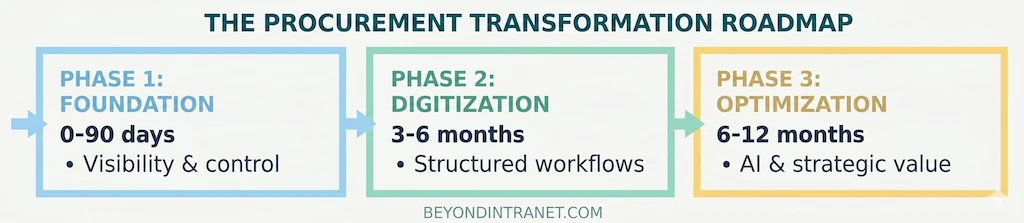
The Procurement Transformation Roadmap: A 3-Phase Approach
Every failed mid-market transformation we’ve studied has the same origin story: the team tried to overhaul everything simultaneously and ran out of steam by month four. A procurement transformation roadmap works because it sequences the effort into stages where each phase earns credibility for the next.
PHASE
TIMELINE
GOAL
KEY ACTIONS
OUTCOME
Foundation
0-90 days
Visibility and control
Audit spend, tooling, and supplier list. Consolidate vendor records. Centralize approval workflows. Pick a platform. Run a pilot on one category.
Roll out RFQ workflows. Digitize supplier onboarding. Implement multi-level approvals. Integrate with M365 and ERP. Train the team.
Sourcing cycle time cut 30-50%. Off-contract spend drops. Team capacity freed for strategy.
Optimization
6-12 months
Layer AI and strategic value
Turn on AI RFQ generation and bid scoring. Activate supplier recommendation engine. Deploy spend analytics. Expand to all categories. Tie procurement KPIs to business outcomes.
Procurement operates as a strategic function. Measurable ROI. Ready to scale spend without scaling headcount.
Phase 1 answers a basic question: what are we spending, with whom, and is anyone actually approving it? Phase 2 replaces the manual steps with workflows that run without someone chasing them. Phase 3 hands the repetitive sourcing work to AI so the team can focus on decisions that require judgment.
Sequential, not parallel. Phase 1’s quick wins build the internal case for Phase 2. The data Phase 2 produces is what makes Phase 3’s AI capabilities genuinely useful. Skip the sequence and you end up with an AI engine sitting on top of dirty data.
Procurement Transformation Services vs Building It In-House
Two paths. Hire procurement transformation services from a consulting firm at $200K or more for a 6-month engagement. Or buy a modern platform and roll it out yourselves.
Consulting makes sense when you genuinely don’t know what your procurement operating model should be. But most mid-market teams don’t need a new model. They need their existing process digitized so it runs consistently. That’s a platform decision.
Particularly when the platform sits inside the M365 environment your IT team has already approved. No new cloud. No new security review. Days to deploy, not quarters.
How AI and Microsoft 365 Are Reshaping Procurement Transformation
Here’s the question that changes the math for mid-market teams: why deploy a separate vendor cloud when you already pay for Microsoft 365?
That matters because the IT objection kills more mid-market transformations than budget does. When the procurement system runs inside the existing M365 tenant, the security review, the vendor risk assessment, and the credentials conversation all disappear.
On top of the hosting model, AI is accelerating the sourcing work itself. AI-generated RFQ documents from intake data. Automated supplier-response review that flags inconsistencies and scores bids against weighted criteria. A recommendation engine that surfaces qualified suppliers the team might not have considered. These capabilities turn the analyst’s week from 70% manual sourcing execution to 70% strategy and relationship management.
Beyond Intranet is built on this exact model. RFQ, RFP (request for proposal), vendor evaluation, e-auctions, and multi-level approvals all running inside the customer’s own M365 tenant. Inherits existing security policies. Works with Teams for collaboration, Power BI for analytics, and SAP and S/4HANA at the ERP boundaries. Rated 5 stars on Capterra. 4.9 on Microsoft AppSource. See the full procurement management software capabilities.
Start Your Procurement Transformation
Replace manual sourcing with AI-powered workflows, centralized approvals, and complete spend visibility—all within Microsoft 365.
Start with sourcing cycle time. Measure the weeks between a purchase requisition (PR) entering the system and the award going out. After Phase 2, a 30-50% reduction is realistic. If the number isn’t moving, the workflows aren’t doing their job.
Spend under management tells you what percentage of total company spend is flowing through procurement. If 40% of purchases bypass your team entirely, transformation hasn’t reached the departments where maverick buying lives.
Realized savings versus negotiated savings catches the gap between the discount you negotiated and what the company actually paid. If those two numbers don’t match, procurement’s work isn’t reaching the P&L.
Supplier consolidation rate tracks how many active vendors you have per category. Fewer, better-managed relationships produce better pricing and lower risk.
And the percentage of RFQs running through a structured workflow versus ad hoc tells you whether the team is using the system or working around it. If you can’t measure these on Day 1, you’re not transforming. You’re just buying software.
It means rebuilding how your organization buys: the processes, the team structure, and the technology underneath. The goal is turning procurement from a department that processes transactions into one that measurably drives value. Swapping one spreadsheet for a new tool isn't transformation. The change has to be structural.
Three come up in every conversation: teams that are comfortable with how things work today and resist change, data trapped in spreadsheets and disconnected tools that nobody wants to migrate, and budgets that don't stretch to cover a big-bang rollout. Getting the executive team on board is harder when procurement has historically been treated as a back-office function. Phasing the rollout helps because early wins build credibility faster than a business case on a slide. For more on this, see our post on common procurement challenges every mid-market team should be planning for.
Depends on your starting point. Phase 1 (getting visibility into spend and cleaning up vendor data) typically takes 90 days. Phase 2 (digitizing the sourcing workflows) runs 3-6 months. Phase 3 (AI and optimization) fills months 6 through 12. M365-native platforms compress Phase 2 significantly because deployment is measured in days, not months. The full arc for a mid-market team is usually 9-12 months, versus 18-24 for enterprise.
It's the sequenced plan that takes your procurement function from wherever it is today to a digitized, strategic operating model. The version in this article uses three phases: foundation, digitization, optimization. The roadmap matters because it prevents the "we tried to change everything and nothing stuck" failure mode. Each phase produces a result the next one builds on.
AI handles the tasks that used to consume most of a sourcing analyst's calendar: writing RFQ documents from intake data, flagging inconsistencies in supplier responses, scoring bids against weighted criteria without manual spreadsheet work. For mid-market teams, the bigger shift is procurement software running inside the customer's own M365 tenant. No separate cloud. No new security posture. Beyond Intranet operates this way: the entire sourcing lifecycle lives inside your existing Microsoft 365 environment.
Procurement transformation isn’t about adopting another SaaS platform your IT director has to vet. It’s about finally running procurement inside the Microsoft 365 environment you already pay for, with AI handling the manual work that kept the team in tactical mode.