A practical, vendor-neutral guide for CIOs, IT directors, and digital workplace leaders evaluating SharePoint consulting partners in Australia — including a comparison...
TL;DR: Organizations face a daunting 8.8% productivity gap. Discover how an automated purchase requisition workflow improves approval speed, spend control, and compliance. Learn essential steps and how digital orchestration acts as a strategic lever to enhance overall sourcing efficiency today.
Introduction
Currently, 43% of companies rely on outdated manual approvals. A digitized purchase requisition workflow dictates whether these internal purchases can even proceed. In this guide, we’ll walk through the essential structures, the common failure points, and how advanced automation strategies can truly eradicate value leakage.
What Is a Purchase Requisition Workflow?
At its core, a purchase requisition workflow is the strictly governed internal pathway that begins the moment an employee requests goods or services. It concludes when that request is fully vetted and ready for Purchase Order (PO) conversion. Think of it as the vital bridge between a departmental need and an external commitment. It ensures that every request is formally evaluated against corporate policies, budgets, and vendor risk profiles before any capital actually leaves the building.
Why a Structured Purchase Requisition Workflow Matters
Intelligent structure actually creates operational freedom for your teams. The strategic implementation of purchase requisition yields significant business outcomes, acting as a profound mechanism for margin protection.
Spend Control: When you manage things manually, it costs roughly $15.00 per document. Automated environments compress this operational burden significantly before money is committed.
Compliance: Manual structures consistently suffer from a 3.6% critical error rate, risking duplicate payments. Systemic policy enforcement eliminates this risk entirely.
Accountability: By attaching approval responsibility to named roles, we curb maverick spend. Just look at Oklahoma; they identified $174 million in savings simply by enforcing centralized requisition controls.
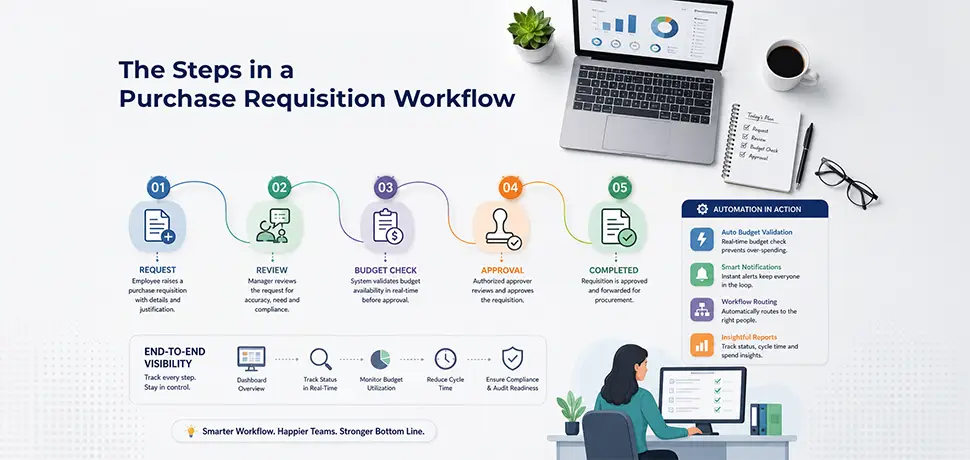
The Steps in a Purchase Requisition Workflow
When there is an intimate understanding of how data moves across your organization, designing a resilient process is easier. The architecture of your internal steps really determines your procurement cycle’s overall velocity
Workflow Design Questions to Address First
Before finalizing any standard operating procedures, leadership must define clear rules of engagement:
Which purchases require review? Capital expenditures require intense scrutiny, whereas routine office supplies may only need a cursory check.
Which requests can be auto-approved? Setting smart monetary thresholds prevents frustrating administrative bottlenecks.
Who reviews requisitions at each stage? Clear designation prevents routing confusion. Is it a single line manager, or a matrix involving IT and Finance?
What happens when an approver is unavailable? Escalation timeouts ensure the workflow purchase requisition process never stalls during employee absences.
Single Document Workflow for All Requested Goods or Services
When a user submits a cohesive request, such as a specific software license or a bundle of related marketing materials; the single document approach is highly efficient. This streamlines the pr workflow by keeping all related line items bundled under one dedicated approval path.
Roles Involved
Requester: The individual who identifies the business need, gathering accurate specifications and pricing estimates.
Reviewer: Often a procurement analyst ensuring the form is not missing critical data, preventing incomplete requests from wasting executive time.
Requester’s Manager: The individual holding budget authority, assessing the strategic necessity of the request.
Process Flow
The requisition is submitted for review: The preparer enters the data into the system.
The reviewer checks completeness and accuracy: Bad data is immediately bounced back to the preparer.
The requester’s manager approves, rejects, or returns it for revision: Upon verifying budget availability, the manager executes the final internal authorization.
Individual Document Workflow for Each Requested Good or Service
For complex operational environments, a user might request highly disparate items simultaneously—for example, a new server rack and external consulting services. An individual document workflow separates these items into parallel tracks, ensuring domain experts only review what is relevant to them.
Roles Involved
Requester: Initiates the multi-line or multi-category request.
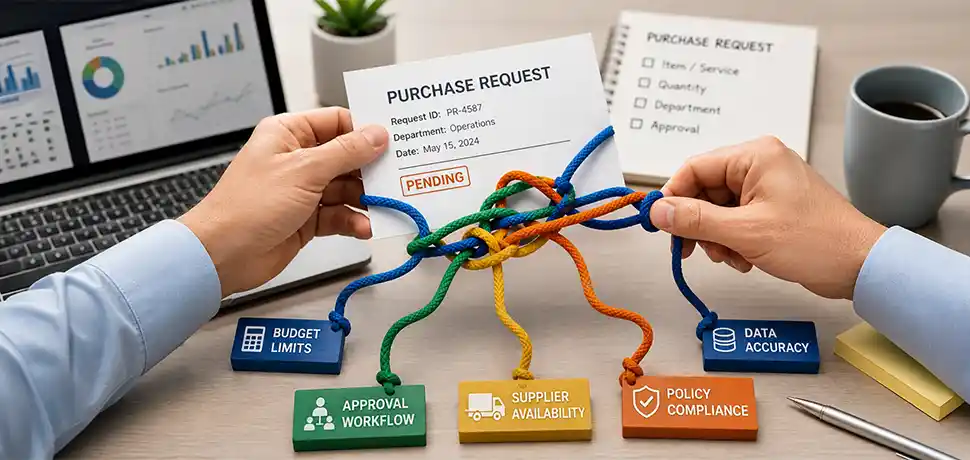
Breakdowns in a purchase request workflow actively destroy value. Manual approvals create severe delay, and frustrated employees often circumvent slow systems.
Without dynamic delegation, a manual workflow purchase requisition can completely pause if just one manager goes on leave.
Automation & Best Practices
Technology never replaces operating discipline; instead, it amplifies it. Once forms are standardized that removes ambiguity, sets clear approval thresholds to prevent fatigue; it maximizes the overall efficiency.
Modernizing requires a shift to dynamic orchestration. Automated routing moves requests instantly, while exception detection flags non-compliant requests early.
This digitized purchase request workflow ensures budget data stays connected during review, providing approvers with exact financial context.
Eliminate operational bottlenecks instantly and gain complete process visibility without disrupting your current systems.
Whether your team handles 10s or 100s of requests each week, our system helps you stay organized, efficient, and in control of every spend.
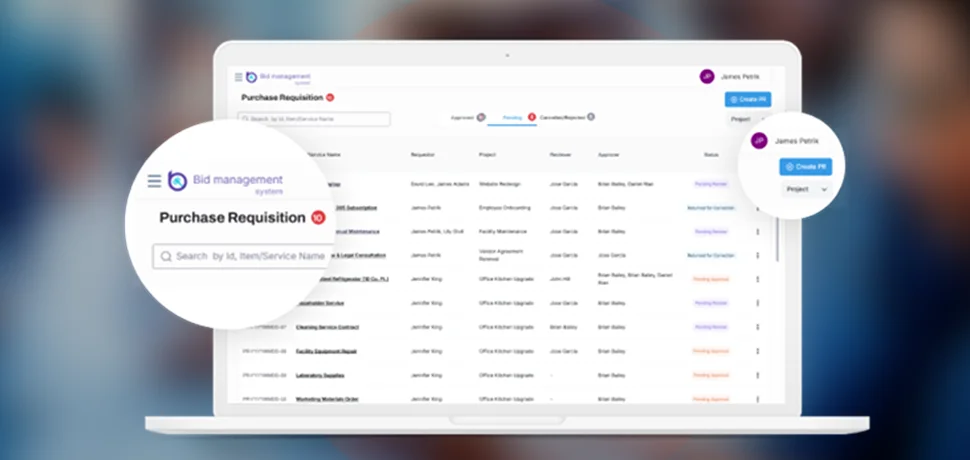
Beyond Intranet’s purchase requisition solution streamlines the entire lifecycle seamlessly within your Microsoft 365 environment. Approved requisitions automatically turn into RFQs, bridging the gap to supplier engagement.
Transform your pr workflow today. Start gaining real-time visibility with our Purchase Requisition Software. It is a trusted system built for teams needing total spend control.
Our dedicated professionals are ready to assist you; please get in touch today.
It is the internal pathway for approving requests. It enforces policy compliance, and ensures funds are available before formal external commitments are made.
Automation utilizes intelligent routing to instantly notify approvers. Top-performing teams achieve 76% faster PO processing compared to legacy methods.
The workflow purchase requisition sequence involves an employee submitting a formalized need, routed to managers and finance to validate the business case before a PO generates.
A user details the item, quantity, and cost, submitting it through an internal portal where it undergoes predefined managerial and financial validation checks.
The Purchase Requisition (PR) always comes first. It is the internal request for spend permission, while the PO is the legally binding external document.
Conclusion
You know, when you look at it, a well-architected purchase requisition process is what truly protects corporate spend, keeps approvals disciplined, and ensures reliable execution. It is untrue that automation replaces human control; infact it makes control faster, structurally sound, and much easier to scale.
To eliminate operational bottlenecks and build a world-class procurement infrastructure, contact us.