A practical, vendor-neutral guide for CIOs, IT directors, and digital workplace leaders evaluating SharePoint consulting partners in Australia — including a comparison...
Your operations team calls on a Thursday afternoon. A piece of equipment broke. They need a replacement part by Monday. There’s no contract in place for this supplier. No time for a formal RFQ. What does your procurement team do? They spot buy. It’s the right call in the moment. But if that “one-off” purchase happens 50 times a year across different departments, it stops being an exception and starts being a procurement control problem. Here’s what spot buying is, when it makes sense, and when your team should be doing something different.
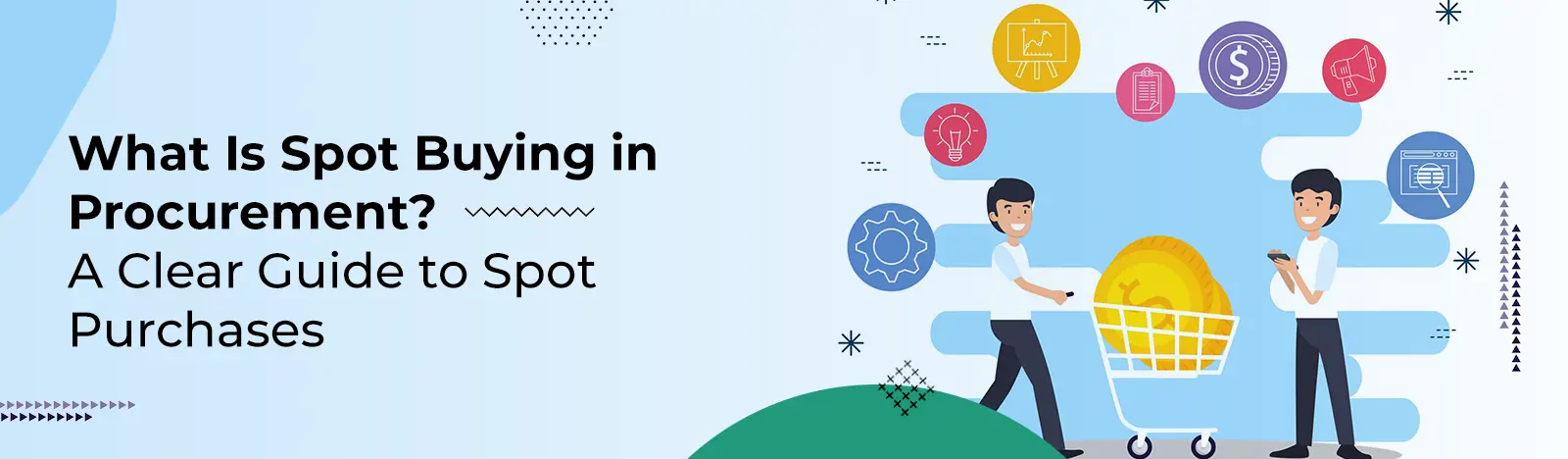
What Is Spot Buying? Definition and Context
Spot buying is a one-off, uncontracted purchase made to meet an immediate need. It sits outside the regular procurement cycle. No framework agreement. No pre-negotiated pricing. No pre-qualified supplier. The buyer finds a vendor, agrees on a price, and places the order. What is spot buying in practical terms? It’s the emergency MRO part your maintenance team sources from a local distributor at 9am because the production line is down. It’s the $3,000 worth of office furniture a regional office orders directly because the contract with the preferred supplier doesn’t cover their location. It’s a spot buy for a specialized testing service that the company has never purchased before and doesn’t have a category for.
The distinction from contract purchasing is straightforward. A contract purchase happens inside a pre-negotiated agreement with a vetted supplier at agreed terms. A spot purchase happens outside that structure. Speed is the advantage. Control is what you give up. For a deeper look at how sourcing fits into the broader procurement function, see our guide on what sourcing means in procurement (beyondintranet.com/blog/what-is-sourcing/).
How a Spot Buy Works: The Process
A typical spot buy follows six steps, though “follows” is generous because most spot purchases skip at least two of them.
The need surfaces. Usually urgent. An employee or department head identifies something they need that isn’t covered by an existing supplier agreement. They do a quick market check: who sells this, what does it cost, can they deliver by the deadline? A price comparison happens, sometimes formally, often informally. An approval goes through, frequently expedited or skipped entirely because the value falls below the threshold that triggers procurement’s attention. A PO gets raised after the fact. For clarity on how purchase requisitions differ from purchase orders in this context, see our guide on purchase requisition vs purchase order (beyondintranet.com/blog/purchase-requisition-vs-purchase-order/). Delivery and payment close the loop.
Here’s the thing most procurement teams miss: with eSourcing tools, even urgent spot buys can run as rapid mini-RFQs. Send a structured request to three suppliers through a portal, collect responses in a day, and award with a documented comparison. It takes marginally longer than calling one vendor. But it creates a record, introduces competition, and gives your team a defensible decision. BeyondIntranet’s eSourcing software handles exactly this: rapid competitive spot purchases without slowing the process down.
Benefits of Spot Buying in Procurement
Speed. That’s the primary advantage and the reason spot buying exists. When the need is urgent and no contract covers it, a spot purchase gets the item on-site faster than any formal sourcing process. No RFQ timeline. No evaluation period. No three-week approval chain.
Flexibility matters too. A spot buy doesn’t lock you into a long-term commitment. You’re testing a supplier, filling a gap, or responding to a one-time requirement. If the vendor performs well, you know who to invite to the next formal sourcing event. If they don’t, there’s no contract to unwind.
For tail spend categories and low-risk items, what is spot buying if not the practical answer? Office supplies in a pinch. A specialist contractor for a single project. IT accessories for a new hire starting Monday. The value is too low and the urgency too high for a structured procurement process. Spot buying handles it.
Risks and Drawbacks of Spot Buying
The cost is almost always higher. A spot purchase at list price on a category where the organisation could negotiate a 12-15% discount through a framework agreement is money left on the table every time. One $2,000 purchase at list price doesn’t matter. Fifty of them across the year at 15% above negotiated rates is $15,000 in unnecessary spend.
Compliance risk is the structural problem. A spot buy typically means the supplier hasn’t been vetted. No credit check. No insurance verification. No signed terms. No data protection clauses. If that vendor handles anything sensitive, or if they’re on-site, the organisation carries a risk that procurement never assessed. BeyondIntranet’s eSourcing software addresses this: even rapid purchases can be routed through a supplier qualification check before the PO is raised.
And then there’s the data problem. Every spot purchase that bypasses the procurement system is a transaction the organisation can’t see in its spend analytics. Multiply that across departments and you have thousands of pounds in spend that nobody can categorise, benchmark, or manage. That’s how maverick spend habits form. One spot buy becomes the default, and nobody notices until the annual spend review reveals 40 suppliers in a category that should have three.
Spot Buying Too Often? There’s a Faster Way to Run Competitive Events.
BeyondIntranet’s eSourcing software turns urgent spot buys into structured mini-RFQs inside Microsoft 365. Competitive. Documented. Still fast.
Spot Buying vs Contract Purchasing: Key Differences
DIMENSION
SPOT BUYING
CONTRACT PURCHASING
Timeframe
Immediate. One-off transaction.
Planned. Recurring over the agreement term.
Price
Typically higher. List or spot market pricing.
Lower total cost through volume and negotiated rates.
Supplier relationship
Transactional. Minimal relationship.
Long-term. Managed. Performance tracked.
Compliance
Higher risk. Limited or no supplier vetting.
Lower risk. Vetted, contracted, terms on file.
Process
Quick. Minimal approval. Often undocumented.
Structured. RFP or RFQ, evaluation, formal award.
Best for
Emergencies, tail spend, one-off low-value items.
Strategic, high-volume, recurring categories.
The table makes the trade-off clear. A spot purchase trades control for speed. That’s acceptable when the value is low and the need is urgent. It’s not acceptable when the category is high-value, recurring, or compliance-sensitive.
When Should You Use Spot Buying?
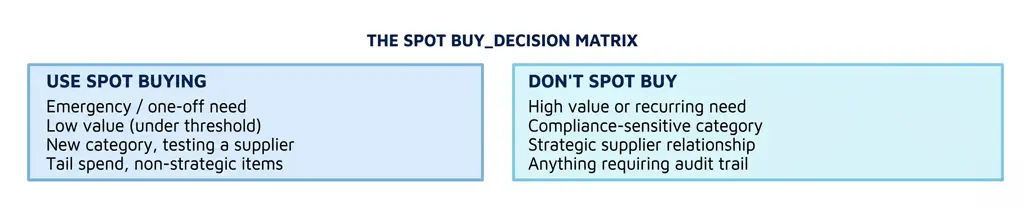
Use it for genuine emergencies where waiting for a sourcing event would cause operational damage. A production line is down. A critical piece of IT equipment failed. The regional office needs something by Monday that the regular supplier can’t deliver.
Use it for one-off, low-value items that fall below your procurement threshold. The $800 replacement monitor. The $1,500 consultancy for a single project. Anything where the cost of running a full sourcing process exceeds the savings it would generate.
Use it to test a new supplier on a small order before inviting them into a formal competitive event. Think of it as a paid pilot. If you’re unsure whether a category should stay as spot buying or move to structured sourcing, talk to our team (beyondintranet.com/contact).
Don’t use it for anything recurring. If your team spot-bought the same category three times this quarter, that’s not an emergency. That’s a category management gap. Don’t use it for high-value purchases where a 10-15% price difference represents real money. And don’t use it for compliance-sensitive categories where an unvetted supplier creates risk the organisation hasn’t assessed.
Spot buying is fast and flexible. It handles the urgent, low-value, one-off purchases that every procurement team encounters. But speed comes with a cost, a compliance gap, and a data blind spot. The best procurement teams use spot buying selectively and run even their rapid purchases through structured tools where possible. A spot buy that takes one extra hour but produces a documented comparison, a vetted supplier, and a visible spend record is worth that hour every time.
Even Rapid Purchases Deserve a Process
BeyondIntranet’s eSourcing software runs mini-RFQs for urgent spot buys inside Microsoft 365. Competitive. Documented. Fast.