Choosing a SharePoint consulting company in Australia involves more than comparing service lists. The right partner needs relevant project experience,...
Quick answer: The right Azure consulting partner holds current Microsoft Solutions Partner designations, shows named references in your industry, and...
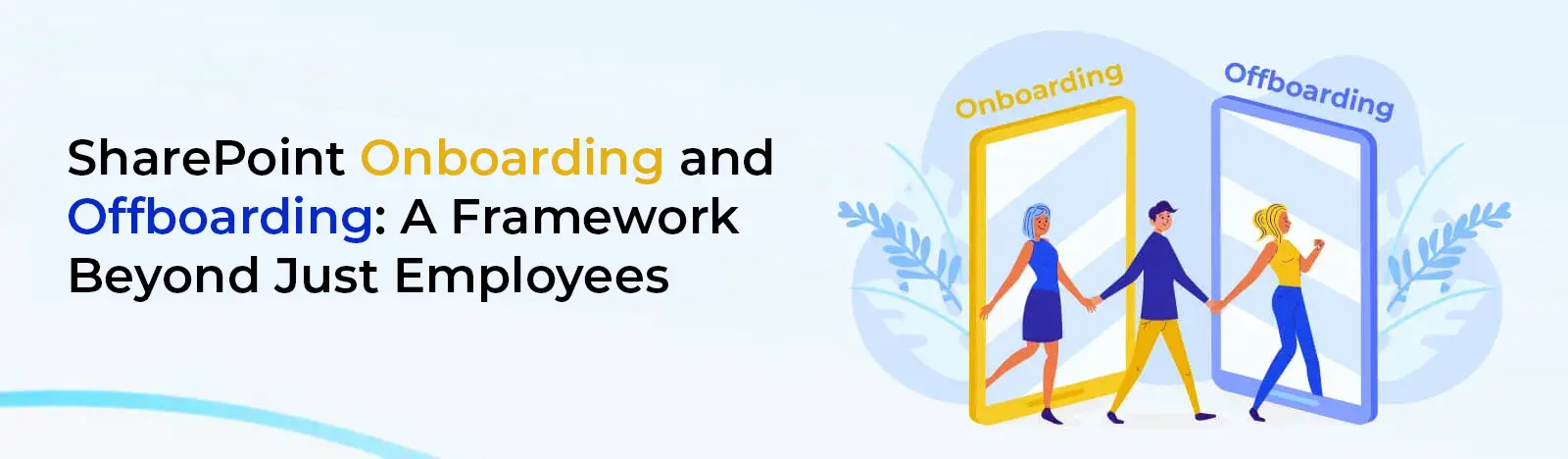
Search for onboarding and offboarding software and every result assumes you mean employees. The category was built around hiring, and the content follows it.
Your organization starts and ends other relationships too. A vendor signs a contract and eventually the contract expires. A student enrolls and eventually graduates. A contract nurse arrives for a twelve-week assignment and leaves at the end of it. Each of those people submits documents, receives system access and needs that access removed on a specific date, and almost none of them appear in an onboarding playbook.
Teams already running Microsoft 365 have more of the answer than they realize. This guide covers what SharePoint onboarding and offboarding looks like across five relationship types, with verified outcomes for three of them.
In This Article
Why onboarding and offboarding outgrew HR
The common SharePoint backbone
Vendor onboarding and offboarding
Student onboarding and offboarding
Healthcare staff onboarding and offboarding
Client onboarding: where SharePoint fits today
One framework, not five separate systems
Key takeaways
The onboarding and offboarding backbone on SharePoint covers checklists, routed tasks, a document repository and access control, and none of that is employee-exclusive. Beyond Intranet has configured the same add-in for three non-employee lifecycles with published results. A UAE construction firm now runs its vendor lifecycle on it. An online university reports a 35 percent reduction in student-processing costs alongside a 50 percent increase in student retention. A US healthcare staffing agency reports roughly 30 percent higher nursing-staff retention and a reduction in onboarding costs above 26 percent.
Why onboarding and offboarding outgrew HR
What is the difference between onboarding and offboarding?
Onboarding brings a person or an entity into your systems and processes, collecting what you need from them and granting the access they need from you. Offboarding removes that access and closes out the relationship. Both deserve the same rigor, and only one of them usually gets it.
Consider what actually happens when your organization begins any relationship.
You collect documents. You verify something about the other party. That might be a tax form or an insurance certificate, a transcript or a nursing license. You create an account and grant permissions scoped to what that person legitimately needs. You assign tasks to people in three or four departments who each hold one piece. Then, months or years later, you reverse all of it.
That sequence describes a new hire. It describes a supplier equally well, and a student, and a contract clinician. HR simply got there first, so the software category grew up around employees and the vocabulary followed.
The consequence shows up in procurement and admissions teams building the same process by hand. McKinsey’s procurement practice describes supplier discovery as a traditionally manual and time-consuming process, and the onboarding that follows it usually inherits the same character. Nobody set out to run three parallel manual processes. The tooling just never arrived for two of them.
The scale of the gap is easy to underestimate. A mid-sized organization might onboard forty employees in a year while onboarding two hundred vendors, enrolling several hundred students or processing clinical assignments continuously.
The common SharePoint backbone
How can SharePoint be used for onboarding and offboarding?
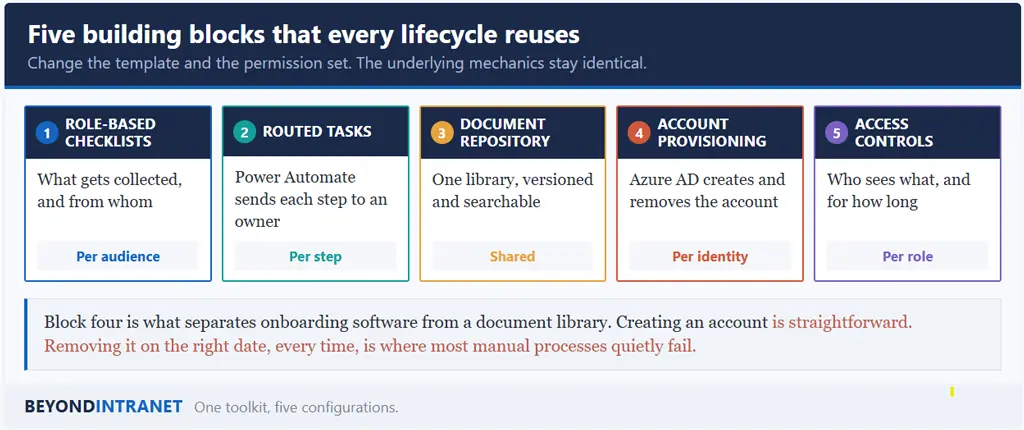
SharePoint supplies five reusable components. Role-based checklists define what gets collected. Power Automate routes each task to its owner. A central document library holds what arrives. Azure Active Directory creates and removes accounts. Permission controls decide who sees what, and for how long.
Change the template and the permission set. The underlying mechanics stay identical.
Those five components are what every lifecycle in this article reuses. What changes between audiences is the template and the permission set, and very little else.
Building block
What it does
What changes per audience
Role-based checklists
Defines the documents and steps for each relationship type
The list of items and who supplies them
Routed tasks
Sends each step to a named owner with a due date
Which department owns which step
Document repository
Holds submissions in one versioned, searchable library
The folder structure and retention rules
Account provisioning
Creates and removes accounts through Azure Active Directory
The access scope and the end date that triggers removal
Access controls
Governs visibility, aligned to GDPR practice
Which roles can see which records
Table 1. Five components. The right-hand column is the only part that varies.
The fourth component deserves emphasis, because it separates onboarding software from a well-organized document library. Creating an account is straightforward work. Removing it on the correct date every time, across vendors and students and contract staff, is where manual processes quietly fail.
None of this requires custom development. Every component listed above ships inside Microsoft 365, which is why teams already licensed for it are further along than they tend to assume.
Vendor onboarding and offboarding on SharePoint
Vendors also arrive in volume and leave quietly, which is the combination that creates exposure. Nobody circulates an announcement when a supplier contract lapses.
Can SharePoint be used for vendor onboarding?
Yes. Beyond Intranet configured its onboarding and offboarding add-in for a UAE construction firm managing its full vendor lifecycle on SharePoint. That deployment covers compliance documentation, approval routing and access removal at contract close. The same building blocks that handle a new hire handle a new supplier.
Vendor onboarding carries a heavier documentation burden than most HR processes. A supplier submits registration details, tax documentation, insurance certificates and any industry-specific compliance evidence. Somebody in procurement verifies each item, somebody in legal reviews the contract, and somebody in finance sets up payment details.
Construction adds another layer, since site access, safety certification and subcontractor documentation all sit inside the same approval chain. Missing one item does not slow a process down. It stops a supplier from working on site.
Risk-based vetting is worth building into the checklist instead of handling it separately. A supplier providing stationery and a supplier providing structural steel warrant different levels of scrutiny, and a role-based template can route the second through additional approval steps without slowing the first.
Offboarding is where vendor management most often falls apart, and it fails more quietly than employee offboarding does. A contract expires. Nobody schedules the removal of portal access, so the supplier keeps a login into systems holding pricing, drawings or project documentation. Nothing prompts anybody to notice, because no leaving date appeared in an HR system.
Running the vendor lifecycle on the same platform closes that gap. The contract end date becomes the trigger, the same way a termination date does for an employee, and the access removal happens on schedule rather than when somebody remembers.
Beyond Intranet’s Employee Onboarding & Offboarding add-in has already done this for a UAE construction firm’s vendor lifecycle.
The same checklists, routing and access controls, configured for suppliers instead of staff.
Education runs the highest-volume version of this problem. An intake of several hundred students compresses into a few weeks, and every one of them needs the same documents collected and the same access granted.
How do you offboard a student rather than an employee?
The steps stay the same. You revoke system access, close out the documentation record and run an exit checklist, applied to a student record instead of a staff record. Graduation and withdrawal both function as end dates in exactly the way a resignation does.
Student onboarding is a coordination problem before it is a document problem. Admissions holds the application while the registrar holds enrollment. The accounts office holds fee status and IT holds the account. Four departments, four systems, and a student caught between them chasing whichever one has not yet confirmed.
Beyond Intranet configured the add-in for an online university to run admissions through to graduation on one platform. The published outcome of that student onboarding case study records a 35 percent reduction in student-processing costs and a 50 percent increase in overall student retention. Those figures come from Beyond Intranet’s own case study rather than independent research.
The retention number is the interesting one. Nobody expects document workflow to affect whether students stay, and the mechanism becomes clearer on reflection. An enrollment that takes three weeks and four follow-up emails teaches a student something about the institution before their first class begins.
Consolidating those four departments onto one record removes most of the chasing. Each team still owns its own step, and the student sees a single status rather than four unsynchronized ones.
Offboarding matters here for reasons that differ from the employee case. A graduating student needs their access wound down while their academic record is retained, sometimes permanently. A withdrawing student needs the same wind-down on a different timeline, with different fee implications. Both are end dates, and both suit an automated trigger better than a manual one.
Healthcare staff onboarding and offboarding on SharePoint
A note on scope before the detail. This section covers onboarding clinical staff, meaning the nurses and practitioners an organization employs or places. Patient intake is a different problem with different regulatory obligations, and nothing here addresses it.
Clinical staffing raises the compliance stakes considerably. Before a nurse begins an assignment, a coordinator verifies licensure and confirms certifications remain current. Immunization status gets recorded and policy acknowledgments captured. Every item carries a regulatory consequence when it is missing.
Credential expiry adds a dimension employee onboarding rarely handles. A license or a certification has its own end date, independent of the assignment, and tracking both at once is precisely the kind of work that suits a checklist with routed reminders.
A US healthcare staffing agency deployed the same add-in for its nurse onboarding . The published nurse onboarding case study records approximately 30 percent higher nursing-staff retention and a reduction in onboarding costs above 26 percent, again as Beyond Intranet’s own reported figures.
Assignment-based work makes offboarding routine work. A staffing agency offboards constantly, because every assignment ends by design. Access tied to an assignment end date removes itself, which matters when the same clinician may return on a new assignment three months later and need a fresh access scope.
Reporting carries weight in this sector too. When a regulator or a client hospital asks which credentials were verified before a given assignment began, an answer assembled from email threads takes days. An answer held against the assignment record takes minutes.
Whichever relationship you are managing, it runs on the same SharePoint-native toolkit.
One configurable add-in, deployed inside the Microsoft 365 tenant you already administer.
Client onboarding and offboarding: where SharePoint fits today
Client engagements follow a recognizable version of the same shape. A kickoff collects scope documents, contact details and any access the client needs to shared workspaces. An engagement close reverses it. Deliverables get archived and external access to collaboration sites comes down.
The building blocks described earlier apply to that pattern without modification. A checklist defines what a kickoff collects. Routed tasks assign each item to an owner in delivery, legal or finance. A document library holds the engagement record, and permission controls govern what an external guest can reach.
Worth being direct about the status of this one. No client onboarding case study has been published, and this section makes no claim about a proven deployment. What the underlying platform supports is a configuration question, and any team considering it should treat it as a build rather than an off-the-shelf template.
Employee onboarding and offboarding: the short version
Employee onboarding is the most mature use case of the five, and it is covered thoroughly elsewhere on this site rather than repeated here. For the stage-by-stage treatment covering pre-boarding through the 90-day review, along with the automation layer underneath it, see the complete guide to onboarding automation. The mechanics described there are the same five components this article has been tracking, applied to the audience the category was originally built for.
One framework, not five separate systems
Relationship
What you collect
What ends it
The mechanics
Vendor
Contracts, insurance, compliance evidence
Contract expiry or termination
Same five components
Student
Enrollment records, ID, fee status
Graduation or withdrawal
Same five components
Clinical staff
Licenses, certifications, policy sign-off
Assignment end date
Same five components
Client
Kickoff documents, scope, contacts
Engagement close
Same five components
Employee
Tax forms, policy acknowledgments, equipment
Resignation or termination
Same five components
Table 2. Five relationships. One set of underlying mechanics, configured five ways.
Three of those rows are backed by published Beyond Intranet case studies, and all three ran on the same add-in. No separate vendor product exists, and no separate student product exists. What differs between the construction firm and the university is the checklist template and the permission model, not the software.
The integration cost is the part organizations underestimate. Three separate systems holding overlapping records about people and organizations need reconciling, and that reconciliation becomes permanent work in place of a one-time project.
That matters commercially as well as architecturally. Organizations buying a vendor management tool, a student information add-on and an HR onboarding platform are paying three times for one set of mechanics, then integrating three systems that hold overlapping records about people and organizations.
There is an architectural argument alongside the commercial one. A single record of who holds access to what, spanning employees and vendors and contract staff, answers a security question that three separate systems cannot answer without reconciliation.
For teams already licensed for Microsoft 365, the practical question is narrower than a platform selection. You are asking which lifecycles to configure first, and in what order.
Sequencing usually favors the lifecycle with the clearest end date. Vendors and contract staff both come with a documented close, which makes the automated trigger straightforward to configure and easy to demonstrate internally.
Crossboarding covers an internal move or role change rather than a new hire or a full exit. The person stays, while their access changes along with their equipment and reporting line, which makes it a hybrid of the two processes and a common gap in tooling built for hiring alone.
No. All three published case studies ran on the same configurable add-in inside the organization's existing Microsoft 365 tenant. Adding a vendor lifecycle alongside an employee one is a configuration exercise involving new templates and permission sets.
Identically in mechanism. An end date triggers the checklist, routed tasks handle document close-out, and Azure Active Directory removes the account. What changes is which record type the trigger sits on and which retention rules apply afterward.
Guest access covers most vendor and client scenarios, scoped to specific sites or libraries rather than the wider tenant. Confirm the current licensing terms with your Microsoft partner, since external-sharing entitlements change and vary by agreement.
Where to start
List every relationship type your organization starts and ends in a year. Most teams find four or five, and can name a documented process for only one of them.
Pick the lifecycle where a missed access removal would cost you most. That is usually vendors, because contract end dates rarely reach anybody in IT.
Check what your existing Microsoft 365 licensing already covers before evaluating a separate platform. The backbone is frequently already paid for.
Onboarding discipline is not an HR problem
Every relationship your organization begins carries the same underlying obligations. Collect the right documents, grant the right access, and remove that access when the relationship ends. HR built the discipline first and named it after employees. That left procurement and admissions solving the identical problem, clinical operations too, without the vocabulary or the tooling. Teams already on Microsoft 365 own the components. The remaining work is deciding which lifecycle to configure first.
If your organization is juggling onboarding and offboarding across more than one audience, a short call is the fastest way to see what’s configurable out of the box.
We will walk through the templates, the routing and the access model against your own tenant.