Choosing a SharePoint consulting company in Australia involves more than comparing service lists. The right partner needs relevant project experience,...
Quick answer: The right Azure consulting partner holds current Microsoft Solutions Partner designations, shows named references in your industry, and...
Read almost any supplier risk framework published this year and you’ll hit the same assumption somewhere around the third section. It takes for granted that you have external data feeds, a governance platform, and somebody whose job title contains the word risk.
Plenty of procurement teams have none of that. They have a spend report, a shared drive of certificates, and one person who remembers which supplier caused trouble last year. This piece is the version of the framework that team can actually run.
In This Article
What counts as supplier risk? Six categories to track
Why most continuous monitoring advice doesn’t fit every team
Building a supplier risk tiering model
The supplier risk assessment process, step by step
A practical assessment template you can start with
Making continuous achievable without a dedicated platform
Where risk assessment connects to onboarding and sourcing
Key takeaways
Six categories cover most supplier risk. Financial and operational, compliance and cybersecurity, then geopolitical and reputational.
Start with tiering rather than a software purchase. Sorting suppliers by spend and criticality tells you where to spend assessment effort.
Run the assessment as a defined sequence, with depth matched to tier.
Continuous monitoring is a discipline before it’s a subscription. Expiry alerts and a supplier portal cover most of what a mid-market team needs.
What counts as supplier risk? Six categories to track
What is supplier risk management?
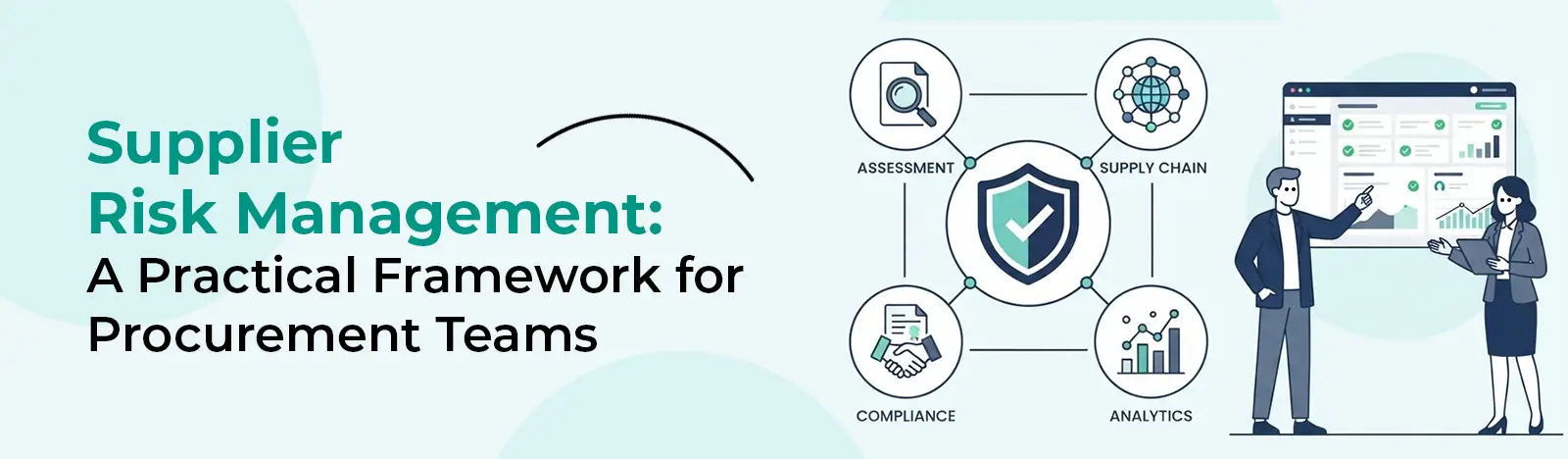
Supplier risk management is the process of identifying and assessing the risks a supplier could introduce into your operations or finances, and into your compliance posture. The scope runs from financial and operational exposure through compliance and cybersecurity, out to geopolitical and reputational risk across the whole relationship.
The categories overlap in practice, which is fine. A supplier who’s financially strained often starts missing deliveries before anything appears in their accounts, so operational signals frequently arrive first.
What are the main types of supplier risk?
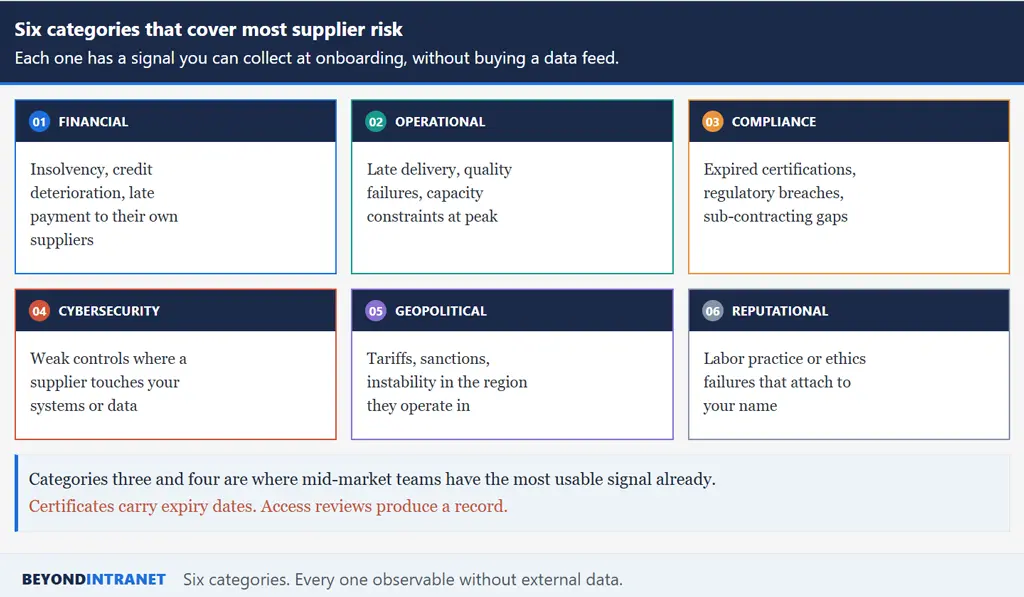
Six categories cover most of it. Financial risk means insolvency or credit deterioration. Operational risk covers delivery and quality failures. Compliance risk includes third-party regulatory gaps. Cybersecurity risk sits wherever a supplier touches your data. Geopolitical risk covers tariffs and sanctions. Reputational risk is what attaches to your name when a supplier behaves badly.
Each category has a signal you can collect at onboarding.
Category
What it looks like
A signal you can collect
Financial
A supplier misses payroll, stretches payables, or files for protection
Late deliveries, quality escapes, capacity shortfalls at peak demand
On-time delivery rate and defect data from your own records
Compliance
Lapsed certifications, regulatory breaches, undisclosed sub-contracting
Certificates on file, with expiry dates tracked
Cybersecurity
Weak controls where the supplier holds your data or touches your systems
A completed security questionnaire, plus what access you granted
Geopolitical
Tariff exposure, sanctions, instability where they manufacture
Country of origin and manufacturing footprint, declared at onboarding
Reputational
Labor practices or ethics failures that become your problem publicly
Declared policies, plus adverse media checks on critical suppliers
Table 1. Six categories. Every signal in the right-hand column is available without an external data subscription.
Compliance and cybersecurity deserve attention because they’re where mid-market teams already hold usable evidence. Certificates carry expiry dates. Access grants leave a record. Neither needs a feed.
A word on what this framework deliberately leaves out. Sub-tier mapping, where you trace risk through your suppliers’ own suppliers, is genuinely valuable and genuinely out of reach without specialized tooling. Nothing below pretends otherwise.
Why most continuous monitoring advice doesn’t fit every team
Continuous monitoring beats annual assessment. Every framework published this year opens with some version of that claim, and it’s correct.
The trouble is what comes next. Most guidance assumes threat-intelligence integrations and sanctions screening APIs. Credit-rating feeds too, and sub-tier supply chain mapping. Those are real capabilities with real value, and they sit behind a budget most mid-market procurement teams have never been given.
Data quality is worth pausing on, because it underpins all of this. Gartner puts the average annual cost of poor data quality at $12.9 million per organization. Worth reading that number carefully, though. It comes from a 2020 survey of 154 large enterprises. Every one was already buying data-quality software, so that makes it an enterprise average and not a mid-market benchmark. The principle still holds: your supplier risk assessment is only as good as the supplier records underneath it.
Here’s the reframe that makes this workable. Continuous monitoring is a discipline before it’s a subscription. It means recurring checkpoints on a defined cadence, plus alerts on signals you already collect. A team with none of those platform capabilities can still run the discipline.
Building a supplier risk tiering model
Here’s the mistake worth avoiding. Teams often start by assessing suppliers alphabetically. They get through forty of them and stop. Tiering first means you’ve covered what matters before the energy runs out.
Before any assessment happens, sort your supplier base. This is the step that makes the rest affordable in time.
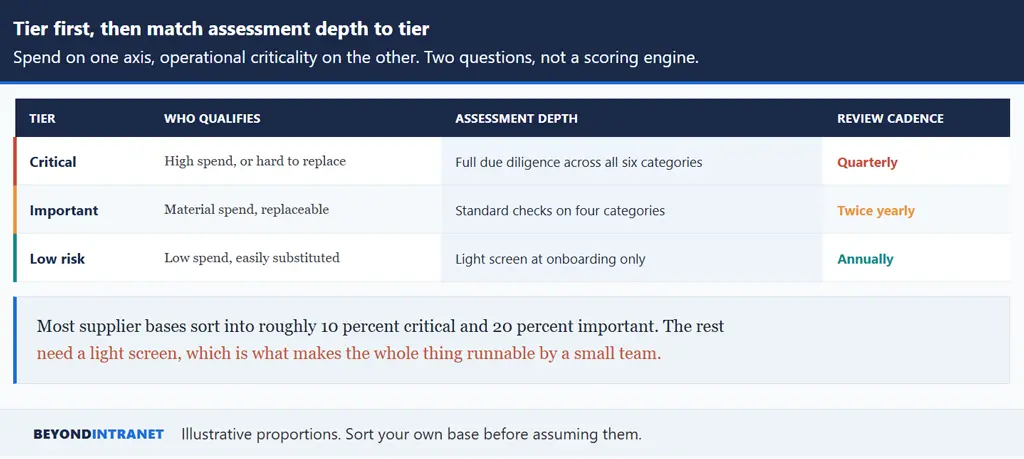
Two questions do the sorting. How much do you spend with them, and how badly would it hurt if they stopped delivering tomorrow? Spend is easy to pull. Criticality takes a conversation with whoever owns the category.
Two questions, not a scoring engine.
Tier
Who qualifies
Assessment depth
Review cadence
Critical
High spend, or genuinely hard to replace at short notice
Full due diligence across all six categories
Quarterly
Important
Material spend, replaceable given reasonable notice
Standard checks on financial, operational, compliance and cyber
Twice yearly
Low risk
Low spend, readily substituted
Light screen at onboarding only
Annually
Table 2. Three tiers. Depth follows tier, which is what keeps the workload manageable.
The Kraljic Matrix, published by Peter Kraljic in Harvard Business Review in 1983, remains the reference model for this kind of segmentation. It sorts on supply risk against profit impact. The three-tier version above is a simplification, and for a team building a process for the first time, simpler is what gets finished.
Expect roughly a tenth of your base to land in critical and perhaps a fifth in important. Sort your own suppliers before assuming those proportions, since category mix moves them considerably.
Tiering only works if the assessments and documentation behind it live somewhere your whole team can see, not in one person’s inbox.
ProcureKey’s Supplier Management module gives you centralized supplier records, document storage with expiry tracking, and customizable onboarding and pre-qualification forms inside your Microsoft 365 tenant.
The supplier risk assessment process, step by step
What are the steps in a supplier risk assessment process?
Define scope by supplier tier. Collect risk signals at onboarding. Score suppliers against the core categories. Assign a risk rating. Define mitigation actions for whatever you find. Then set a review cadence, running more frequently for critical suppliers and lighter for low-risk ones.
Six steps, run in order. The sequence matters more than the sophistication of any individual step.
Step 1. Define scope by tier
Decide which categories apply at which tier before you start. A critical supplier gets all six. Your low-risk stationery vendor gets a compliance screen and nothing else. Writing this down prevents the scope creep that makes assessments feel endless.
Step 2. Collect signals at onboarding
Onboarding is the only moment a supplier is motivated to give you information promptly. Use it. Certificates and insurance documents arrive more easily before a contract is signed than afterward. So do security questionnaire responses and declarations covering ownership or manufacturing footprint.
Step 3. Score against the categories
Keep the scale coarse. Three levels beat ten, because a five-point scale invites debate about whether something is a three or a four when the useful question is whether it needs action. Low, medium or high covers it.
Consistency matters more than precision here. Two people scoring the same supplier should land in the same band, which is easier with three levels than with ten.
Step 4. Assign an overall rating
Roll the category scores into one rating, and let a single high score override the average. Somebody with excellent financials and no cyber controls is not a medium-risk supplier wherever they touch your data.
Step 5. Define mitigation per finding
Every high or medium finding needs a specific action with a named owner and a date. Mitigation might mean a contractual clause or a dual-source arrangement. Sometimes it means terms, or simply a shorter review interval. Vague findings without owners are how assessments become paperwork.
Ownership is where most mitigation plans quietly die. Findings assigned to procurement sit until somebody remembers them. The same finding assigned to a named buyer with a date on it tends to get closed.
Step 6. Set the review cadence
Cadence follows tier, as in the table above. The point of tiering is that you’re not committing to review four hundred suppliers quarterly. You’re committing to review perhaps forty of them.
A practical supplier risk assessment template you can start with
What should a supplier risk assessment template include?
A usable template needs the supplier identifier and tier, plus a rating for each risk category. Add supporting documents with their expiry dates. Then specific mitigation actions with an owner, and a scheduled next-review date. Keep the structure consistent enough that you can compare two suppliers side by side.
Field
Why it earns its place
Supplier ID and name
Ties the assessment to your existing records rather than creating a parallel list
Tier
Determines depth and cadence, so it belongs at the top
Rating per category
Six ratings, coarse scale, so a single weak area stays visible
Overall rating
One number for reporting, with the category detail behind it
Documents on file
Certificates and insurance, named and dated
Document expiry dates
The single most useful field for lightweight monitoring
Mitigation actions
What you’re doing about each finding, specifically
Action owner
A person, not a department
Next review date
Derived from tier, and the thing that makes the cycle repeat
Table 3. Nine fields. This lives perfectly well in a structured list or a supplier portal.
Expiry dates deserve their own mention. They convert a static document into a scheduled event, which is what turns a filing cabinet into something approaching monitoring.
None of this requires specialized risk software. A structured list with these columns, stored where the team can reach it, outperforms a sophisticated tool that one person maintains and nobody else opens.
In our solution the documents-on-file and expiry-date fields sit on the supplier record, and suppliers keep them current through the supplier portal. The rating, mitigation and review fields can live in the structured list alongside it.
Making continuous achievable without a dedicated platform
This is the section where most published frameworks lose a mid-market reader. What follows assumes nothing beyond a supplier record, a document library and a calendar you already keep.
Can a team monitor supplier risk continuously without a dedicated risk platform?
Yes, at a lighter scale. Use expiry-based alerts on compliance documents and certifications, a supplier portal for self-reported updates, and a review cadence tied to risk tier instead of a fixed annual cycle. It won’t replace external threat intelligence. What it does close is the biggest gap, where risk information goes stale between reviews.
Tactic
What it catches
What you need
Expiry alerts on documents
Lapsed insurance or certifications, before the supplier ships again
Document storage that tracks expiry dates
Supplier self-service portal
Ownership changes, new addresses, updated certificates
A portal suppliers can log into and update
KPI dashboard review
Delivery or quality drifting outside tolerance
Performance data you already record, shown on a dashboard
Tier-based review cadence
Slow-moving risk on critical suppliers
A calendar and a named owner
Onboarding re-screen on renewal
Anything that changed since the last contract
Your existing onboarding assessment
Table 4. Five tactics. None requires an external data subscription.
Start with expiry alerts if you only do one of these. Certificates and insurance documents already carry dates. The work is entering them once and letting the reminder fire on its own.
Be honest about the limits. This approach will not tell you a supplier suffered a breach last week, nor flag a sanctions listing the day it lands. Those genuinely need external feeds. What it does cover is the far more common failure, where a certificate expired in March and nobody noticed until an auditor asked in November.
Expiry alerts on certifications, performance dashboards for compliance and performance, and a self-service supplier portal cover most of what continuous monitoring means for a team this size.
Where risk assessment connects to onboarding and sourcing
Two moments decide whether any of this affects an outcome. Everything else is documentation.
Most frameworks fail at this point rather than at the design stage. The document is sound; nobody consults it when a decision is actually being made.
A risk framework that lives in its own document gets read once. Tie it to the two moments where it changes a decision.
The first is onboarding. Assessing a supplier after they’re already active means you’re documenting exposure rather than deciding whether to accept it. Running the screen before activation is the whole point, and catching risk at the point a supplier comes on board is where the sequencing gets set. In the software, that screen is the pre-qualification step: suppliers register through a portal, submit the documents you require, and only approved suppliers are invited into RFQs and auctions.
The second is sourcing. When you evaluate bids, risk rating belongs alongside price as a weighted criterion. One bid ten percent cheaper with a high operational rating isn’t obviously the better award, and matching sourcing strategy to supplier risk profile covers how to weight that properly.
One caution on the portal approach. Self-reported updates are only as reliable as the supplier’s diligence, so treat them as a prompt to verify rather than as verification. For critical suppliers, that distinction matters.
Worth noting what this buys you commercially. An assessment history built over a couple of years is what makes a larger platform evaluable on evidence rather than on a vendor’s claims about what you’re currently missing.
Tie it to tier. Critical suppliers quarterly, important ones twice a year, low-risk annually. A fixed annual cycle for everybody wastes effort on the long tail and leaves your most exposed relationships unreviewed for eleven months at a stretch.
A tier is enough to start. Scores become useful when you have enough assessment history to compare suppliers meaningfully. Teams that build an elaborate scoring model first tend to spend their effort calibrating weights rather than assessing anybody.
That's a signal in itself, particularly from a critical supplier. Escalate it commercially rather than administratively. A supplier who won't answer a security questionnaire before signing isn't going to become more forthcoming afterward.
Somewhere the whole team can reach, with documents and expiry dates attached to the supplier record. A shared drive works better than a personal folder, and a structured list with access controls beats both.
Where to start
Sort your top fifty suppliers by spend, then mark which ones would genuinely hurt if they stopped delivering. That’s your critical tier, and it’s usually shorter than expected.
Pull every certificate and insurance document you hold and check the expiry dates. Most teams find at least one that lapsed without anybody noticing.
Write the nine template fields into whatever system you already use before evaluating anything new. The structure matters more than the tool.
Start with tiering, not a purchase
The framework in this piece needs no new software and no risk function to begin. Sort your suppliers by spend and criticality. Run a defined assessment at a depth that matches the tier. Attach expiry dates to the documents you already collect, and let your existing systems alert you when something lapses. That combination covers most of what a mid-market team needs, and it produces the assessment history that makes a larger platform worth evaluating later, if it ever is.