A practical, vendor-neutral guide for CIOs, IT directors, and digital workplace leaders evaluating SharePoint consulting partners in Australia — including a comparison...
If your procurement team is still managing RFQs through email threads, tracking supplier quotes in spreadsheets, and relying on somebody’s inbox as the system of record, you already know the problem. E sourcing exists because that manual approach breaks down the moment you’re managing more than a handful of events at the same time. Quotes get lost. Versions get confused. And when someone asks for an audit trail, the answer is usually a shared folder with 47 files in it and no clear record of who changed what.
This guide covers what e sourcing means in practical terms, how the process works step by step, what good esourcingsoftware looks like, and where the real savings come from.
What Is eSourcing?
E sourcing, or electronic sourcing, is the process of managing supplier selection activities through a digital platform instead of email, phone calls, and manual documents. Your RFIs, RFPs, RFQs, and eAuctions run inside a single system. Bids are captured as they arrive. Deadlines are enforced automatically. And the decision record builds itself as the event progresses.
The esourcing meaning in practical terms? Think about the last time you sent an RFQ as an email attachment to five suppliers. Two responded in the format you asked for. One used a completely different layout. One forgot the delivery terms. And the fifth replied to the wrong thread. An esourcing platform eliminates that by giving suppliers a structured place to bid, where every response comes back in a format you can actually compare without reformatting anything.
eSourcing vs Traditional Sourcing: What’s the Real Difference?
This is the section most guides get wrong. They list benefits without showing the contrast. Here’s what actually changes when you move from manual to electronic sourcing:
Traditional Sourcing
eSourcing
Process visibility
Procurement lead knows where things stand. Nobody else does.
Dashboard shows status of every event to everyone with access
Speed
RFQ cycle takes 2 to 4 weeks with manual follow-ups
Same event runs in 3 to 5 days with automated notifications
Audit trail
Scattered across email threads and shared folders
Every bid, score, and decision time-stamped in one system
Supplier reach
Limited to known contacts. Usually 3 to 5 per event.
Invite from a qualified pool. 10 to 15 per event is normal.
Error rate
Manual data entry, version control issues, formula mistakes
Structured templates eliminate formatting errors
Compliance
Hard to prove the process was followed
Decision record is built into the workflow
The speed difference alone justifies the move for most mid-market teams. But the audit trail is what keeps the CFO happy.
eSourcing vs eProcurement: Are They the Same?
No. This is a common confusion. E sourcing covers the supplier selection phase: RFIs, RFPs, RFQs, eAuctions, bid evaluation, and supplier shortlisting. eProcurement covers what happens after the supplier is selected: purchase orders, goods receipts, invoicing, and payment. They’re complementary pieces of the same overall process. An eSourcing platform gets you to the right supplier at the right terms. An eProcurement system handles the transactional execution downstream. For how strategic sourcing fits into this picture, see our separate guide.
What Does an eSourcing Platform Include?
A proper esourcing strategy runs on four instruments, each designed for a different stage of supplier engagement.
eRFI (Request for Information)
Market research. You’re not buying yet. You’re figuring out who can deliver, what the general cost range looks like, and whether the supply market has enough competition to justify a formal bid event.
eRFP (Request for Proposal)
Complex requirements where capability matters as much as price. Suppliers submit detailed proposals covering approach, team, methodology, and pricing. The evaluation is weighted across multiple criteria.
eRFQ (Request for Quotation)
The spec is locked. You need a price. This is the most common instrument in day-to-day procurement sourcing, and it’s the one that benefits most from an esourcing platform because the comparison is straightforward and the time savings are immediate. For how RFQ events run on a platform, see BeyondIntranet’s RFQ management software.
eRFT(Request for Tender)
The formal bid stage. Requirements are fixed, terms are set, and suppliers respond on a take-it-or-leave-it basis. Common in public sector and regulated industries where the process must be transparent and auditable. No negotiation, just structured, comparable submissions.
eAuctions
Suppliers compete in real time. Reverse auctions drive prices down. Forward auctions drive disposal prices up. The competitive pressure compresses weeks of negotiation into an afternoon.
How the eSourcing Process Works: Step by Step
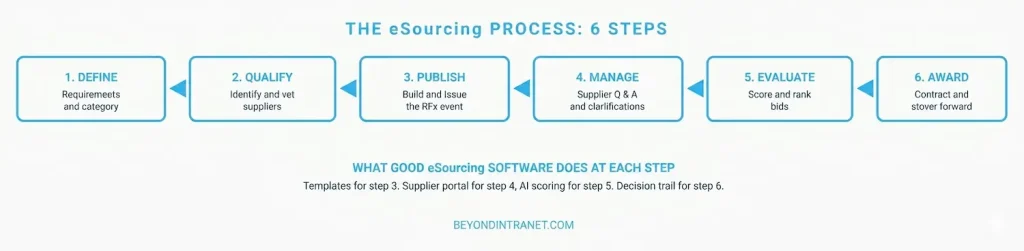
Step 1: Define requirements and category. What does the business need, in what quantity, by when? Get this wrong and the rest of the event falls apart because suppliers end up bidding on different interpretations of the same brief.
Step 2: Identify and qualify suppliers. Who can deliver this? Are they financially stable? Do they have the right certifications? Pre-qualification happens before anyone sees the bid, so your evaluation pool is already vetted.
Step 3: Build and publish the RFx event. Pick the right instrument for the category. An RFQ if the spec is locked. An RFP if the requirement is complex. Set the evaluation weights and the platform pushes invitations to your shortlisted suppliers.
Step 4: Manage supplier Q&A. Questions come in through the portal, not scattered across individual email threads. Answers go to all bidders at once so the playing field stays level.
Step 5: Evaluate responses and score bids. The esourcing solutionhandles weighted scoring in the background. Rankings update with each bid. No manual spreadsheet formulas. For how AI scoring works alongside this, see BeyondIntranet’s supplier management.
Step 6: Award and move to contract. The decision record exists from step one through to the award. That’s the audit trail that internal compliance and finance need.
See How Bid Management System Manages Each of These Steps
Cost savings: competitive bidding through an esourcing platformdrives an average 8 to 14% price reduction on sourced categories, according to Hackett Group research. That’s not theoretical. A mid-market team in Melbourne running $5M through competitive RFQs can expect to find $400K to $700K in savings that simply weren’t visible when each category was negotiated individually.
Speed: automated RFx creation replaces the manual email chain. An event that took three weeks to run manually finishes in under a week. Time savings: that’s procurement capacity you get back for strategic work.
Supplier competition: teams using electronic sourcing typically invite three to five times more suppliers per event than they managed manually. More competition means sharper pricing. And the structured supplier portal makes it easy for vendors to participate without calling someone to ask where to send their quote.
What to Look for in eSourcing Software
Start with RFx event management. Can the platform run RFIs, RFPs, RFQs, and auctions from the same interface? Then look at the supplier experience. If vendors need a licence or a training session to submit a bid, participation will suffer. The audit trail matters too, especially for regulated industries where you need to prove the process was followed. And check integration: does it connect to M365, your ERP, or your CRM without a six-month implementation project?
BeyondIntranet, for example, is an eSourcing platform that sits directly inside Microsoft 365. Your team logs in with existing credentials. The security policies you already have on the tenant carry over without extra configuration. It’s not a bolt-on. It’s native.
eSourcing is the supplier selection side of the equation: running RFIs, RFPs, RFQs, and auctions to find the right vendor at the right terms. eProcurement picks up after that decision is made, covering purchase orders, invoicing, and payment. Different phases, different systems, but they work together.
No. Mid-market teams with $2M to $20M in addressable spend often see the biggest percentage gains because they’re moving from zero process to a structured one. Enterprise teams improve incrementally. Mid-market teams jump.
Some do natively. BeyondIntranet is built directly on SharePoint and M365, so integration isn’t a bolt-on. See the eSourcing platform page for details.
E sourcing replaces the email-and-spreadsheet approach to supplier selection with a structured digital process. The result: faster events, better pricing, more suppliers competing, and a decision trail that finance and audit can trust. If your team is still running RFQs manually, the gap between what you’re paying and what competitive sourcing would deliver is probably wider than you think. BeyondIntranet’s eSourcing platform can be deployed in under a week. Worth a conversation.