A practical, vendor-neutral guide for CIOs, IT directors, and digital workplace leaders evaluating SharePoint consulting partners in Australia — including a comparison...
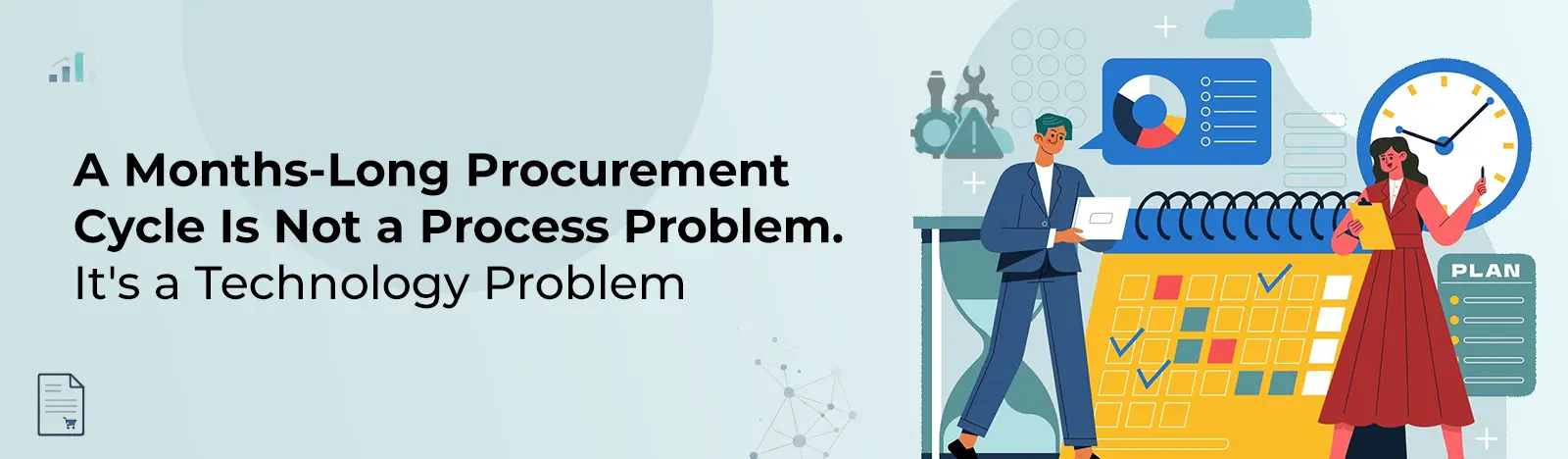
Your procurement team has a process. A documented one, probably. SOPs for intake. Templates for RFQs. An approval matrix that got revised twice last year. Category strategies sitting in a SharePoint folder. And yet a sourcing event that should close in three weeks routinely drags to ten. Sometimes twelve. Some organizations stretch to 16. The CPO reports to the CFO that procurement is “working on cycle time.” The CFO wants to know why a $200K services contract took three months to source.
The instinct when cycle time stretches past eight weeks is to add more process. Another approval tier. A stricter SOP. A compliance checkpoint that didn’t exist last quarter. A weekly status meeting that pulls the team off productive work for an hour every Monday. But here’s the thing: the process isn’t what’s slow. The tools underneath it are. Every additional process layer stacked on top of email and Excel adds overhead without addressing the root cause.
What follows is an argument you can take to your CFO: the months-long procurement cycle isn’t a discipline problem or a staffing problem. It’s an infrastructure problem. And layering more SOPs on top of email and Excel won’t fix it.
Why Procurement Sourcing Cycles Still Take Months
We asked a procurement director in Houston to walk us through the timeline of their last sourcing event. The breakdown was instructive: the purchase requisition sat in an inbox for ten days before procurement was aware of it. Four days went to rebuilding the RFQ because the previous template was stored in a former employee’s email archive. Suppliers received the document on different days because the analyst distributed it individually while managing two other events. Two vendors submitted clarification questions, and the responses reached those vendors but not the other three bidders. The discrepancy only surfaced post-award when one of the unsuccessful vendors raised a formal complaint.
The pattern is consistent across organisations we speak with. The sourcing team has grown, the event volume has tripled, but the tools underneath the process haven’t changed. SOPs written for three sourcing events a month are now supporting twelve. The same email workflows, the same Excel templates, the same Word documents. The process scaled. The infrastructure didn’t. That’s where cycle time expands beyond what any SOP revision can fix.
The Hidden Cost of Manual Procurement on Your P&L
Here’s where the CFO’s attention should be. Long procurement cycles bleed money in four ways that never appear on a procurement dashboard. The team feels it every week. The P&L absorbs it silently.
The sourcing calendar runs at half capacity because each event consumes the team for 10 weeks. A $180K logistics contract in Dallas that should have been competitively bid renewed with the incumbent for the third consecutive year. Not because the supplier was the best option. Because nobody had bandwidth to run the event.
An Ardent Partners study put a number on it: procurement organizations with cycle times over eight weeks have 35% higher off-contract spending than those operating under four weeks. The pattern is predictable. An operations manager needs $80K in equipment next month. Procurement’s queue is six weeks deep. The ops manager calls the supplier directly, agrees to a price, and sends procurement the paperwork after the fact. No competition. No negotiated terms. No contract.
Third: compliance exposure. A sourcing decision made over email with no audit trail is defensible right up until someone audits it. Every manual handoff is a potential compliance gap. And the longer the cycle, the more handoffs accumulate. According to Hackett Group research, procurement organizations with high levels of process automation report 60% fewer compliance findings than those running manual workflows. That gap widens every year as regulatory expectations increase and manual record-keeping struggles to keep pace.
That’s a slow death for strategic procurement. The people who stay become administrators. The category management work that justifies procurement’s seat at the leadership table doesn’t happen because the team is buried in mechanics.
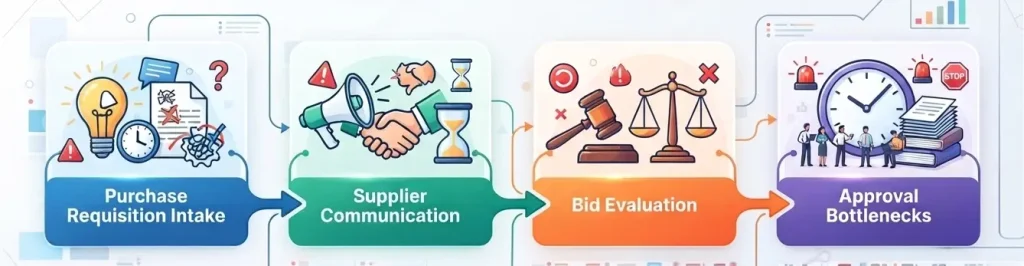
Four Technology Gaps That Add Weeks to Every Sourcing Event
Gap 1: Purchase Requisition Intake
One to two weeks evaporate before the sourcing event even begins. And the data in the PR is often incomplete, which means procurement spends additional time going back to the requester for missing information. Budget codes, delivery timelines, specification details. All of it should be captured at intake. Instead it trickles in across three email exchanges over five business days.
Gap 2: Supplier Communication
The RFQ goes out by email. One supplier at a time. Vendor A receives it Monday, Vendor D receives it Wednesday because the analyst ran out of time. Clarification questions arrive in separate email threads. The answers go to one vendor but not the others. By the time bids close, the playing field is uneven and the procurement team doesn’t realize it until evaluation. A supplier portal eliminates this by putting every vendor on the same timeline with the same information.
Gap 3: Bid Evaluation
A documented scoring record that shows the weights, the individual scores, and the rationale behind each one. That’s the difference between a defensible award and a memory-based recommendation that falls apart under scrutiny .bid evaluation with weighted scoringlooks like, see BMS’s Itemized bidding.
Gap 4: Approval Bottlenecks
She tracked approval data for a full quarter. Recommendation to final sign-off averaged 11 business days. After switching to automated routing with a 48-hour escalation rule, the same approvals closed in 2 days. Same signatories. Same authority levels. The only thing that changed was the delivery mechanism.
Those 9 extra days had a price tag. The supplier’s quote was valid for 14 days. By the time the approval cleared, pricing had expired. Re-confirmation took another three days and came back 2% higher because raw material costs had moved. On a $300K contract, that’s $6,000 lost to an inbox nobody was watching.
Why Process Improvements Alone Don’t Fix This
Tighten the process. Add a turnaround SLA to the approval step. Require that all RFQs use a standardized template. Mandate that supplier communication goes through one shared email alias. Create a weekly status meeting to track open events. These are all reasonable interventions. They look good in the process review deck. And they all fail in practice when the underlying technology doesn’t enforce them.
An SLA on approvals is meaningless if the approval system is email. You can’t enforce a turnaround time on a forwarded message. A standardized RFQ template is useless if suppliers can modify it before submitting their response. A single-email-alias policy for vendor communication collapses the first time someone CCs the supplier directly because it’s faster than routing through the shared inbox.
The process exists in a document that the team reviewed at the last quarterly meeting. Execution happens in whatever way is fastest for the individual doing the work on a Tuesday afternoon with three other events running in parallel. And the fastest path through email, Excel, and Word is almost never the compliant one. It’s the one that skips the template, CCs the supplier directly, and sends the approval request via Teams chat instead of routing it through the formal chain. Not because the person is careless. Because the formal path takes four times longer and nobody is enforcing the alternative. The compliance team discovers this six months later during an internal audit. By then, 40 sourcing events have run the same way.
What Modern Procurement Technology Does Differently
STAGE
MANUAL APPROACH
WITH PROCUREMENT TECHNOLOGY
PR Intake
Email or form to shared mailbox. Manual triage. 1-2 weeks.
Structured digital requisition with budget codes, category tags, and auto-routing to the right analyst. Hours, not weeks.
RFQ Creation
Copy-paste from an old Word doc. Rebuild evaluation criteria from memory.
Template library with pre-built criteria. AI suggests sections based on the category. RFQ published same day.
Supplier Distribution
Individual emails sent one at a time. Uneven timelines.
One-click distribution through a portal. All vendors receive the RFQ simultaneously with the same deadline.
Bid Collection
Responses arrive in email as PDFs, Excel files, and slide decks.
Suppliers respond through a structured portal. Data arrives in one comparable format.
Evaluation
Manual spreadsheet with no pre-set weighting. Subjective ranking.
Weighted scoring against published criteria. AI flags non-responsive answers. Audit trail built automatically.
Approval
Email chain. No visibility. 9-day average.
Automated routing with escalation rules. Real-time status. 2-day average.
Award
Phone call or email. No documented rationale.
System-generated award notification with full scoring history and approval log.
The principle behind that table is simpler than the seven rows suggest. Procurement technology doesn’t replace human judgment. That fear slows adoption in teams where analysts worry that automation means their role disappears.
the team doesn’t just finish the same work faster. They run more events. Categories that went uncontested for years suddenly get competitive attention because the bandwidth exists. A facilities management contract in Melbourne that auto-renewed three times because nobody had capacity to source it finally goes to market. The incumbent drops their price 14% just to keep the business. That one event pays for the technology.
What Faster Procurement Looks Like in Practice
Monday morning. A purchase requisition lands through a structured intake form: budget code, category, specs, delivery timeline, all captured in one submission. No email ping-pong for missing fields. By lunch, the system has matched the request to a category template, pulled evaluation criteria from the last three similar events, and flagged qualified suppliers from the approved vendor database.
Every step is documented. Not because someone remembered to save the email or screenshot the approval. Because the system recorded it automatically.
Not a pilot programme. Not a proof of concept. A real sourcing event, with real suppliers, real bids, and a real award, that closed in three weeks because the tools finally matched the team’s capability. The people were never the problem. The infrastructure was. BMS AI sourcing and procurement capabilities.
Remove it and the process finally delivers what it was designed to. The CPO stops explaining why sourcing takes so long. The operations team stops going direct to suppliers because they can’t wait. Finance sees negotiated savings actually reach the P&L because the cycle is short enough that contract prices don’t expire before the PO gets issued.
Three Things to Do This Quarter
1. Map your last five sourcing events from PR submission to award. Write down how many days each step took. The gaps will be obvious: it’s usually PR intake, bid normalization, and approval routing that eat the most time.
2. Identify the steps where the tool is email. Every step where the system of record is someone’s inbox is a step where time leaks, information gets lost, and the audit trail breaks.
3. Run one sourcing event on a procurement software instead of email. Just one. Time it from requisition to award and compare it against your manual baseline. The delta makes the business case for you.
Technology that automates the mechanical steps and leaves the judgment to the procurement professional produces structural change in cycle time. Not incremental. Structural. The kind of improvement that shows up on the CFO’s dashboard as a 60% reduction in average cycle time and a 30% increase in the number of sourcing events the team can execute per quarter. If your team has the process and the people but the cycle still takes months, the technology is what’s missing. One sourcing event run on the right tools, timed against the manual baseline, makes the case better than any slide deck.BMS was built for exactly that test.
Your Team Has the Process. Give Them the Right Technology.
AI-powered sourcing, automated approvals, structured bid collection. All inside Microsoft 365.