A practical, vendor-neutral guide for CIOs, IT directors, and digital workplace leaders evaluating SharePoint consulting partners in Australia — including a comparison...
Quick answer: A SharePoint AI Readiness Assessment is a structured evaluation of a Microsoft 365 tenant’s governance, information architecture, content...
Five suppliers submitted bids on your last RFQ. One sent a PDF. Two sent Excel files in completely different formats. One replied in the body of an email. The fifth attached a Word document with pricing buried in paragraph three. Your procurement analyst spent a day and a half reformatting everything into a single comparison spreadsheet. Then somebody noticed that Supplier B quoted in USD while everyone else quoted in GBP. Back to the spreadsheet.
That’s bid analysis at most mid-market companies. Not the evaluation itself. The preparation for the evaluation. And by the time the comparison is ready, the team is too exhausted from data wrangling to do a proper job of the actual decision. The scoring becomes “who’s cheapest?” because nobody has the energy left to assess quality and capability after two days of building the spreadsheet.
What Changes When Bid Analysis Moves to a Platform
You already know what bid analysis is. The question is why it takes your team a week to do something that should take an afternoon. The answer: the analysis itself isn’t the bottleneck. The data preparation is.
In an eSourcing platform, the analysis isn’t something you cobble together after bids arrive. It’s built into the event from the start. Evaluation criteria get set before suppliers submit. Scoring weights are locked. Bids land in a structured format because the platform controlled the submission template. The comparison doesn’t need to be built. It already exists.
Why Traditional Bid Analysis Falls Short
The cost of manual bid evaluation isn’t just time. It’s accuracy. A 15-line-item RFQ with six suppliers means 90 data points copied or typed by hand. Even a 2% error rate puts nearly two wrong cells in the comparison. On a $500K contract, one mistyped number can swing the award to the wrong supplier. And there’s no audit trail beyond whoever last saved the file.
When the losing bidder asks why they didn’t win, the answer is a spreadsheet that three people edited without track changes. That’s not a defensible process. That’s a liability.
What You Get When Bid Analysis Is Done Properly
The obvious win is better decisions. When every bid is scored against the same criteria with the same weights, the evaluation produces a result you can stand behind. Not “we went with the cheapest” but “we went with the highest overall value based on price at 60%, technical capability at 25%, and delivery at 15%.” Try saying that when your evaluation was a colour-coded spreadsheet somebody eyeballed on a Friday afternoon.
Speed matters too. A process that takes a week manually compresses to hours on a platform. And transparency changes how suppliers engage with you. When you can show a losing bidder exactly where they fell short, they stop disputing the decision. They come back sharper on the next event because they know the evaluation is real.
See What Structured Bid Analysis Looks Like
BMS gives your team weighted scoring, real-time comparison, and a full audit trail on every event.
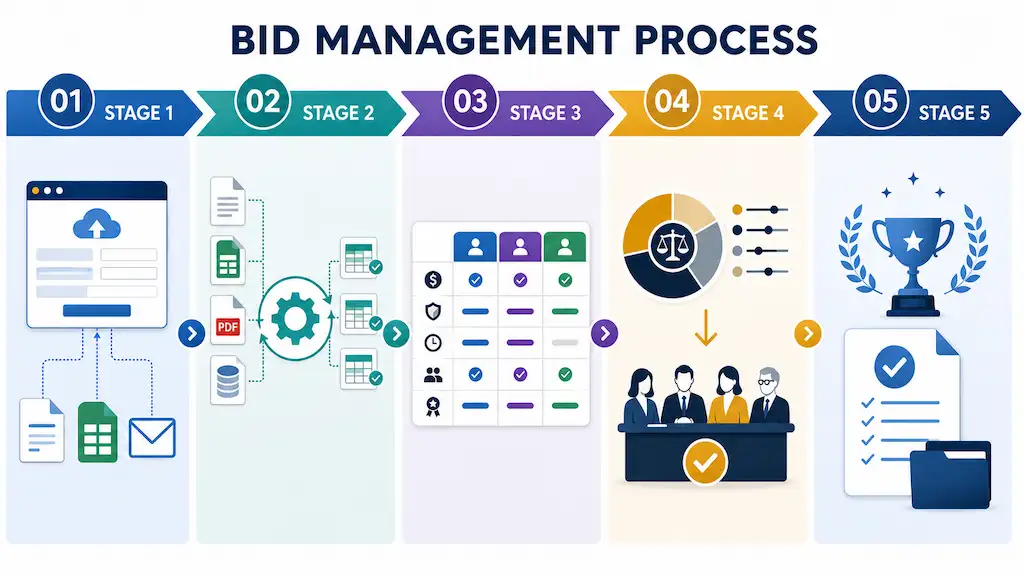
How Bid Analysis Works in a Modern eSourcing PlatformStage 1: Bids come in through a controlled portal
No more chasing responses across email threads. The platform gives every bidder the same submission template. Pricing goes in a pricing table. Technical responses have their own section. Delivery terms get their own fields. Everything lands in one place, in one format, at one deadline. Bid collection and consolidation handled before your team touches a thing.
Stage 1: Bids come in through a controlled portal
No more chasing responses across email threads. The platform gives every bidder the same submission template. Pricing goes in a pricing table. Technical responses have their own section. Delivery terms get their own fields. Everything lands in one place, in one format, at one deadline. Bid collection and consolidation handled before your team touches a thing.
Stage 2: The data gets normalised automatically
Supplier A quotes per unit. Supplier B quotes per pallet. Supplier C is in euros while everyone else used dollars. In a spreadsheet, your analyst fixes these by hand and hopes the conversion is right. On a platform, normalisation happens automatically. Units convert, currencies standardise at the rate you set, and every bid shows up in the same structure. Apples to apples.
Stage 3: Side-by-side comparison
Once normalised, the bids line up. Price per unit, delivery timeline, payment terms, certifications, technical scores. All in one view. No scrolling between tabs. No cross-referencing three files. The gaps between suppliers are visible immediately and the outliers stand out. And if the category supports it, this comparison is what feeds into a reverse auction. The bid analysis identifies the qualified shortlist. The auction drives the final price down further.
Stage 4: Weighted scoring and bid approval committee
Before the event launched, your team locked the criteria: price 60%, technical capability 25%, delivery 15%. Maybe you separated commercial and technical streams. Finance scores the commercial side. Engineering handles the technical. Neither group sees the other’s scores until both are complete. Once individual scoring is done, the bid approval committee reviews the consolidated ranking before the award recommendation goes forward. The platform calculates the weighted total automatically and routes it to the approval workflow. The ranking reflects value, not just cost.
Stage 5: Award recommendation with documentation
The highest-scoring supplier gets flagged for award. But the platform doesn’t just tell you who won. It gives you the documentation to prove why. Every score, every weight, every evaluator comment. Time-stamped and logged. When the CFO asks why you didn’t go with the cheapest option, the answer is a report. Not a conversation somebody has to reconstruct from memory.
What to Look For in a Bid Analysis Tool
Weighted scoring that’s configurable. You need to set criteria and weights per event. A packaging RFQ and a consulting RFP shouldn’t use the same scorecard. The tool should let you build templates by category and reuse them.
Commercial and technical separation. On complex events, the people evaluating price shouldn’t see the technical scores during evaluation. This prevents anchoring bias. It’s how serious procurement organisations run evaluations on anything over $50K.
Real-time dashboards. Your stakeholders shouldn’t wait for somebody to finish the spreadsheet. They should see bid status, evaluation progress, and preliminary rankings as the event unfolds.
And integration with your existing systems. Award data should flow into your ERP or contract management system without manual re-entry. Look for platforms with secure API connections that keep the data chain intact from bid to PO.
What Automation Changes About the Outcome
The most obvious fix is the time sink. Those two days your analyst spent reformatting bids? Gone. Bids arrive normalised. The comparison builds itself. Your team evaluates instead of preparing to evaluate.
But accuracy is the bigger story. A manual evaluationon a 15-line-item RFQ with 6 suppliers means 90 data points typed or copied by hand. Even a 2% error rate means nearly two wrong cells. On a $500K contract, one wrong number in a cost comparison can swing the award to the wrong supplier. The platform doesn’t make that mistake.
There’s also the auction connection. When bid analysis feeds into a reverse auction, the initial evaluation identifies qualified bidders and the auction drives the price down further. Analysis and competition working together instead of as separate exercises.
How BMS Handles Bid Analysis
BMS was built by a team that watched procurement organisations struggle with exactly these problems. The bid analysis capability isn’t bolted on. It’s central to how the platform works.
When you create a sourcing event, you define the evaluation criteria and weights before the event goes live. Suppliers submit through a structured portal that controls the format. No PDFs in random layouts. No pricing buried in a Word doc. Every response lands in the same structure.
The comparison generates automatically once submissions close. Normalised, side-by-side, with weighted scores calculated in real time. Commercial and technical evaluations run in parallel with different evaluator groups. The audit trail records every action: who scored what, when, and whether any score was changed after initial entry. All inside Microsoft 365. Your existing security policies apply automatically. For the full picture.
Best Practices That Actually Make a Difference
Set your evaluation criteria before the bids arrive. Not after you’ve seen the prices. This sounds obvious but the number of teams that decide how they’re going to score after they’ve already opened the bids is staggering. That’s not evaluation. That’s rationalisation.
Get your evaluators on the same page about what the scores mean. If a “4 out of 5” on technical capability means something different to the engineering lead than it does to the procurement manager, your weighted scores are noise. One sentence per score level. Define it before the event.
And verify the data before you trust the output. If a supplier submits a unit price 60% below everyone else’s, don’t celebrate. Call them. Ask whether they understood the spec. The best bid analysis tool in the world can’t fix a bid that was based on the wrong assumptions.
Bid analysis isn’t supposed to be the hard part of sourcing. Finding the right suppliers, writing a clear spec, negotiating terms that work for both sides. That’s the hard part. The evaluation should be where the data does the work. If your team spends more time building the comparison than reviewing it, the problem isn’t the team. It’s the process. Modern eSourcingplatforms exist because the spreadsheet approach hit a ceiling years ago.BMS is one way to get above it.