A practical, vendor-neutral guide for CIOs, IT directors, and digital workplace leaders evaluating SharePoint consulting partners in Australia — including a comparison...
Last year, a mid-market manufacturer we work with ran a spend audit on their indirect categories. Turns out 22% of that spend was going to suppliers nobody in procurement had ever evaluated. The department heads just kept calling whoever they’d used before. No RFQ. No comparison. The sourcing strategies didn’t exist because nobody had decided that sourcing needed a strategy in the first place.
That’s more common than anyone admits. This article covers ten approaches to procurement sourcing that we see working in 2026 and how to figure out which one fits which category.
What Does a Sourcing Strategy Actually Mean?
A procurement sourcing strategy is how your team decides the way you’re going to buy a specific category. Do five suppliers compete in a formal RFQ? Does one trusted partner handle everything because they know your specs better than you do? Do you go global for cost, or stay regional for speed? Those questions need answers before anyone sends a PO. And the answers should be different for every major category.
That’s different from purchasing. Purchasing is the transaction. Sourcing strategies in procurement sit above the transaction. They’re the reason you’re buying from this supplier instead of that one, through this process instead of an email chain, at this price instead of whatever the sales rep quoted first.
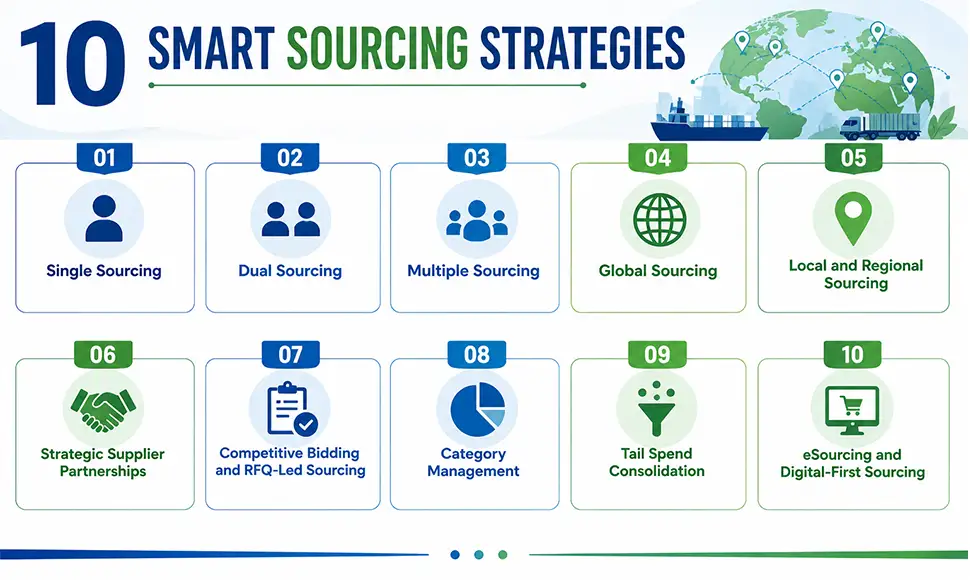
10 Proven Procurement Sourcing Strategies for 2026
You wouldn’t run a reverse auction for a custom-engineered motor assembly. And you wouldn’t sole-source copier paper. Different categories need different procurement and sourcing strategies. Here’s the full playbook.
1. Single Sourcing
Most companies that are single-sourced didn’t choose it. They drifted into it. The original supplier was “good enough,” nobody ran a competitive event, and five years later you’re locked in with no leverage. That’s not single sourcing. That’s neglect. Real single sourcing is a deliberate call: this supplier has proprietary tech we can’t get elsewhere, and switching costs outweigh the risk. If you can’t explain why you’re single-sourced, you probably shouldn’t be.
2. Dual Sourcing
70/30. That’s the split we see most. Primary supplier gets the bulk of the volume. A qualified alternate gets enough to stay invested and ready. Common in manufacturing where you absolutely cannot have a production line go down because one steel supplier missed a delivery. Two vendors is the sweet spot for critical inputs. More than two and you’re managing relationships that don’t justify the overhead.
3. Multiple Sourcing
Does adding a fifth bidder to an RFQ actually move the price? On packaging and MRO consumables, yes. Almost every time. On specialised categories? Not always. We’ve seen companies invite eight suppliers to bid on a complex fabrication job only to discover that six of them didn’t understand the spec. The team burned a week evaluating bids that were never going to work. More competition helps on commodities. On anything technical, you’re better off with three suppliers who genuinely qualify.
4. Global Sourcing
One of our clients sourced a $400K tooling package from Shenzhen. Quoted at 35% below domestic. Looked like easy money. Then freight cost $38K. Lead time pushed production back a month. First batch failed inspection. Had to fly an engineer out for rework. Landed cost ended up 8% below domestic. Not 35%. Global sourcing works, but the spreadsheet needs a column for everything between the factory gate and your receiving dock.
5. Local and Regional Sourcing
The pendulum swung hard toward low-cost countries for fifteen years. Now it’s swinging back. After the disruptions of 2020 through 2023, a lot of procurement teams figured out that a supplier you can drive to in two hours is worth a premium. Quality problems get solved with a site visit instead of a video call at 6 AM across nine time zones. And for anything time-sensitive or perishable, local isn’t a nice-to-have. It’s a requirement.
6. Strategic Supplier Partnerships
Ask ten procurement leaders whether they have strategic supplier partnerships and nine will say yes. Ask them what that looks like in practice and you’ll get vague answers about “close relationships.” A real partnership looks specific. The supplier reserves capacity for your orders three months out. You co-develop a packaging format that cuts your logistics cost by $200K a year. The procurement sourcing strategy for categories where the supplier’s brain matters as much as their price. Difficult to govern without the right tools, which is why strategic sourcing software matters here more than anywhere else.
7. Competitive Bidding and RFQ-Led Sourcing
The bread and butter for a reason. You publish a structured RFQ, lock the evaluation criteria before any bids show up, and let qualified suppliers compete on total value. Not whoever sends the lowest email first. This is the sourcing strategies for procurementteams that care about auditability. Beyond Intranet’s eSourcing platform was built for this exact workflow. Controlled bid collection, weighted scoring, approvals routed through policy rather than chased over Slack. Probably 60 to 70 percent of sourcing events at most companies should run this way, and most don’t.
8. Category Management
Treating every spend category the same way is like wearing hiking boots to a wedding. Technically you’re wearing shoes. Visibly wrong. A $3M logistics category needs dedicated market analysis and quarterly performance reviews with the top three suppliers. A $150K cleaning supplies category needs a reliable vendor and a once-a-year price check. The discipline is in treating each one as its own problem instead of applying a single sourcing template across the board.
9. Tail Spend Consolidation
80% of your supplier base probably accounts for 20% of your total spend. That tail is where procurement’s blind spots live. Software licences somebody bought on a corporate card. A facilities vendor who’s been sending invoices without a contract since 2021. Nobody’s running a competitive event on a $300 purchase. The play is consolidating vendors for the repeating stuff and making sure the rest at least routes through procurement so somebody knows the money’s leaving.
10. eSourcing and Digital-First Sourcing
Honestly? Not a strategy on its own. It’s the infrastructure underneath strategies 1 through 9. When your sourcing runs through a platform instead of email chains, the process works the same way regardless of who’s managing the event. The templates are there. Bids come through a portal instead of arriving in three different formats across four inboxes. Approvals fire automatically instead of getting stuck behind someone’s holiday. That’s what separates a procurement team with a strategy from one running on muscle memory. See where this is heading in our piece on procurement automation.
How to Choose the Right Sourcing Strategy
There’s no formula. But a few questions get you 80% of the way there. What are you buying and how many suppliers can realistically provide it? A commodity with a dozen qualified vendors is a competition problem. A specialised component with one realistic manufacturer is a relationship problem. Completely different procurement and sourcing strategies needed for each. Then consider volume, risk concentration, and urgency. A $500K category with quarterly orders justifies a formal sourcing event. A $3,000 one-off doesn’t. Map your major categories against those dimensions once a year and the right approach for each one becomes fairly obvious. eSourcing software makes the mapping and tracking side much less painful than doing it in a spreadsheet.
There’s no single right answer. The procurement teams that consistently reduce cost are the ones applying different sourcing strategies to different categories and running all of them through a structured process. They single-source the custom components deliberately, not by accident. They compete aggressively on commodities because the market supports it. They invest in real partnerships on the categories where supplier expertise drives their own margins. And they run the whole thing on a platform, because a strategy that lives in one person’s head dies the day that person moves on.
Build a Sourcing Programme That Scales
BeyondIntranet’s eSourcing platform gives your team structured events, governed approvals, and a full audit trail across every category.