A practical, vendor-neutral guide for CIOs, IT directors, and digital workplace leaders evaluating SharePoint consulting partners in Australia — including a comparison...
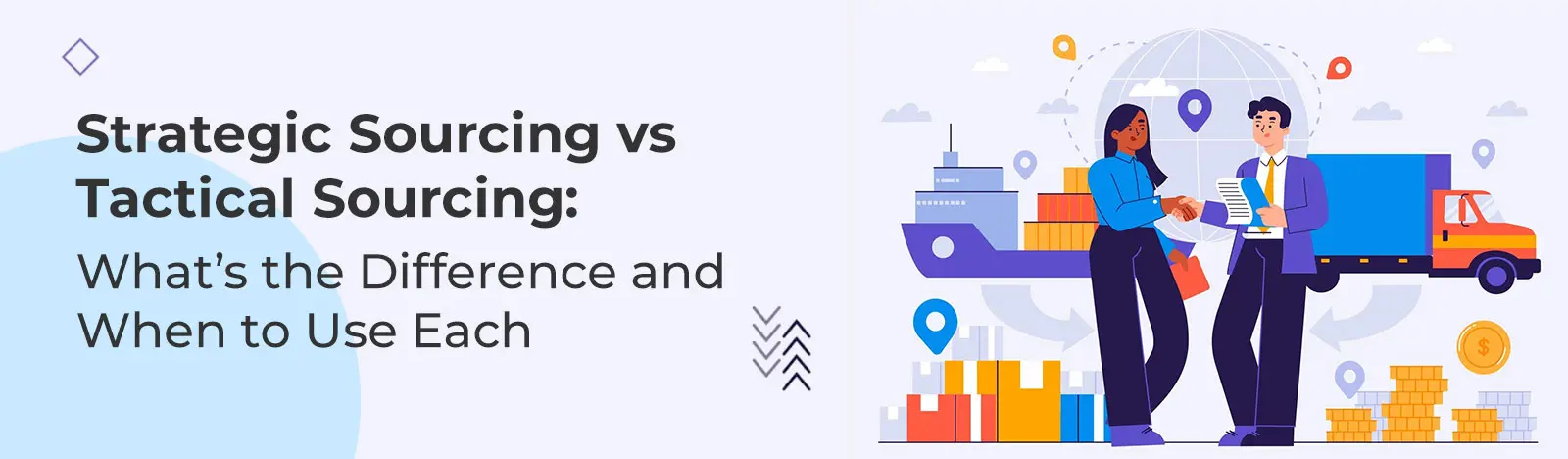
Every procurement team makes the same choice dozens of times a month without thinking about it: do we source this fast, or do we source this right? That’s the line between tactical sourcing and strategic sourcing. And the difference matters more than most operations leads realise — because the sourcing tactics you default to directly shape your cost outcomes, supplier relationships, and whether procurement scales with the business or stays stuck reacting to the next fire.
What Is Tactical Sourcing?
Tactical sourcing is the short-term, transactional approach. Someone needs something now. A production line is waiting on a part. An office expansion needs furniture by Friday. The team finds a vendor, gets a quote, issues the PO, and moves on. Speed is the priority. Price comparison is minimal — maybe a quick check against one or two alternatives, maybe not even that.
And for a certain class of purchases, that’s fine. Low-value, low-risk, one-off buys don’t need a six-week RFP process. But here’s the problem with making it the default: the transactional approach scales badly. When 60% of your purchasing volume runs on quick quotes and inbox-based approvals, you’re not managing spend. You’re chasing it.
What Is Strategic Sourcing?
The strategic approach is the opposite motion. The strategic approach starts further upstream. What does the business need over the next one to three years? Which categories carry real risk? Where is volume concentrated enough to negotiate properly? Those questions get answered before a single supplier is contacted. Then the RFP goes out, bids get evaluated on total cost of ownership — not just unit price — and finance, legal, and operations weigh in before the award. It takes longer. It’s supposed to.
Strategic Sourcing vs Tactical Sourcing: Key Differences
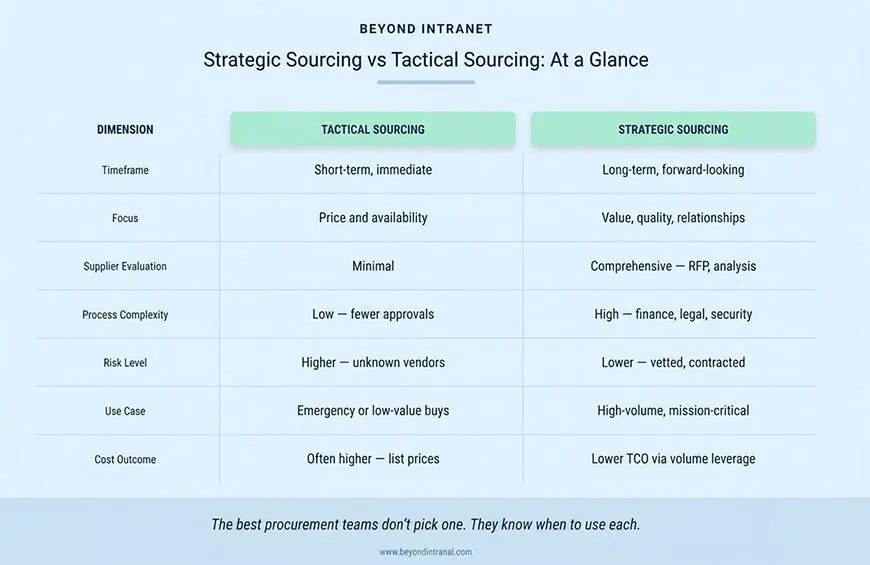
The difference between strategic sourcing vs tactical sourcing isn’t subtle once you lay it out. It’s not just about speed versus thoroughness. It’s about what the organisation optimises for — and the sourcing tactics that follow from that choice.
The timeframe difference drives everything else. Tactical decisions happen in days. Strategic ones take weeks, sometimes months — but the cost advantage compounds over the life of the contract. When you evaluate suppliers properly upfront, you avoid the 15–20% price premium that comes from buying off list price under time pressure.
And the risk profile is completely different. A quick buy from an unknown vendor carries delivery risk, quality risk, and compliance risk that nobody assessed because there wasn’t time. A strategically sourced vendor has been vetted, scored, contracted, and has skin in the game. That’s not just cost management. That’s supply chain governance.
Process complexity matters too. The tactical approach needs one approval and a PO. The strategic approach needs finance sign-off, legal review, technical evaluation, and often a formal scoring committee. More work upfront, yes. But that work prevents the rework, disputes, and cost overruns that show up six months into a poorly evaluated contract.
The Pros and Cons of Going Tactical
Let’s be fair. The tactical approach has real strengths. It’s fast. It’s flexible. It doesn’t require committee approvals. For tail spend, emergency purchases, and genuinely one-off buys, it’s the right tool. Smaller teams and startups often run entirely this way because they don’t have the volume or the headcount for anything more structured.
But the downsides are serious when it becomes the default sourcing tactic. Costs run higher because nobody negotiated volume terms. Supply continuity suffers because there’s no contracted relationship — just whoever picked up the phone last time. Compliance gaps appear because approval workflows were skipped. And the organisation misses the long-term value that comes from proper supplier evaluation, contract management, and category strategy. The transactional approach is a scalpel. Too many teams use it as a chainsaw.
When Should You Use Each Approach?
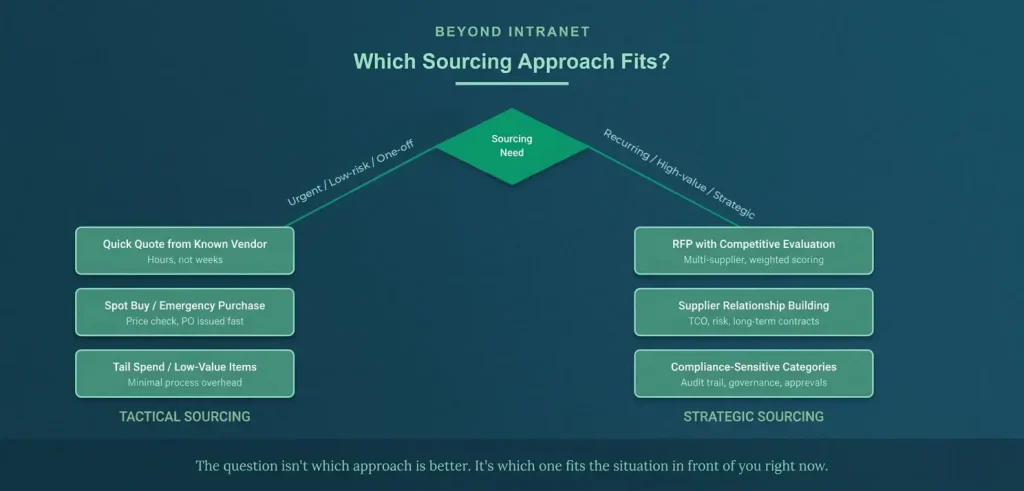
The decision framework is simpler than most people make it. Ask three questions about any sourcing need: how urgent is it, how much is at stake, and will we buy this again?
If the answer is “urgent, low-value, and probably not,” treat it as a one-off transaction. Don’t wrap it in a process designed for a different purpose. But if the spend is recurring, the value is material, or compliance matters — that’s where the structured approach earns its keep. And if you’re not sure? Default to structured. The cost of over-governing a small buy is a few extra hours. The cost of under-governing a large one can be six figures.
Urgent, low-value, non-recurring? Go tactical. Get the quote, validate the budget, issue the PO. Done. But recurring spend categories, high-value purchases, compliance-sensitive areas? That’s strategic territory. Run the RFP. Evaluate properly. And make sure the process distinguishes clearly between the initial request and the purchase itself — understanding the purchase requisition vs purchase order distinction matters here, because it’s the governance gate that keeps both approaches disciplined.
How the Right Sourcing Tactics Support Better Procurement
The best procurement teams don’t pick one approach and run with it. They apply the strategic method to core spend categories — the 20% of suppliers that account for 80% of value — and the tactical approach to edge cases that don’t justify a full process. The key is having workflows and approval structures so the team applies the right method at the right time, not whichever one is faster. That’s wherepurchase requisition software makes a material difference: it gives both approaches a structured starting point and an audit trail, whether the buy takes two days or two months.
The tactical approach gets you through the week. The strategic one builds procurement that scales. The difference between the two isn’t knowledge — every procurement professional understands the trade-off. The difference is process. Teams that know when to use each approach, and have the systems to enforce it, spend less, manage risk better, and make decisions that hold up under scrutiny.
Structured Sourcing That Doesn’t Slow You Down?
Beyond Intranet’s bid management platform gives your team the PR-to-award process that works for both tactical and strategic sourcing — inside your Microsoft 365 environment.