Learn what hierarchy is, how the levels work, what it unlocks (and breaks), and how org chart software keeps it governable, without slowing teams down.
Quick Summary
In 2026, hierarchy isn’t “old-school.” It is a speed tool when designed with clarity. This guide explains what hierarchical models are, how work moves through authority, and how to define roles across levels without creating bottlenecks. You’ll also learn why a living org chart matters and how SharePoint-based org chart software keeps structure accurate, searchable, and easy to manage.
So, why does your org feel busy, but decisions still feel slow?
It’s a weird moment in modern work: teams can ship code, launch campaigns, and close deals from anywhere, yet many still can’t answer a basic question fast: Who owns this decision?
That’s not a motivation problem. It’s a design problem, specifically, a structure problem. And when role clarity slips, performance slips with it: Gallup reports that only 46% of employees clearly know what is expected of them at work. A modern org needs a way to keep responsibility visible, not implied.
The goal of this guide is simple: help you understand a hierarchical structure as an operating system for people, one that can be crisp, humane, and fast when it’s maintained like a real system.
What is a hierarchical structure in 2026, really?

A hierarchy is the arrangement of roles into layers, where authority, accountability, and escalation paths become explicit. It’s usually visualized as a pyramid: the top sets direction, the middle coordinates, and the front line executes day-to-day work.
The difference between “hierarchy that helps” and “hierarchy that hurts” is not the existence of levels. It’s whether the levels create clarity or friction. In practice, hierarchy should reduce cognitive load: fewer guesses, fewer backchannels, fewer “let’s circle back.”
Modern organizations still need clear structure to align people, workflows, and decisions.
If you want a practical baseline for “what an org chart is” and how it maps reporting lines, this overview of organizational charts and how they work is a helpful reference point.
How do you define a hierarchical organization without overcomplicating it?
A hierarchical organization is a company designed with clear levels of authority, where each role knows who it reports to and what decisions it can make. This creates a vertical chain of command, useful for scale, coordination, and accountability.
In well-run hierarchies, the point is not to “control” people. The point is to allocate decisions to the right places so work doesn’t stall. Deloitte’s research on decision rights underscores the value of clarity: improving decision clarity can double the likelihood of improving processes to maximize efficiency.
How does hierarchical order actually move work, decisions, and accountability?
Think of hierarchical order as a routing system. Work moves down for execution, information moves up for visibility, and exceptions move sideways for coordination. When the routing is clear, teams go faster because escalation is predictable.
Downward flow (direction)
Strategy becomes goals, goals become programs, programs become tasks. This is where leaders should be specific: what “good” looks like, and what tradeoffs are acceptable.
Upward flow (signals)
Front-line teams surface risk, customer feedback, and operational constraints. If leaders want truth, they design for it: short paths, clear forums, and safe escalation.
Where it breaks is when approvals replace ownership. If every decision requires a ladder climb, hierarchy stops being structure and becomes delay.
What are the levels of an organisation, and what should each level own?
The levels of an organisation are typically described as top leadership, senior leadership, middle management, and front-line roles. Names vary, but responsibilities should not.
A simple org chart visual makes reporting lines and accountability immediately visible.
- Top leadership: Sets direction, defines success metrics, allocates major resources, and owns enterprise-level decisions.
- Senior leaders: Translate strategy into operating plans, manage major functions, and resolve cross-domain conflicts.
- Middle managers: Coordinate execution, coach teams, remove blockers, and maintain operational rhythm.
- Front-line roles: Deliver the work, improve processes, and surface reality from the field.
The trick is to define where decision-making should live. Too high, and speed dies. Too low, and alignment dies. This balancing act is what makes modern hierarchy design a craft.
What are the key components of a hierarchical business structure?
A hierarchical business structure is not only “who reports to whom.” It’s a bundle of design choices that determine how work happens.
- Roles and responsibilities: Clear expectations, decision rights, and boundaries.
- Reporting relationships: A line of accountability (and an escalation path) that people trust.
- Departments and groupings: Functional, divisional, geographic, or product-based groupings, chosen for how the business creates value.
- Communication channels: Cadences, forums, and “default routes” for information sharing.
- Career pathways: Visible growth routes that keep talent engaged and progressing.
Done well, hierarchy becomes a shared map. Done poorly, it becomes folklore, where only “old-timers” know how to get things done.
What are real examples of hierarchical structures across industries?
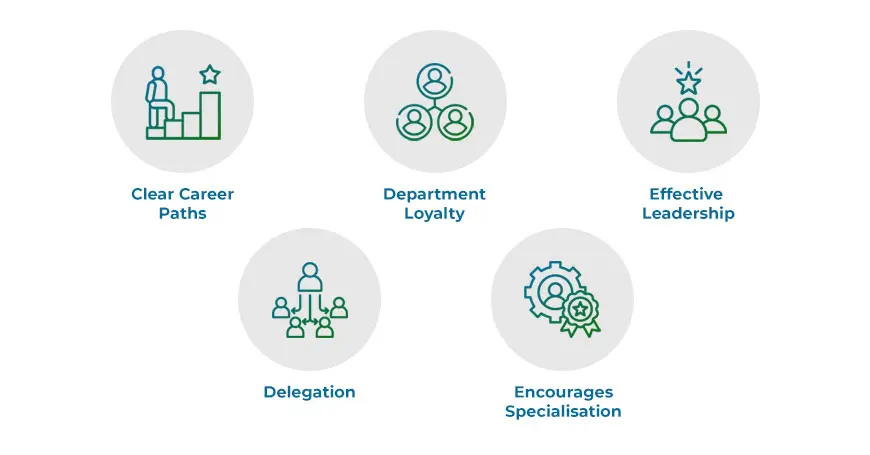
You’ll see hierarchy wherever scale, risk, or coordination cost is high, large corporations, government agencies, hospitals, logistics, and complex product organizations.
The pattern is recognizable: executives at the top, leaders of functions in the middle, supervisors near the front line, and specialists delivering the work. In many environments, hierarchy also supports professional specialization. People know what “their lane” is.
Hierarchy can improve clarity, delegation, and specialization, if communication stays healthy.
What benefits does a hierarchical structure still deliver (when designed well)?
The biggest upside of a hierarchical structure is clarity at scale: who decides, who executes, and how work moves. When the model is healthy, employees spend less time navigating ambiguity and more time delivering outcomes.
- Clear roles and communication routes: People know where to go for approvals, support, and escalation.
- Career development visibility: Advancement paths are easier to explain and plan.
- Delegation with accountability: Managers can distribute work while maintaining quality control.
- Specialization: Functional departments allow deeper expertise and consistent standards.
In other words: hierarchy is a coordination machine. The question is whether you maintain the machine, or let it rust.
Where does a hierarchical structure break down?
A hierarchical structure becomes fragile when it’s too rigid for the speed of the environment. The common failure modes are not mysterious. They’re predictable.
- Slow decisions: Too many layers, unclear delegation, or “approval culture.”
- Silo behavior: Departments optimize locally instead of for the customer or enterprise.
- Communication lag: Messages travel through multiple hops, losing context each time.
- Reduced autonomy: People stop experimenting because they feel constrained or unheard.
These issues get worse when the org chart is outdated because people stop trusting “official structure” and create shadow routes.
Hierarchical structure vs flat organization: what changes in day-to-day work?

In a flat setup, authority is distributed and layers are fewer. Employees often have more autonomy, but role boundaries can blur. In a hierarchical organization, roles and reporting lines are clearer, which can reduce confusion, especially as headcount grows.
Modern work needs flexibility, and it also needs crisp decision routes and accountability.
Practically, flat orgs trade structure for speed, until ambiguity creates drag. Hierarchies trade autonomy for coordination, until layers create drag. Many modern companies end up hybrid: hierarchy for accountability, cross-functional collaboration for delivery.
When should you choose a hierarchical business structure (and when shouldn’t you)?
Choose a hierarchical business structure when coordination costs are real: regulated work, complex operations, multiple geographies, or high-stakes risk management. Hierarchy gives you a dependable way to assign ownership and ensure consistency.
Avoid heavy hierarchy when your main constraint is innovation speed and the work is ambiguous, exploratory, or creative, unless you intentionally keep layers light and decision-making distributed.
If you’re aligning leadership around “why a chart matters” for transparency, onboarding, and coordination, this perspective on why companies keep org charts reflects how structure supports everyday execution.
Either way, your structure isn’t the org chart alone. It’s the lived reality of how people route work.
Why do org charts matter inside hierarchical organizations?
A chart is not a decoration. In a hierarchical organization, it’s a decision-support tool: it clarifies reporting lines, shows spans of control, and reveals gaps. It also supports onboarding. New hires can see where they fit without guessing.
More importantly, org charts keep the human system coherent. When people can quickly see who owns what, collaboration becomes intentional, not accidental.
How can you manage hierarchy with org chart software, without turning it into bureaucracy?
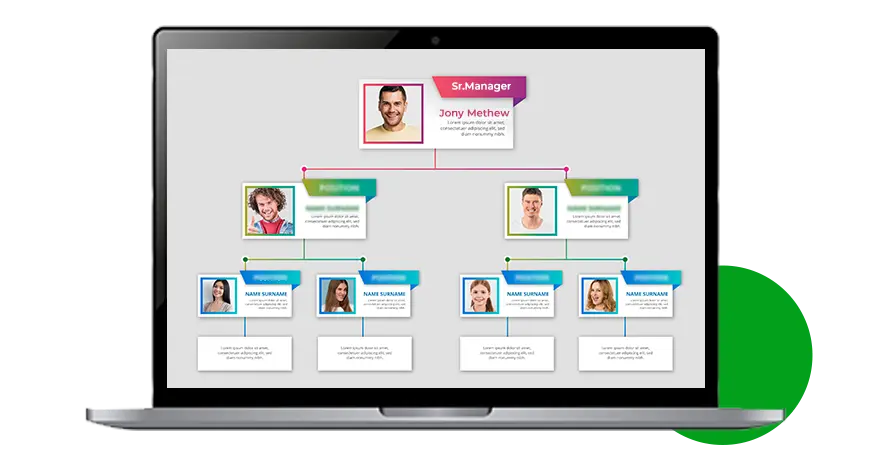
The problem isn’t hierarchy. The problem is drift: people move, teams change, and the chart becomes stale. That’s when hierarchical order stops being clear and starts being debated in meetings.
Modern org chart software solves drift by connecting structure to a reliable data source. In Microsoft environments, the practical approach is a SharePoint-based org chart that uses Microsoft 365 and directory data, so the “official view” doesn’t require manual redrawing.
Interactive org charts reduce confusion by making structure accessible and easy to navigate.
For example, a SharePoint org chart app can keep the hierarchy current, let users expand/collapse levels, and surface employee profile details in-context, so managers and employees can act on the structure instead of hunting for it.
If you’re comparing tool categories, this roundup of org chart software options in 2025 highlights the features that matter most: integration, access control, real-time updates, and exportability.
If you need a clear, product-focused snapshot of capabilities, layouts, and what “always current” really means in a Microsoft environment, see a SharePoint org chart software overview.
Turn your org chart into a living system, accurate, searchable, and permissioned
Book A DemoBest practices for designing a hierarchical structure that stays fast
A hierarchical structure should be designed like a product: tested, iterated, and kept understandable. Here are practices that hold up in modern, hybrid work.
- Write decision rights down: If you can’t say who decides, you don’t have a design. You have a hope.
- Keep spans of control intentional: Avoid overload that forces micro-management.
- Make cross-team routes explicit: Use lightweight forums so teams don’t escalate everything upward.
- Maintain clarity across the levels: The levels of an organisation should each have a “why we exist” statement, short, specific, and understood.
- Update the chart as operations change: If it’s stale, it’s noise.
Common challenges and how to overcome them
A hierarchical organization often struggles in the same few places, especially as hybrid work increases the cost of confusion. Gallup links role clarity to outcomes like productivity and retention, and highlights the fragility introduced when expectations aren’t clear.
- Challenge: “Too many approvals.” Fix by delegating decisions downward and defining escalation thresholds.
- Challenge: Silo rivalry. Fix by aligning goals across functions and establishing cross-functional delivery routines.
- Challenge: Unclear reporting lines. Fix by ensuring the chart matches reality and is easy to access.
- Challenge: Change fatigue. Fix by communicating why the structure changed and what stays stable.
The punchline: structure is only as useful as it is visible. If your hierarchical business structure is real, your org chart should reflect it, and it should stay current as the organization evolves.
A practical way to keep this visible is to treat your chart like a system artifact. This explanation of what an org chart includes emphasizes roles, relationships, and departments as the core building blocks.
Conclusion: Is a Hierarchical Structure Right for Your Business?
In 2026, the best hierarchies aren’t “tall.” They’re explicit. When the levels of an organisation have clear decision rights, teams move with confidence through a shared hierarchical order. If your work demands coordination, risk control, or scale, a hierarchical business structure can be a competitive advantage, especially when your org chart stays accurate and accessible.
FAQs On Hierarchical Structure
It’s a model where roles are arranged in layers of authority, with clear reporting lines from leadership to frontline teams. It helps people understand accountability, escalation routes, and who owns decisions, especially as the organization grows and work becomes more interdependent.
Common types include hierarchical, flat, matrix, and divisional structures. Each changes how teams coordinate and how decisions are made: flat prioritizes autonomy, matrix prioritizes cross-functional delivery, divisional organizes by product/region, and hierarchical prioritizes clarity and governance.
Pros include role clarity, defined authority, repeatable communication channels, and predictable career paths. Cons can include slower decisions, silo behavior, and reduced autonomy if too rigid. The outcome depends on decision delegation, communication design, and whether the org chart stays accurate.
Large enterprises, government agencies, hospitals, and logistics organizations commonly rely on layered authority. You’ll also see hierarchy in corporate functions like finance, HR, and operations where standards and risk controls matter. The model supports governance and consistent execution at scale.
Org chart software makes reporting lines visible, searchable, and easier to maintain as people move roles. With integrations to directory or HR data, charts can update automatically, reducing drift. This helps managers plan spans of control and helps employees quickly find decision owners and collaborators.