
Strategic Sourcing vs Tactical Sourcing: What’s the Difference and When to Use Each
By beyondintranet / March 31, 2026
Every procurement team makes the same choice dozens of times a month without thinking about it: do we source this...
Read More
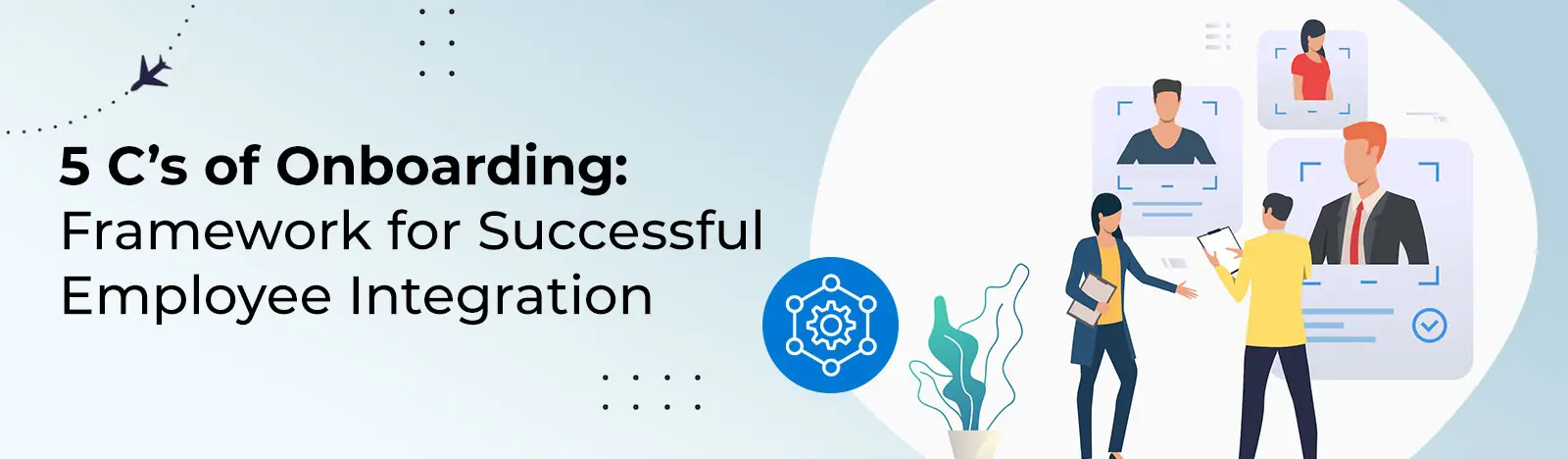
Employee integration is more than a checklist or a list of documents to tick off. It is a period in which your new hire’s expectations are taking shape, where you are fulfilling your part of the job as a hirer, and infusing new confidence in your new hire. Long-term engagement, quicker cultural integration, faster training, etc., are all reaching their fulfillment stage in that exact period. Organizations that understand this invest in a structured onboarding experience. At the heart of it lie the 5 Cs of the onboarding framework.
If you are an organization that is struggling with early attrition, disengagement, or slow productivity, this blog is for you. Most organizations, while struggling with these issues, believe the problem lies in the quality of their hires. But that is not the case. A scattered, unstructured onboarding experience is inadequate to integrate new hires into your cause. It is thus your imperative to create a structured and well-thought-out onboarding experience.
In this blog, we explore the 5Cs of onboarding, which are key components that help create a meaningful experience for your new hires. Also, we share some practical tips on how to onboard new employees successfully into modern workplaces.

Your employees are expecting clarity. They want their work life to hold purpose. A sense of belonging, when developed in the initial phase of their journey into your organization, can work wonders.
Modern workplaces must not view onboarding as an orientation program. Rather, see it as providing a top-end first experience with your organization. An introduction to your organization’s way of working, culture, practices, and vision. Such an experience would allow your new hires to view themselves as investing years in your organization and working towards long-term and short-term goals.
Emma Galdo’s study lists five ways to make the first few weeks a strong start for your new hires. She places strong emphasis on clarity of roles, goals, and expectations. She highlights how integrating a new hire into the social and cultural background of your organization is important.
While this is true, there is also plenty of evidence that a poorly designed onboarding experience creates uncertainty. New hires face difficulties asking questions and seeking clarifications on their roles and responsibilities and may feel disconnected from your organization.
Such behavior calls for immediate action. You must work on replacing scattered manual processes and activities with a structured onboarding workflow. You must balance compliance with human connection. And this is what the 5 Cs of onboarding do for you. An onboarding experience that does not overload employees with information. That models their mind for progressive learning and helps people absorb information at the right time.
Here are 5 essential pillars of onboarding, aka, the 5 Cs of onboarding: –
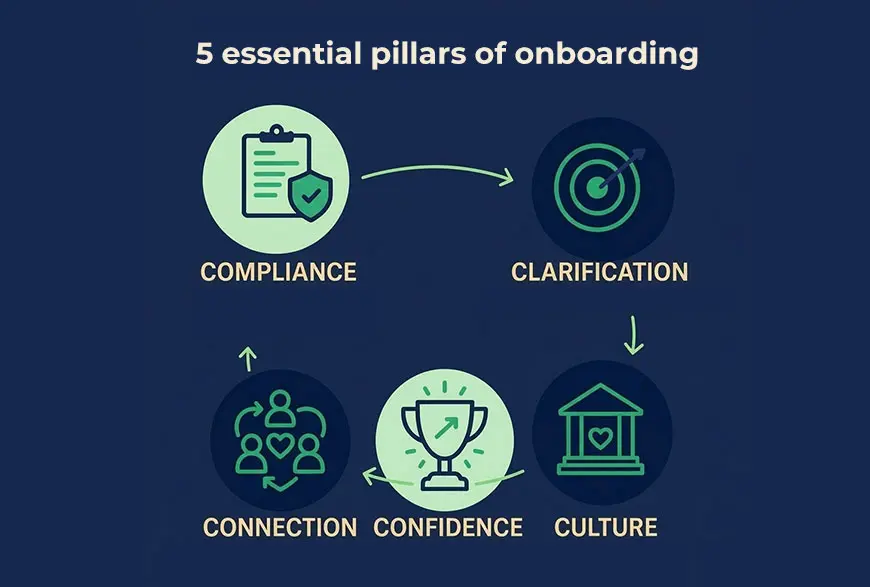
These 5 Cs of onboarding represent different stages of employee integration. Infused into a single, holistic onboarding lifecycle, they support both organizational and individual goals. Let’s take a closer look at each of the 5 Cs of having a rock-solid onboarding workflow.
Compliance is one of the most important parts of onboarding. A typical compliance routine includes paperwork, legal requirements, and training. While it may appear administrative, it helps reduce confusion and protects both the parties – employees and organizations.
When it comes to new hires, clarity around workplace policies, security protocols, compensation structure, organizational expectations, and employee benefits is very crucial. And without compliance, you may be leaving your new hire in a lot of confusion. If not done correctly, new hires might unknowingly violate company policies. A structured orientation program should introduce new employees to your policies and procedures.
Furthermore, modern hiring demands digital workflows and a centralized platform. Tools such as employee onboarding software help you streamline documentation and automate repetitive tasks. It reduces manual efforts and ensures accuracy and consistency.
Many onboarding failures happen because companies assume job descriptions are enough, but they are not. The real-world scenario is always way different from what is conveyed over an email. It is ever evolving. In the clarification stage, aim to have conversations that guide the new hire toward your organization’s central goal. And with that, provide continuous feedback and give positive affirmations.
At the end of the day, managers take center stage. They make the early alignment happen; they help to set the goals, such as
They may also help you create an easy and comprehensive learning path for the new hire. They act as the best mentors for new hires during the early phase.
When clarity exists, performance anxiety takes a back seat, and you get a confident, motivated employee.
We have been talking a lot about confidence. But how do you define it in the corporate environment? Confidence no longer stays abstract in a workplace scenario. It can be quantified through the performance metrics. A confident individual who is well-supported by an organization feels safe experimenting and sharing new, productive ideas. They are better team players and open to understanding challenges as opportunities for individual growth and organizational success.
Focus on providing support, learning opportunities, and early wins. Here are a few tips on nurturing confidence:
Just like compliance, confidence-building activities may also use technology. Through onboarding automation tools, companies can now deliver personalized learning modules, reminders, and progress tracking that help employees move forward at their own pace.
It is no wonder that humans have thrived so much by developing a sense of community and belonging. If we go by the laws of sociology, our ability to communicate, coordinate, and emotionally connect with fellow humans has brought us where we are. The sense of belonging, the sense of being part of a tribe, and the sense of working as an important cog in the larger schema of things have always held the communities together and been primary to our survival.
Modern societies work on the same phenomenon, too. It is important that organizations work on connecting people emotionally to their cause. Help your new employees connect with your organization on an emotional level.
You can use the following tips to develop it:
This aspect becomes even more critical when onboarding remote employees. If your organization does not provide opportunities for casual interactions, then virtual engagement activities and structured communication are the only ways to create a sense of connection.
An organization’s culture speaks to how decisions are made, how teams collaborate, and how employees are treated. A PowerPoint presentation may not adequately communicate that. Organizations that truly value their company’s culture believe in demonstration.
The culture phase of the onboarding process is all about introducing your new employees to the leadership philosophy, communication styles, and workplace behaviors.
Do this to make that happen:
Effective onboarding should produce measurable outcomes. Organizations should track metrics such as:
Regular evaluation ensures onboarding evolves alongside organizational growth. Companies that treat onboarding as a continuous improvement process consistently outperform those relying on static programs.
Even well-intentioned onboarding programs can fail if certain mistakes persist:
Avoiding these pitfalls ensures the onboarding journey remains supportive rather than overwhelming.
Onboarding is not merely an administrative task. It is important to keep a human-centric approach while creating the right onboarding workflow. A well-structured onboarding experience can help you accelerate productivity, strengthen culture, and build lasting employee relationships.
The 5Cs mentioned in the blog can help you achieve your organizational needs, as well as meet the employee expectations. It can help you create an inclusive environment where employees feel more valued and welcomed.
Hope this blog has helped you learn how to successfully onboard new employees. When onboarding a new employee, focus on potential, expectations, and emotions. This will help you empower your employees and thrive in tough competition.